4. The Case and the Counter-Case
Learning Objectives
After reading this chapter, you should be able to:
- State the optimistic case for the African century in its strongest form, organized by the three terms of the book’s identity, and say which term each element of the case is a claim about.
- State the counter-case in its strongest form, place growth without jobs, premature deindustrialization, the dual-firm finding, consumption cities, the debt wall and the coups belt on the same three terms, and say why the sixth objection, that the workers may not be needed, is the one that, if it holds, defeats the case rather than delaying it.
- Say what the Africa Rising literature of 2011 claimed, what the decade after it delivered, and why the disappointment was a failure of the identity’s second and third terms rather than its first.
- Use the development bargain as a test rather than a mood: state Dercon’s question, place it beside Khan’s political settlements and the deals framework of Pritchett, Sen and Werker, and say what evidence would answer it for a named country.
- Do the identity arithmetic under each case, distinguish an illustrative path from a projection, and name the later chapters carrying the evidence that would settle the argument.
Prior work: the policy-supply-versus-policy-demand frame used here to read the continental trade agreement, and the consumption-city argument in the counter-case, are developed at length in the companion volume, The New Regional Economics, chapters 13 and 14 (Wilse-Samson, 2026). This chapter cites them rather than repeating them.
In May 2000 The Economist ran a cover under the words “The hopeless continent”. In December 2011 the same magazine ran one under the words “Africa rising”, and a year later Time ran a cover of its own under the same two words (The Economist, 2000; The Economist, 2011; Time, 2012). Nothing much had happened in between to the underlying apparatus that produces African economic statistics, which Chapter 1 described. What had happened was a decade of growth: Sub-Saharan output rose at roughly 5 percent a year between 2000 and 2014, fast enough to double the region’s economy inside fifteen years (International Monetary Fund, 2026f). The decade after 2014 delivered about half that rate, and once population growth is netted out it delivered almost nothing per head (World Bank, 2026a).
That is the hangover this chapter has to metabolize. It is tempting to read the two sets of covers as a single lesson about the folly of enthusiasm, and a good deal of writing about Africa since 2015 has done exactly that, swapping one mood for another at the same level of evidence. The more useful reading is narrower. The Africa Rising literature was not wrong about the first half of its arithmetic; it was wrong about what the first half implied for the second, and the mistake is legible in the identity this book is built on.
Recall the arithmetic from Chapter 1. GDP growth is approximately the growth of output per worker, plus the growth of the employment-to-working-age ratio, plus the growth of the working-age population, and all three are growth rates. Term one is demographics. Term two is jobs. Term three is productivity. What the 2000s delivered was a large term one, a term three lifted substantially by commodity prices, and a term two that did very little. When the commodity cycle turned, the part of the growth that had been borrowed from prices went with it, and what remained was a demographic term that adds people to the labour force whether or not there is anything for them to do.
This chapter stages the argument as an argument. The case comes first, in its strongest form and organized by the three terms, because a position worth attacking deserves to be stated by someone who understands it; the counter-case comes second, in equally strong form. Then comes the part that matters more than either: the test that could decide between them, which is a question about specific countries at specific moments rather than about a continent. The chapter closes with the arithmetic under each case, and with what later chapters would have to show for the argument to resolve.
The Case
Term one: the workers are already born
The case begins where the evidence is strongest, which is also where it is least interesting, because almost nobody disputes it. Africa’s population aged 15 to 64 rises from 867 million in 2024 to 1,559 million in 2050, and its share of the world’s working-age population goes from 16.3 percent to 25.5 percent over the same period (WPP, 2024). The people who will be working in Africa in 2050 are, with the exception of the youngest of them, already alive. No macroeconomic surprise, no election, no coup and no default changes that number by very much.
The comparative claim is what gives it force. Everywhere else the supply of new workers is running out. China’s working-age population is falling, as are Europe’s, Japan’s and Korea’s, and India’s peaks within a generation (WPP, 2024). If labour is the factor that becomes scarce in the second half of this century, then the continent that has it is the continent that matters, and the interesting question stops being whether Africa can catch up and becomes whether capital, institutions and market access arrive in time to meet the workers who are already on their way.
The case’s second move is that low income is an asset rather than an embarrassment. A country at $871 per head, which is where the Democratic Republic of the Congo sits, does not need to invent anything to double its income. It needs fertilizer, a road, a port that clears containers, electricity that stays on, and courts that let a firm collect what it is owed. Every one of those is a solved problem somewhere, often somewhere nearby, which is why the countries that have managed catch-up growth have sometimes managed it very fast.
Terms two and three: the removals
The second leg of the case is that some of the constraints that made the first leg impossible have moved, and moved recently enough that the record of the past twenty years understates what the next twenty can do.
The clearest instance is payments. Mobile money did to African finance what the mobile telephone did to African telecoms, by skipping a generation of infrastructure rather than building it, and the volumes are no longer marginal: mobile money moved about $836 billion across Africa in 2022 (GSMA, 2023). A woman selling tomatoes in Kaduna who can be paid electronically and reached by a cash transfer at a cost approaching zero is not yet more productive, which is why this is a claim about the conditions for terms two and three rather than about the terms themselves. The transaction cost of formalizing her has collapsed, and Chapter 16 takes up what has followed.
The second instance is the continental trade agreement. The African Continental Free Trade Area exists, has agreed rules of origin covering the large majority of tariff lines, with textiles, apparel and automotive the conspicuous holdouts, and has begun trading under its own rules (tralac, 2025). Its critics are right that the flows are thin: intra-African trade was 14.9 percent of the continent’s trade in 2023, on a value of $192.2 billion, up from 13.6 percent in 2022 (Afreximbank, 2024). The companion volume’s answer to why is the one this book adopts, and it is not a counsel of despair. The binding constraints on intra-African trade were never mainly tariffs, which the regional communities had already brought down; they are non-tariff barriers, currency fragmentation and the days a truck spends at a border, and the agreement is best read as policy supply that has run ahead of policy demand (Wilse-Samson, 2026). Chapters 7 and 19 test that reading corridor by corridor. What belongs in the case is the narrower point that the architecture now exists, which it did not in 2011, and that architecture is a precondition for the export discipline the next section is about.
The recipe, and whether it travels
The third leg of the case is the strongest, because it is not a claim about potential at all. It is a claim that the sequence which produced the East Asian miracles is known, is written down, and has already been run in parts on this continent.
Studwell (2026) is the most recent attempt to write it out for Africa: land policy that raises smallholder yields first, because a household farm at high labour intensity is the most efficient use of an economy whose only abundant factor is people; then manufacturing for export, with subsidies disciplined by the test of whether the goods sell abroad; and financial policy that keeps capital pointed at both rather than at property, consumption and capital flight. The sequence matters as much as the ingredients. Agriculture pays for industry, exports discipline industry, and finance is the instrument that enforces the first two rather than an industry to be developed for its own sake.
He tests it on four countries, and the choice is itself an argument: Botswana, Mauritius, Ethiopia and Rwanda. Figure 4.2 puts them against the continental income distribution, and the first thing to notice is that they sit at both ends of it. Mauritius records $12,977 per head, the second highest of the 54 cards, and Botswana $7,662, the fourth; Rwanda records $1,128, thirty-eighth, and Ethiopia $987, fortieth. Between them the four hold 9.9 percent of the continent’s population and produce 5.1 percent of its output.
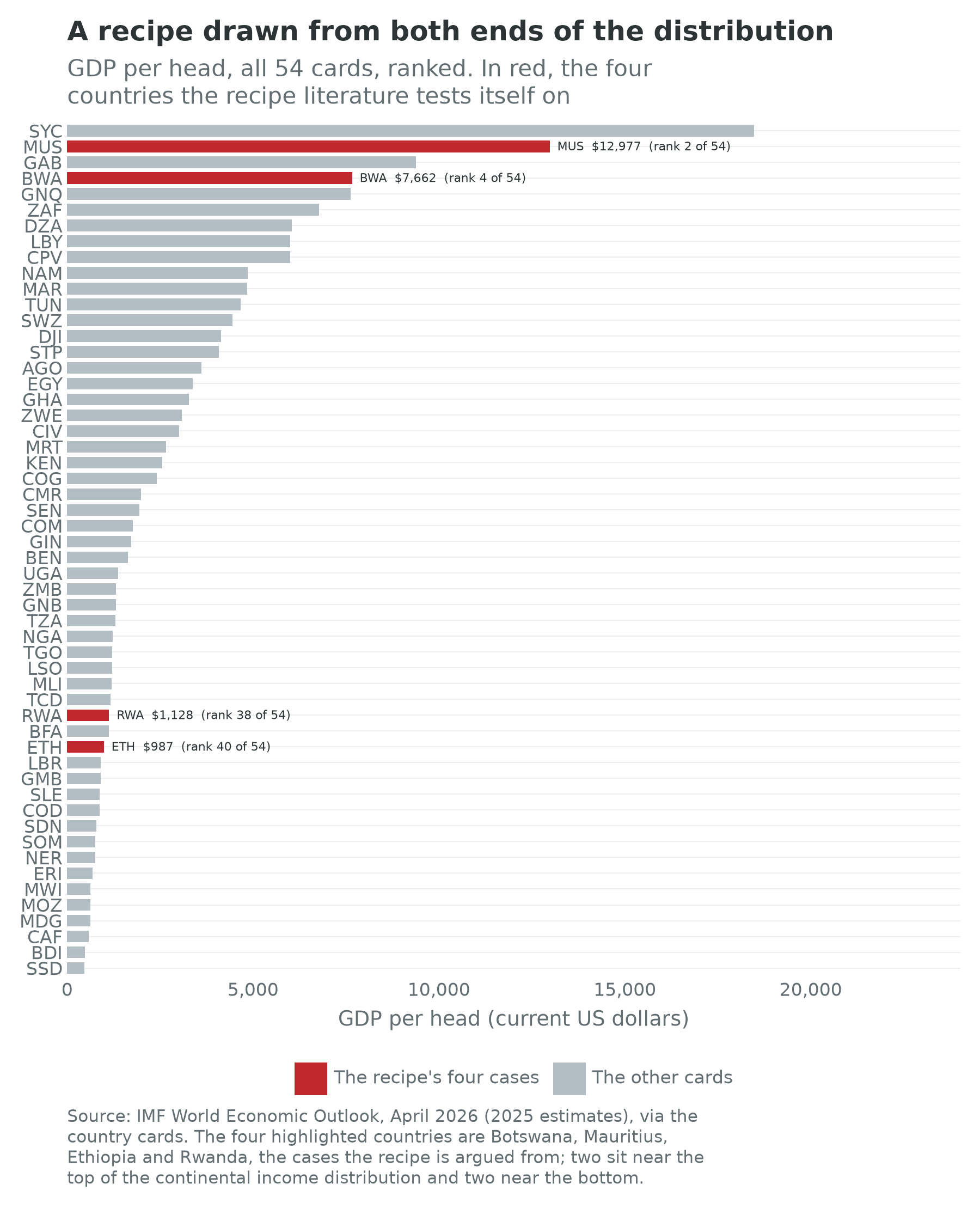
Read charitably, that spread is the point rather than an embarrassment. Two of the four are what the recipe produces when it is allowed to run for two generations, and two are what its early years look like from inside. Botswana and Mauritius are small states that made specific choices about diamonds and about textile quotas and then defended those choices against the domestic interests that wanted the proceeds distributed instead. Ethiopia and Rwanda are states that decided, in the 1990s, to behave as though growth were the object, and whose agricultural yields and industrial-park build-outs moved accordingly.
The counter-argument arrives immediately, and the honest version of the case has to carry it. Oliver Kim’s review of the book presses the transferability question hardest (Kim, 2026), and the question has three parts. The first is that the East Asian sequence ran under conditions specific to the Cold War: guaranteed access to the American market, a tolerance for protection that no African exporter enjoys today, and land-scarce agrarian structures in which redistributing land to smallholders raised output rather than fragmenting it. The second is that two of the four cases are very small and the other two are authoritarian, so the sample is not obviously informative about Nigeria, or about the Democratic Republic of the Congo, or about any state whose problem is that it cannot enforce a decision rather than that it enforces the wrong ones. The third is the shadow the next section is about: the manufacturing step in the middle of the recipe may not absorb labour the way it did when Korea took it.
The book’s position, developed at length in Chapter 9 and not settled here, is that the recipe is best read as a claim about sequencing rather than a claim about instruments. What Botswana, Mauritius, Ethiopia and Rwanda have in common is not a policy list. It is that somebody in each of them decided what the economy was for, and then held to it for longer than an electoral cycle. That is a claim about politics, which is where this chapter ends up.
The Counter-Case
The two lists do not overlap
Begin the counter-case with a fact about composition rather than about policy, because it constrains everything that follows.
Figure 4.1 plots each of the 54 countries by the growth of its working-age population against its income per head. The engine of the demographic story and the productive base of the continental economy are, with almost no exceptions, different countries. The five largest economies and the eight countries that at least double their populations by 2054 are two lists with no member in common. The five largest ran working-age population growth at a median of 1.6 percent a year over the decade to 2024, well under the continental middle. The eight doublers produce $393 billion between them, 12.4 percent of continental output, on 312 million people.
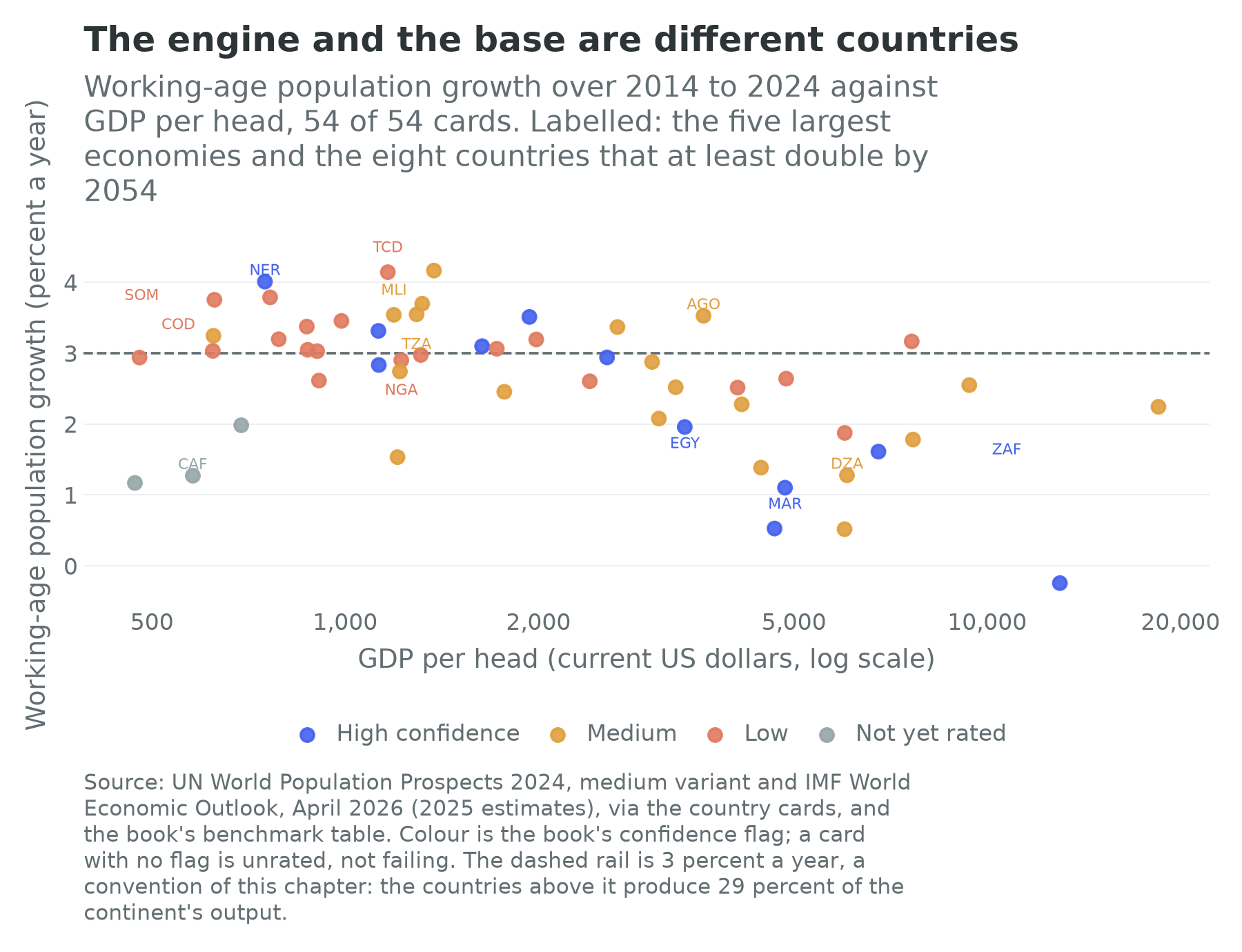
Take the cut at 3 percent a year, a convention of this chapter and not a finding, and count the cards on each side of it. Twenty-three of the 54 countries sit above it. They hold 50.7 percent of the continent’s people and produce 29.6 percent of its output, at a median income of $1,165 per head. The fourteen countries below 2 percent hold 20.7 percent of the people and produce 45.3 percent of the output, at a median of $4,665. Across the 54, working-age population growth and the logarithm of income per head are negatively correlated at about minus 0.53.
This does not refute the case. Convergence stories are supposed to run from poor and young to less poor, and a positive correlation would be the strange finding. What it does is raise the price of the case’s central move. The workers arrive where the capital, the electricity, the ports and the firms are thinnest, and getting the two into one place requires either that capital travel to the workers, which is the hard version, or that workers travel to the capital, which requires functioning cities and, across borders, a mobility regime the continent has legislated more than implemented. Chapter 10 owns the second half of that; Chapters 24 and 25 are where the first half is tested against two poles.
The first objection: growth without jobs
The sharpest statement of the counter-case is that the growth Africa has already had did not do the thing growth is supposed to do. Ten to twelve million young Africans enter the labour market each year, and the formal economy creates roughly three million jobs; the rest of the entrants land in low-productivity informal work (AfDB, 2016). Opalo (2026a) carries the argument to the present: African economies are extending more than twenty-five years of successive expansion, and many of them will still struggle to convert that growth into reliable jobs.
In the identity, that is a claim about term two, and it is worth being precise about why the claim is hard to test. The adding-up series for term two is the modelled ratio of employment to working-age population, and that series will not show the problem, because subsistence agriculture and informal trade count as employment. On the international definition, almost everyone in the Sahel is employed. The claim is therefore carried by overlays: the share of employment that is waged, the share that is outside agriculture, hours, and youth not in employment, education or training. Chapter 10 reads those overlays country by country, for the 34 countries whose labour-force surveys are recent enough to bear it and, more cautiously, for the rest.
The uncomfortable part is where the survey coverage sits. Of the 23 countries whose working-age population grew at 3 percent a year or more, only 13 have a labour-force survey within five years; 12 carry a low confidence flag and 0 cannot be rated because no such survey has ever been run. The countries where term two matters most are the countries where term two is least observable. That is not a rhetorical flourish about African statistics; it is the operating constraint on this book’s central argument, and Figure 4.3 states it plainly.
The second objection: the recipe’s middle step may be closed
The second objection is that the structural transformation the case depends on may no longer be available on the terms it was available on in 1965.
Manufacturing everywhere now absorbs less labour at a given level of income than it did when Korea industrialized, and developing countries have begun to deindustrialize at income levels far below those at which the early industrializers did, a pattern Rodrik (2016) named premature deindustrialization. Rodrik (2018) puts the African version of the point directly: the growth of the 2000s arrived with little structural change toward non-traditional tradables, in an external environment of high commodity prices, low interest rates and strong demand from China, rather than from a reallocation of workers into tradable industry, which is a description of a term-three gain that does not compound.
Underneath the aggregate sits the finding that gives the objection its teeth. Diao, Ellis, McMillan and Rodrik (2021), looking at Tanzanian and Ethiopian firms, find an economy split in two: large firms raise productivity without adding employment, and small firms add employment without raising productivity. The two halves of the recipe do not meet. A country can therefore post a respectable term three and a respectable term one at the same time as term two does nothing, which is precisely the configuration the previous section described, and it is why this book splits term three into its within-sector and between-sector components in Chapters 6, 9 and 10 rather than quoting a single output-per-worker number.
There is a qualifier, and the case is entitled to it. Kruse, Mensah, Sen and de Vries (2023) find manufacturing employment shares rising again across much of the developing world in the 2010s, including in Sub-Saharan Africa, with the growth concentrated in small and largely informal firms. That is a real finding and it cuts both ways: it is evidence that the manufacturing door is not bolted, and it is evidence that what is coming through it is the low-productivity half of the dual structure. Chapter 15 works through what that means for the auto and apparel platforms.
The third objection: cities without production
The third objection is about where the term-one cohort goes when it leaves the farm. Africa’s cities are growing as fast as Asia’s did, and a considerable number of them are growing as consumption cities financed by resource rents rather than as production cities financed by exports (Gollin, Jedwab and Vollrath, 2016). Density is not agglomeration without tradable production, and a city that concentrates people around the distribution of a rent delivers neither the productivity gain nor the employment the case assumes urbanization delivers. The companion volume works the argument through for Lagos, Luanda and Libreville and against Nairobi (Wilse-Samson, 2026); Chapter 22 carries this book’s version, and Chapter 24 is where a demographic-engine pole meets it head on.
The fourth objection: the balance sheet
The fourth objection is that the money to build the ports is going somewhere else. More than $90 billion of African government external repayments falls due in 2026, of which Egypt alone accounts for roughly $27 billion (S&P Global Ratings, 2026). The creditor composition is more fragmented and less transparent than it was in the Heavily Indebted Poor Countries era, the restructuring machinery is slower, and a government spending a large share of revenue on external debt service is not the government that electrifies the industrial park. Chapter 21 works through Zambia, Ghana and Ethiopia; Chapter 32 sets the official debt statistics beside the loan-level Chinese lending database and treats the difference as the object of study. The point for this chapter is narrower: the balance-sheet constraint binds precisely on the term-three investments the case requires, and it binds now rather than later.
The fifth objection: the settlement itself is failing
The fifth objection is political and it is the one the case has the least to say about. Between 2020 and 2023 soldiers took power in Mali twice, in Guinea, in Sudan, in Burkina Faso twice, in Niger and in Gabon, and in Chad the army installed the late president’s son at the head of a transitional council (Associated Press, 2025). Three of those states have left the West African regional community. A belt of countries running from the Atlantic to the Red Sea is now governed by administrations whose first commitment is survival, and Chapter 2 has already shown that this belt is where the identity’s first term runs fastest and the other two are least measurable.
It would be convenient to treat this as a shock exogenous to the economics, and it is not: a state that cannot secure a road cannot collect a customs duty, and a state that cannot collect a customs duty cannot pay the soldiers who secure the road. Chapter 36 carries the full Sahel section; Chapter 31 handles the two cases where the state is thinnest and the argument has to be made without most of the usual series.
The sixth objection: the workers may not be needed
The sixth objection is the one Chapter 1 set out at length, and it is the only objection that, if it holds, defeats the case rather than delaying it. Every one of the five objections above is an argument about whether Africa can climb the ladder: whether jobs will follow growth, whether the manufacturing rung is still there, whether the cities will produce, whether the money will arrive, whether the state will hold. The sixth is that the ladder is being taken away from everyone at once. If the frontier of production over the next few decades becomes a stock of machines that reason and machines that move, then the marginal worker stops being the thing that growth is made of, and a continent whose one unarguable endowment is working-age people is holding the asset the century has stopped paying for (Acemoglu and Restrepo, 2019; Korinek and Stiglitz, 2021).
The objection does not need the strong version to bite. Even on modest estimates of what current systems can do, the tasks they do first are the tasks the recipe’s later rungs are made of: the call handled in Nairobi for a bank in Manchester, the image labelled in Accra for a laboratory in Boston, the invoice processed in Lagos for a shipper in Rotterdam. Those are the jobs that an African graduate took in the 2010s precisely because they were tradable and did not need a port. The counter-case is that Africa is, on the ILO’s own estimates, the region least exposed to that first wave, because so much of its employment is agricultural and informal (Gmyrek, Berg and Bescond, 2023). A farmer in Kano is not going to be replaced by a language model. But the protection is the protection of not being worth automating, and a case for the growth century cannot rest on it.
What the case can say in reply is what Chapter 1 said: the identity holds in both worlds, and in the second one the relevant endowments are not people but the inputs the machines need. Africa has the sun and the land that compute is starting to be constrained by, and it has the minerals the machines are made of. A continent that sold electrons and copper to the world’s data centres on good terms would be a growth economy of the labour-redundant century. It would not be the one this book’s title describes, and the difference is ownership. The sixth objection therefore converts into a test, which Chapter 21 and Chapter 32 apply to debt and which Chapters 13 and 14 apply to minerals and power: when the asset is sold, does the return stay on an African balance sheet? Chapter 35 carries the two worlds as a scenario axis. This chapter proceeds on the first, because it is the one in which the terms can be measured, and it says so.
The Test That Decides Between Them
Both lists above are lists of conditions. Neither is a prediction, and treating either as one is how the argument became a mood. What is needed is a test that can be applied to a country rather than to a continent, that can be answered with evidence, and that can come out differently in Kigali and in Kinshasa in the same year. The book takes that test from Dercon (2022): has the country’s elite, meaning the people who actually have power rather than the people who hold the formal offices, struck a bargain to bet on growth, rather than on dividing the pot that already exists?
The formulation is deliberately unromantic. It does not ask whether a country has good institutions, a question usually answered by looking at outcomes and calling them causes, nor whether the leadership is benevolent, democratic, or committed to inclusive development in the language of the donor documents. It asks whether the people with power have concluded that their own position is better served by an economy that grows than by an economy that is divided, and whether they have then stuck to that conclusion when it cost them something.
Two literatures supply the vocabulary. Khan (2010) argues that institutions work only when they are compatible with the underlying distribution of organizational power, the political settlement, and that transplanting the institutions of a country with one settlement into a country with another produces formal rules that are not enforced. This is why the same anti-corruption statute is a live instrument in one capital and a dead letter in the next, and why a technically excellent industrial policy can fail without anyone opposing it in public. Pritchett, Sen and Werker (2018) supply the complementary machinery, distinguishing the world of rules from the world of deals and sorting deals by whether they are open or closed to newcomers and ordered or disordered in their enforcement. A growth acceleration, in their reading, is usually a change in the deals environment rather than a change in the rules, which is one reason accelerations are so poorly predicted by cross-country regressions on institutional indices.
The African literature was there earlier and is cited too rarely. Mkandawire (2001) argued that the African developmental state was declared impossible on the basis of a very short and very unusual sample, and that the conditions under which African states were asked to develop, external debt crises and imposed adjustment above all, would have defeated the East Asian states too. Ndulu and co-authors (2008) sorted the record from 1960 to 2000 into recurring growth syndromes, which is a way of saying that African growth failures had specific and diagnosable political forms rather than a single cultural cause. Lopes (2019) makes the constructive version of the same point: the continent’s transformation agenda has been written repeatedly by African institutions, and the constraint has been the settlement that would have to enforce it. Jerven (2015) makes the methodological complaint that ties this to Chapter 1, namely that economists have consistently modelled African growth as a chronic condition to be explained when it is in fact a sequence of episodes to be dated.
The reason this book treats the bargain as a test rather than a theme is that it is observable. Rhetoric is not the evidence; the budget is. The questions a reader can put to a country are concrete, and they recur in every pole chapter of Part VI. Does public investment go into things that raise the traded output of somebody who is not politically connected, or into things that can be allocated? When an exporting firm and a domestic rent-holder want opposite decisions, who wins, and how often? Is there a policy the government has held to across a change of minister, or across an election, at a visible cost to a constituency it needed? Does the statistical office publish numbers that embarrass the government, which is the cheapest available signal that somebody in the state wants to know the truth? Chapter 5 sets out the framework in full and Chapters 24 to 31 apply it pole by pole, each with a growth-diagnostic tree in the manner of Hausmann, Rodrik and Velasco (2005) beside it.
The test also disciplines the enthusiasm, which is its main virtue. A development bargain is a country-level fact with a date attached. It can exist in Kigali and not in Kinshasa; it can exist in Addis Ababa in 2004 and be in question in 2021; it can be struck by a government nobody would call democratic and fail under a government that is. Nothing about the continental aggregate follows from any single instance of it, which is exactly why a book organized around the aggregate cannot answer the question and a book organized around poles, corridors and country cards can at least ask it.
What the Identity Would Look Like Under Each Case
Put numbers on the two cases, and label them as what they are. What follows is illustrative arithmetic, not a projection: the term-one rate comes from the population data, and the term-two and term-three rates are values chosen to make the two cases concrete. Chapter 35 does the projections properly, with the assumptions exposed as sliders.
Start with what is not chosen. Over 2024 to 2050 the continental working-age population grows at about 2.3 percent a year on the medium variant, and the total population at about 1.9 percent. Term one, in other words, hands the continent a little over two points of output growth a year before anybody does anything, and income per head requires clearing the 1.9 percent hurdle before a single household is better off.
Now the case. Suppose the employment-to-working-age ratio rises at 0.5 percent a year, which requires the formal economy to absorb workers faster than the cohort grows, and suppose output per worker rises at 3.0 percent, which is roughly what a serious industrialization delivers. The identity gives output growth of 5.8 percent a year, and 3.9 percent a head after the population hurdle. Compounded to 2050, income per head is about 2.7 times its present level, and doubles in about 18 years. That is a continent transformed inside one working life, and it is not a fantasy: 5.8 percent is close to what the boom decade delivered. The difference is that this version has the employment term contributing rather than sitting still.
Now the counter-case. Suppose the employment ratio falls at 0.3 percent a year, as informality absorbs the cohort and the wage share of employment slips, and suppose output per worker rises at 0.8 percent, which is what an economy gets from within-sector improvement without reallocation. The identity gives output growth of 2.8 percent, and 0.9 percent a head. Compounded to 2050, income per head is up by about a quarter, at about 1.3 times its present level, and doubles in about 77 years. Nothing in that path is a catastrophe. There is no famine in it, no default in it, and the aggregate economy still grows every year for a quarter of a century, which is why this path is the dangerous one: it is entirely compatible with continued announcements that Africa is growing.
The gap between the two is worth stating without decoration. The whole distance between a continent that transforms and a continent that treads water is about three points a year on terms two and three combined, on a term one that is fixed. That is the argument. It is not about whether Africa grows; it is about whether the growth arrives in the two terms that require a state, firms and a bargain rather than in the one that requires only that people be born.
What Would Settle It
The honest position at the end of a chapter like this is that the argument is not settled and that the book has not settled it. What can be said is what would settle it, and where in this book the evidence lands.
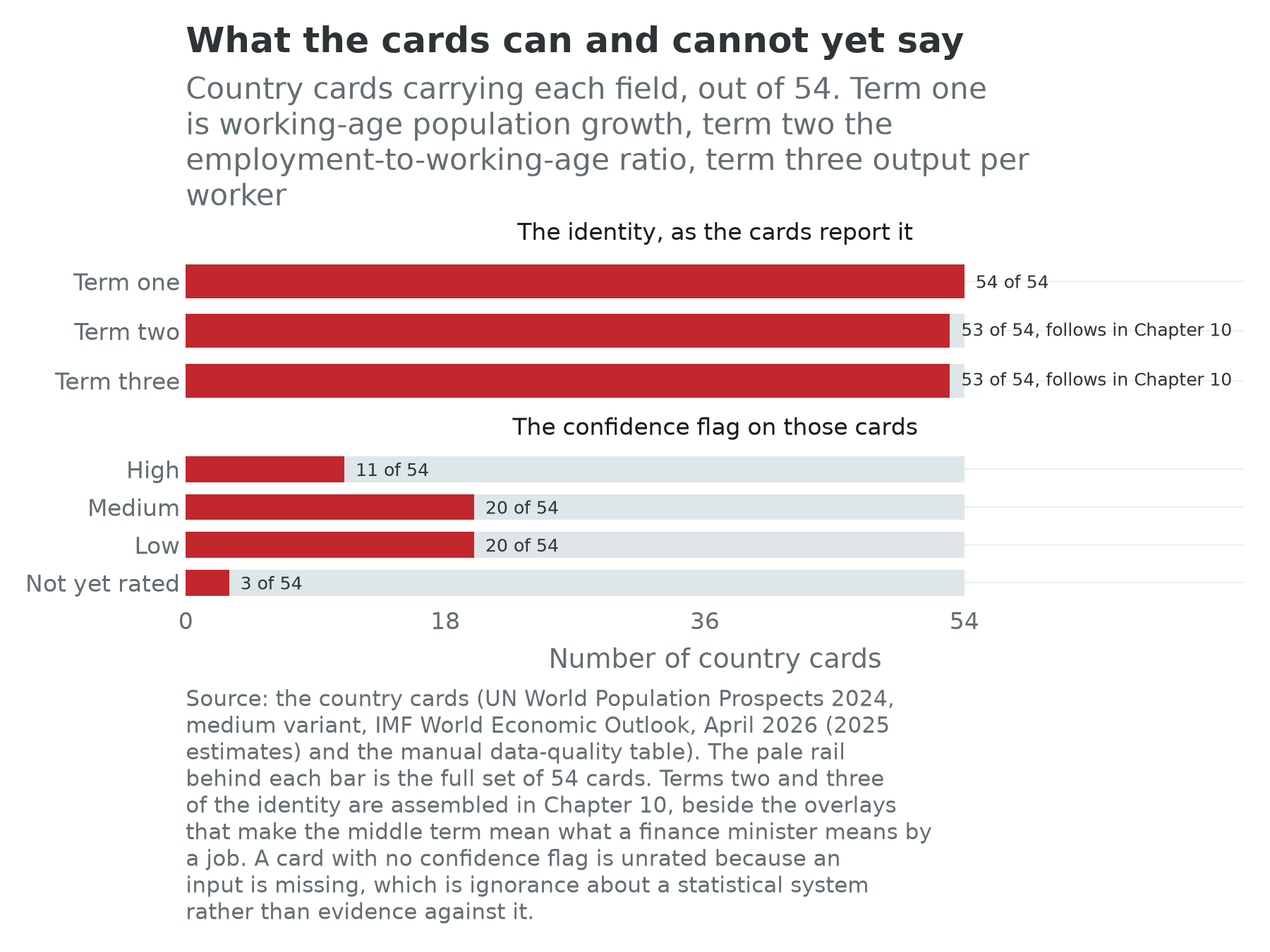
Figure 4.3 is the state of the argument as this chapter leaves it. Term one is on all 54 cards and it supports the case exactly as far as the case’s weakest claim: the workers are coming. The two terms that decide whether those workers become income are the subject of Chapter 10, and until they are read there against the survey coverage and the overlays, this chapter’s two paths are arithmetic rather than evidence.
Five chapters carry the evidence that would move the argument. Chapter 9 puts the recipe’s four cases into one comparative table against the identity rather than four admiring essays, and asks which parts of the sequence each of them actually ran. Chapter 10 is the decisive one: it reports terms two and three country by country, with the wage-employment and non-agricultural overlays that separate a job from an activity, and if the growth-without-jobs claim is false, that is the chapter where it fails. Chapter 21 prices the balance-sheet constraint, which is where the counter-case is most likely to be right in the short run and least likely to be right about the long run. Chapters 24 and 25 test whether the pole typology holds, by setting a demographic engine with a jobs problem beside a productivity platform with a jobs problem and asking whether the two failures have the same cause. Chapter 36 takes the failure modes seriously enough to give them their own chapter, the Sahel above all.
What would change this author’s mind is worth naming. The case would be strengthened by a decade in which the wage-employment share rises in the large low-income countries rather than in the small well-governed ones, because that is the signature of a term-two improvement that is not a composition effect. It would be weakened by a decade in which measured output per worker rises while the wage-employment share falls, because that is the dual-firm economy consolidating rather than converging. Both are things the country cards will show, in a table, without an adjective. That is the standard this book is trying to hold itself to, and the reason Chapter 1 spent so long on what the numbers are made of.
Connections to Other Chapters
- Chapter 1 (Africa in Numbers) states the identity used here and the assumption the book’s bet rests on, that the marginal worker still matters. Its case and counter-case, including the labour-redundant world in which that assumption fails, are what this chapter develops into an argument.
- Chapter 2 (The Demographic Century) owns term one, including the dividend-versus-bulge distinction that the case’s first leg quietly assumes.
- Chapter 5 (States, Political Settlements, and Development Bargains) builds out the test in this chapter’s fourth section into the framework every pole chapter uses.
- Chapter 9 (The Studwell Recipe Applied) is where the four cases are compared against the identity, and where the transferability critique is answered rather than summarized.
- Chapter 10 (Labor, Youth, and Migration) carries terms two and three by country, and is where the growth-without-jobs claim is either confirmed or defeated.
- Chapter 15 (Manufacturing and the Auto Industry) takes up premature deindustrialization at the level of plants and value chains.
- Chapter 21 (Capital and Sovereign Debt) prices the balance-sheet objection.
- Chapter 22 (Land) carries the consumption-city argument on the urban side.
- Chapters 24 and 25 (Lagos–Abidjan; Gauteng) are the two poles whose contrast tests the typology this chapter leans on.
- Chapter 35 (Scenarios to 2050 and 2100) turns this chapter’s illustrative arithmetic into projections with the assumptions exposed, and carries the labour-abundant and labour-redundant worlds as a scenario axis.
- Chapter 36 (What Could Go Wrong) carries the coups belt, the Sahel and the fertility-stall scenario at full length.
Discussion Questions
The chapter’s illustrative arithmetic puts the whole distance between transformation and stagnation at about three points a year on terms two and three combined. Suppose a government could buy one point of term two or one point of term three, but not both, at the same fiscal cost. Which should it buy, and does your answer change depending on whether the country is Rwanda, Nigeria or Chad? Use the identity to justify the choice rather than an appeal to what is more important.
Dercon’s test asks whether a country’s elite has bet on growth. A critic replies that the test is unfalsifiable: where growth happens we infer the bargain, and where it does not we infer its absence. Set out the strongest version of that objection, then propose two pieces of evidence that could be observed before the growth outcome is known and that would distinguish a country with a bargain from a country without one. Say what data would be needed to collect them for all 54 countries.
Twenty-three countries on the cards had working-age population growth of three percent a year or more; only thirteen of them have a labour-force survey within five years. A colleague proposes to proceed anyway, using the modelled employment series for the other ten and flagging them. Another proposes to report the thirteen and say nothing about the rest. Argue for one of the two, and state the specific way in which the other choice would mislead a reader.
The first five objections delay the case; the sixth, if it holds, defeats it. Suppose that by 2050 the frontier of production needs almost no labour. For a country whose working-age population is growing at three percent a year, write out what each of the identity’s three terms becomes. Then say which of that country’s endowments, people, land, sun or minerals, the rest of the world would still pay for, and who would have to own the machines for that payment to raise income per head rather than a foreign balance sheet.
Try It
Open the Growth Pole Map and switch on the confidence toggle, so that countries whose statistical systems will not bear the weight are faded. Then find the eight countries that at least double their populations by 2054 and the five largest economies, and note which of them survive the toggle. Write one paragraph answering a single question: if the case in this chapter is right, the investment has to arrive in the countries that fade. What would you need to see in the next five years of data to believe that it had begun to?
Data Exercise
Download all fifty-four cards from the country cards page on this site, either as cards.csv or as cards.json, and build a table of all 54 countries with four columns: identity.working_age_pop_growth, scale.gdp_per_capita, scale.gdp_usd and data_quality.confidence_flag. Then answer four questions. First, reproduce this chapter’s split at three percent working-age population growth and check the population and output shares reported above. Second, compute the correlation between working-age population growth and the logarithm of income per head, and say in one sentence why the logarithm rather than the level is the right variable. Third, weight the same correlation by scale.gdp_usd and then by scale.population, and explain why the two weightings give different answers and which one a finance ministry should care about. Fourth, drop every country whose confidence_flag is low or unset, recompute all three statistics, and write two sentences on whether the counter-case in this chapter survives being restricted to the countries whose numbers can be trusted. Note which fields are null rather than zero, and never impute a null as a zero.
Data Sources and Further Reading
Key data sources
- UN World Population Prospects 2024 (population.un.org): the working-age and total population figures, medium variant, ages 15 to 64 unless stated. The continental benchmarks are the medium-variant totals for 2024, 2050 and 2100.
- IMF World Economic Outlook, April 2026: GDP and GDP per capita on the cards, 2025 estimates; World Bank World Development Indicators where the IMF publishes no figure.
- IMF, Regional Economic Outlook: Sub-Saharan Africa and World Bank, Africa’s Pulse: the growth record over the boom decade and the decade after it.
- ILOSTAT modelled estimates (November 2025): terms two and three on 53 of the 54 cards, with the wage-employment and non-agricultural overlays beside them; the GGDC Economic Transformation Database supplies the within-sector and between-sector split of term three on the 21 countries it covers. Chapter 10 reads both country by country.
- GSMA, State of the Industry Report on Mobile Money: the payments figures.
- Afreximbank, African Trade Report and tralac: intra-African trade shares and the state of the continental agreement.
- ACLED: the conflict and coup record behind the fifth objection.
Further reading
- Joe Studwell, How Africa Works (2026), for the recipe at book length, and Chapter 9 for the test of it.
- Stefan Dercon, Gambling on Development (2022), for the elite-bargain question this chapter adopts as its test.
- Mushtaq Khan, “Political Settlements and the Governance of Growth-Enhancing Institutions” (2010), for why transplanted institutions fail quietly.
- Lant Pritchett, Kunal Sen and Eric Werker, eds., Deals and Development (2018), for growth episodes as changes in the deals environment.
- Thandika Mkandawire, “Thinking About Developmental States in Africa” (2001), for the African statist tradition the recipe literature usually ignores.
- Carlos Lopes, Africa in Transformation (2019), for the agenda as African institutions have written it.
- Dani Rodrik, “Premature Deindustrialization” (2016) and “An African Growth Miracle?” (2018), for the shadow over the recipe’s middle step.
- Morten Jerven, Africa: Why Economists Get It Wrong (2015), for why the argument keeps being conducted as a mood.