7. Regional Architecture: AU, RECs, AfCFTA
Learning Objectives
After reading this chapter, you should be able to:
- Describe the architecture from the top down: the African Union and its 55 members, the eight Regional Economic Communities it recognizes, the customs and monetary unions nested inside them, and the continental free-trade agreement laid over all of them.
- Read the overlapping memberships off the country cards, name the countries that belong to three or four communities, and explain what an overlap costs a customs administration.
- Say what a regional community does on a working day, distinguish the four instruments that make one real, and explain what the African Union Commission and the continental agreement’s secretariat can and cannot compel a member to do.
- Place the architecture in the book’s identity, explain why it is almost entirely a claim about the third term, and say what evidence would show it working.
- Explain why the architecture has run so far ahead of the flows, using trade theory, the gravity evidence on African borders and the political economy of who gains from a border, rather than treating the low intra-African trade share as a failure to be explained away.
Prior work: the case for the continental agreement as a corridor problem rather than a tariff problem, the rules-of-origin state of play, and the small-scale cross-border trade material are developed at length in the companion volume, The New Regional Economics, chapters 12 to 15 (Wilse-Samson, 2026). This chapter cites them rather than repeating them, and adds what the volume does not have: the architecture read as a system, from the cards.
The eight Regional Economic Communities that the African Union recognizes have 112 country memberships between them, spread across 54 states. That is an average of 2.07 memberships each, and because the countries in the most communities are also among the most populous, the eight bodies between them claim 2.22 times the continent’s population as their combined membership. Fifteen hundred million people, counted three thousand three hundred million times.
Nothing about that arithmetic is an accident of drafting. Every one of those memberships was negotiated, ratified, staffed and funded by a government that had reasons for wanting it, and the reasons were plainly not, in the main, reasons about trade: intra-African trade is still on the order of 15 percent of African trade, a share that has barely moved through a decade in which the architecture above it was rebuilt (Afreximbank, 2024; UNCTAD, 2023).
That gap is the chapter, and the emptiness is the argument rather than a bug to be designed around. A continent that has built more integration machinery per unit of realized integration than any other is telling you something, and it is not that Africans are bad at institution-building. It is that the machinery was built to do several things at once, of which moving goods was rarely the most urgent.
The Union, the fifty-five and the fifty-four
Start at the top, with a discrepancy this book has to declare. The African Union has 55 members and this book’s country cards number 54. The difference is the Sahrawi Arab Democratic Republic, admitted under the Union’s predecessor, the Organisation of African Unity, and not a member state of the United Nations (Rawhani, 2018). The book’s data scope follows the UN membership, because that is the scope of the population, output, debt and labour series every card is built from; its political scope follows the Union. So this chapter counts 55 votes, summits, ratifications and protocols, and 54 lots of people, dollars and growth rates.
The consequence for the largest state in the Maghreb is the largest single fact in the Union’s institutional history. Morocco left the Organisation of African Unity in 1984 in protest at the Sahrawi Republic’s admission and stayed out for thirty-three years, so the Union built most of its architecture without one of the continent’s five largest economies in the room (Hoover, 2017; Rawhani, 2018). Morocco rejoined at the summit of January 2017, having spent the preceding decade building the commercial position Chapter 28 describes: banks across francophone West Africa, a fertiliser business selling into African soils, and a construction and telecoms footprint that made the return look less like a concession than like a market entry. The territorial question is unresolved and this book does not adjudicate it: its maps hatch the boundary between Morocco and Western Sahara, there is one Moroccan card, and there is no separate card for the territory. The Somalia card carries the parallel note about Somaliland.
What the Union itself can do is narrower than its letterhead suggests, and the constraint is money. The Union’s annual budget runs near $600 million, just over $608 million in 2025, for a continent of 1.5 billion people (Endale, 2026), and donors rather than members have been its single largest source of funding (Miyandazi and Apiko, 2019). The Kigali summit of July 2016 adopted a 0.2 percent levy on eligible imports to fix that, and three years later 16 of the 55 members were collecting it (Miyandazi and Apiko, 2019). An institution part-funded by the parties it negotiates with is in no position to compel anybody, so its instrument is the one available: convening, drafting, and the slow accretion of texts members can sign at no immediate cost.
The eight communities, counted
The Abuja Treaty of 1991, which established the African Economic Community, set out a six-stage path to a continental customs union and made the regional communities its building blocks: deepen each region first, merge the regions afterwards (Organisation of African Unity, 1991). Eight are recognized, and the Union placed a moratorium on recognizing any more in 2006, by which time the map already looked like Figure 7.2 (UNECA, AUC and AfDB, 2025). They are the Arab Maghreb Union (AMU), the Community of Sahel-Saharan States (CEN-SAD), the Common Market for Eastern and Southern Africa (COMESA), the East African Community (EAC), the Economic Community of Central African States (ECCAS), the Economic Community of West African States (ECOWAS), the Intergovernmental Authority on Development (IGAD) and the Southern African Development Community (SADC).
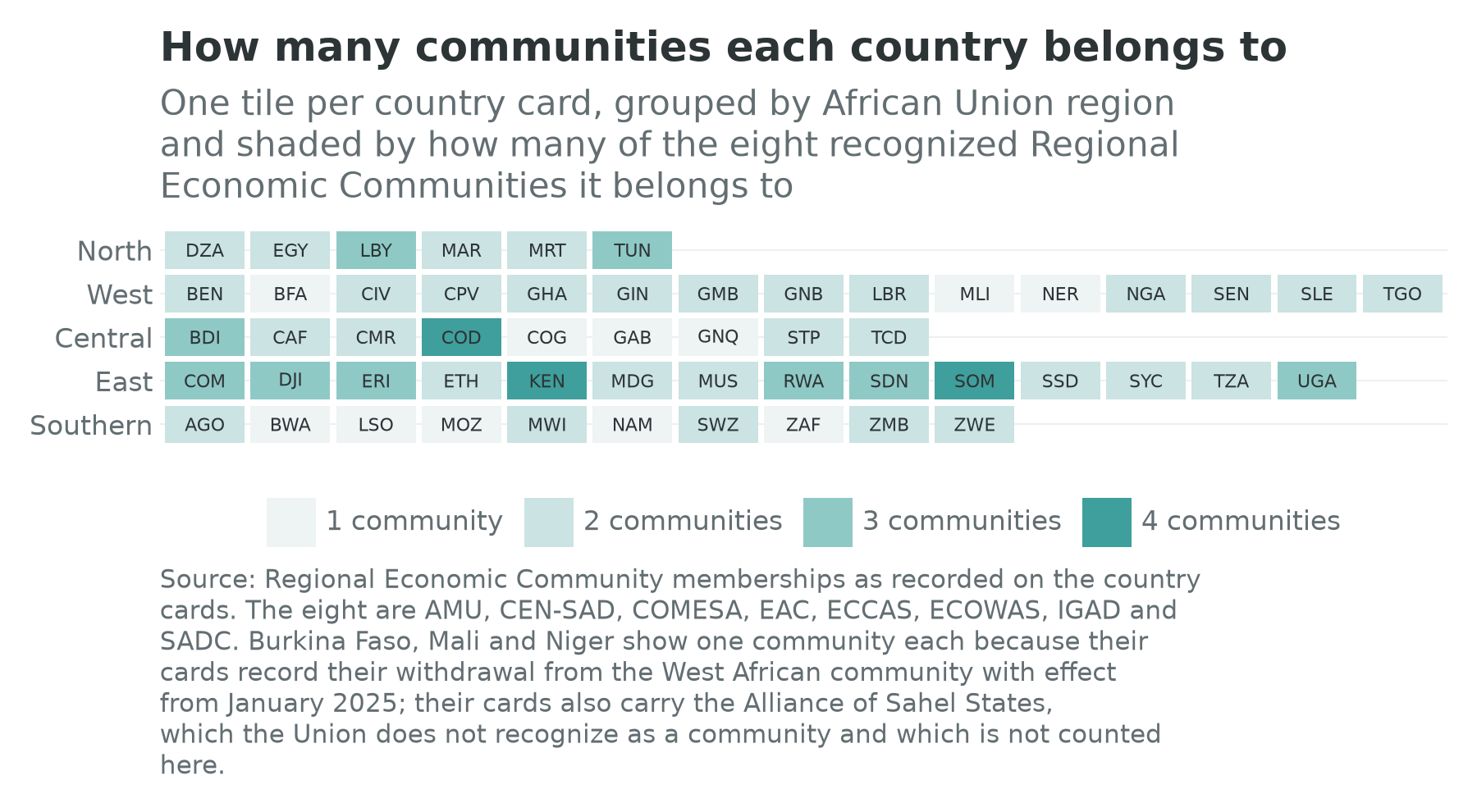
Eleven states belong to exactly one of the eight; thirty-one to two; nine to three; and three, the Democratic Republic of the Congo, Kenya and Somalia, to four. The nine in three are Burundi, the Comoros, Djibouti, Eritrea, Libya, Rwanda, Sudan, Tunisia and Uganda. Three of the eleven single-membership states, Burkina Faso, Mali and Niger, arrived in that category recently and by the exit door, and their cards say so.
The overlaps are the point.
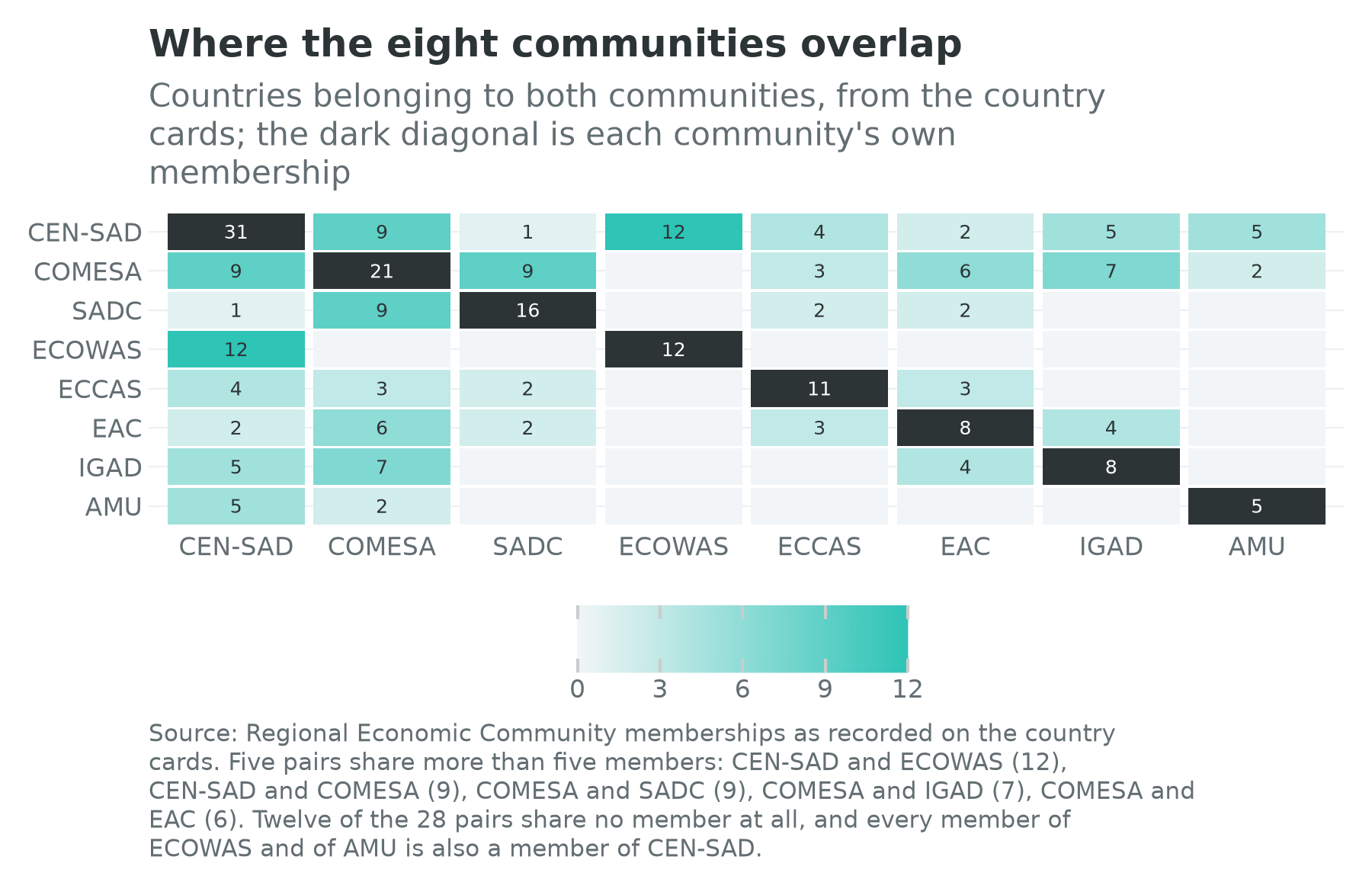
Five pairs share more than five members: CEN-SAD and ECOWAS at twelve, CEN-SAD and COMESA at nine, COMESA and SADC at nine, COMESA and IGAD at seven, and COMESA and the EAC at six. Two of the communities are wholly contained inside a third: every member of ECOWAS and every member of the Arab Maghreb Union is also a member of CEN-SAD. And CEN-SAD, the community that contains them, is the least active of the eight, a body of 31 members holding 57.1 percent of the continent’s people and 61.7 percent of its output whose practical trade programme is close to invisible.
This is the spaghetti bowl, and its cost is worth stating concretely. A customs officer at a border post in Bujumbura is administering, in principle, the East African Community’s common external tariff, the COMESA free-trade area’s preferences, the Central African community’s arrangements and now the continental agreement’s schedules, each with its own certificate of origin, its own rules for what counts as originating, and its own list of exclusions. The Democratic Republic of the Congo is in four, with the weakest administrative apparatus of any state its size in this book: it last ran a census in 1984 and its card carries a low confidence flag. Overlapping membership is a tax on exactly the administrative capacity that is scarcest. Table 7.1 sets out the eight as the cards see them.
| Community | Members on the cards | Population (m) | Output ($bn) | Largest member | Its share of the community’s output (percent) | Term one | Term two | Term three | High-confidence cards |
|---|---|---|---|---|---|---|---|---|---|
| CEN-SAD | 31 | 863.8 | 1,935.2 | Egypt | 18.8 | 2.90 | -0.15 | 1.21 | 8 of 31 |
| COMESA | 21 | 681.5 | 1,095.6 | Egypt | 33.3 | 2.83 | -0.15 | 0.36 | 5 of 21 |
| SADC | 16 | 417.3 | 950.8 | South Africa | 44.9 | 2.55 | -0.18 | -0.05 | 2 of 16 |
| ECOWAS | 12 | 376.0 | 625.9 | Nigeria | 46.4 | 2.94 | 0.07 | 1.65 | 2 of 12 |
| ECCAS | 11 | 241.2 | 392.7 | Angola | 36.1 | 2.94 | 0.01 | -0.78 | 1 of 11 |
| EAC | 8 | 343.5 | 424.2 | Kenya | 32.2 | 3.16 | -0.03 | 1.43 | 2 of 8 |
| IGAD | 8 | 324.6 | 376.4 | Kenya | 36.2 | 3.07 | -0.32 | 0.64 | 1 of 8 |
| AMU | 5 | 109.7 | 582.9 | Algeria | 49.0 | 1.28 | -0.25 | 1.04 | 2 of 5 |
The three identity terms are medians of the member cards, as annual growth rates in percentage points over 2014 to 2024: term one is the working-age population aged 15 to 64, term two is modelled employment aged 15 and over divided by that population, term three is output per worker. Population and output are sums over the member cards; the continent totals 1,513 million people and $3,138 billion of output, so the rows add to far more than the continent because most states are counted twice. Sources: UN World Population Prospects 2024, ILOSTAT modelled estimates (November 2025), the IMF World Economic Outlook (April 2026) and the book’s data-quality table, via the country cards.
Three features of that table deserve names.
The first is hegemony. In every one of the eight, one member is roughly a fifth to a half of the community’s output, and in three of them, the Maghreb union, ECOWAS and SADC, close to half. Each is a hegemon-and-hinterland arrangement, in the companion volume’s framing, and the politics of a community with one member that large is the politics of what the hegemon will concede (Wilse-Samson, 2026). Chapters 24 to 31 open each pole on that question.
The second is that the communities are not variations on a theme. The East African Community’s median working-age population grows at 3.16 percent a year, the fastest of the eight, and the Maghreb union’s at 1.28, the slowest; ECOWAS has the highest median output-per-worker growth at 1.65 percent and the Central African community the lowest at minus 0.78. A common external tariff that suits Algeria and one that suits Uganda are different instruments.
The third is the data-quality layer. The Central African community has one high-confidence card among eleven members, and the East African Community and IGAD, whose working-age populations grow fastest, have two between their twelve taken together. The bodies with the most to gain from integration are the ones whose members can least reliably measure whether it happened.
What sits inside a community
A regional economic community is a treaty, a secretariat and a summit. What makes one bite is the machinery nested inside it, and the machinery is older and narrower than the communities are.
Customs unions. A free-trade area removes tariffs between members; a customs union also sets a common tariff against everyone else, a much larger surrender of sovereignty because it takes away a revenue instrument. The Southern African Customs Union, founded in 1910 and the oldest functioning customs union anywhere, binds South Africa, Botswana, Lesotho, Eswatini and Namibia and distributes the pooled revenue by a formula on which several members’ budgets substantially depend; Chapter 25 works through what that dependence does to the politics of the Southern African pole (SACU, 2026). The East African Community’s customs union protocol was signed in 2004 and its common market protocol entered into force in July 2010 (UNECA, 2026), and its Single Customs Territory started in 2014, under which the destination state’s duty is assessed and paid while the goods are still at the port of first entry (EAC, 2026). The West African Economic and Monetary Union, known by its French acronym UEMOA, has run a customs union among its eight members since 2000, and ECOWAS layered a common external tariff of its own over it from January 2015, in five bands of 0, 5, 10, 20 and 35 percent (de Roquefeuil, 2013; USDA FAS, 2015). CEMAC, its Central African counterpart, has a common tariff on paper.
The gap between a common external tariff on paper and in practice has a name in the francophone customs codes. Libre pratique is the status a third-country good acquires once it has cleared the common tariff at any member’s border: in a working customs union it can then circulate inside as though it were domestic. Neither the ECOWAS nor the CEMAC arrangement delivers it reliably. Goods that paid the common tariff in Lomé are routinely asked to pay again at the next internal border, because the internal border is where a national customs service collects and no member has agreed to a formula that would compensate the collector for standing aside. That is what a customs union looks like when the tariff has been harmonized and the fiscal politics has not.
Monetary unions. The West African CFA franc covers the eight UEMOA members and the Central African CFA franc the six CEMAC members, both pegged to the euro; the rand anchors a common monetary area with three neighbours. The cards carry 42 distinct currency codes across 54 states, the single most important number in this chapter that this chapter does not analyse. Chapter 8 owns money.
Courts. A community with a court can, in principle, be enforced by a firm rather than by a summit. The East African Court of Justice and the ECOWAS Community Court of Justice both sit, and the ECOWAS court has become an unexpectedly consequential human-rights forum. The cautionary case is the Southern African one: the SADC Tribunal ruled against Zimbabwe in a land-expropriation matter, was suspended by the summit in 2010, and a 2014 protocol proposed limiting its jurisdiction to disputes between states (SADC, 2026). The one African regional court to rule against a member on a property question was disassembled for doing so, which is a court in the sense Khan (2010) means when he says formal rules hold only where they fit the distribution of power.
Payment and clearing. COMESA has run a regional payment and settlement system since 2012 and the East African Community a cross-border arrangement between its central banks. Neither is large; the continental version is discussed below.
How it actually works, on a working day
Strip away the treaties and a regional community is four things a trader can actually encounter.
The first is a border post, and specifically the one-stop border post, at which both countries’ agencies clear traffic once, in one building, rather than twice in two. Chirundu, between Zambia and Zimbabwe, was the first in Africa, opened in 2009, and the East African corridor now has a chain of them; the companion volume’s corridor table records clearance at Malaba, on the Kenya and Uganda border, falling from two or three days to between four and eight hours (Wilse-Samson, 2026). This is the highest-return item in the whole toolkit and the least glamorous, which is why the evidence box below is about border posts rather than treaties.
The second is a rule about what a good is. A tariff preference is worthless without a rule of origin, because otherwise a member becomes a transshipment point for goods made elsewhere. Rules of origin are negotiated line by line, which is why they take years and why the outstanding sectors are always the ones somebody wants to protect. The third instrument is the common external tariff and the fourth is a court.
What a secretariat mostly does, day to day, is none of these. It runs meetings, drafts protocols and chases contributions. The East African Community, the most integrated of the eight, collected only about three fifths of what its members owed it in 2024 and 2025, a fact Chapter 26 sets out, while expanding from five members to eight. Deepening obligations and thinning finances is the standing condition of African regional bodies, and a secretariat that cannot pay its statisticians cannot verify a rule of origin.
Set the two working examples against each other. The East African Community is the case where the machinery is genuinely installed: a customs union with a single customs territory, a common market protocol, functioning border posts, a court that sits, and a corridor whose transit times fell by roughly two thirds between 2010 and 2023 (Wilse-Samson, 2026). ECOWAS is the case where the mobility works and the customs union does not: its free-movement protocol dates from 1979 and is the one genuine free-movement regime on the continent, decades ahead of the African Union’s own, which needs fifteen ratifications and has four (African Union Commission, 2019; Deutsche Welle, 2025). West Africans move; West African goods pay twice.
The third case is the attempt to solve the overlap by merging. The Tripartite Free Trade Area, launched in 2015, joins COMESA, the EAC and SADC into a single free-trade area of 29 states, and entered into force in July 2024 after its fourteenth ratification (tralac, 2025). Read one way it is the Abuja staging plan working as designed, regions consolidating before the continent does. Read another, it is a ninth arrangement laid over three existing ones when a tenth, continental one was already in force, with practical content that overlaps heavily with that one’s. Both readings are defensible, which is itself the problem.
The continental agreement
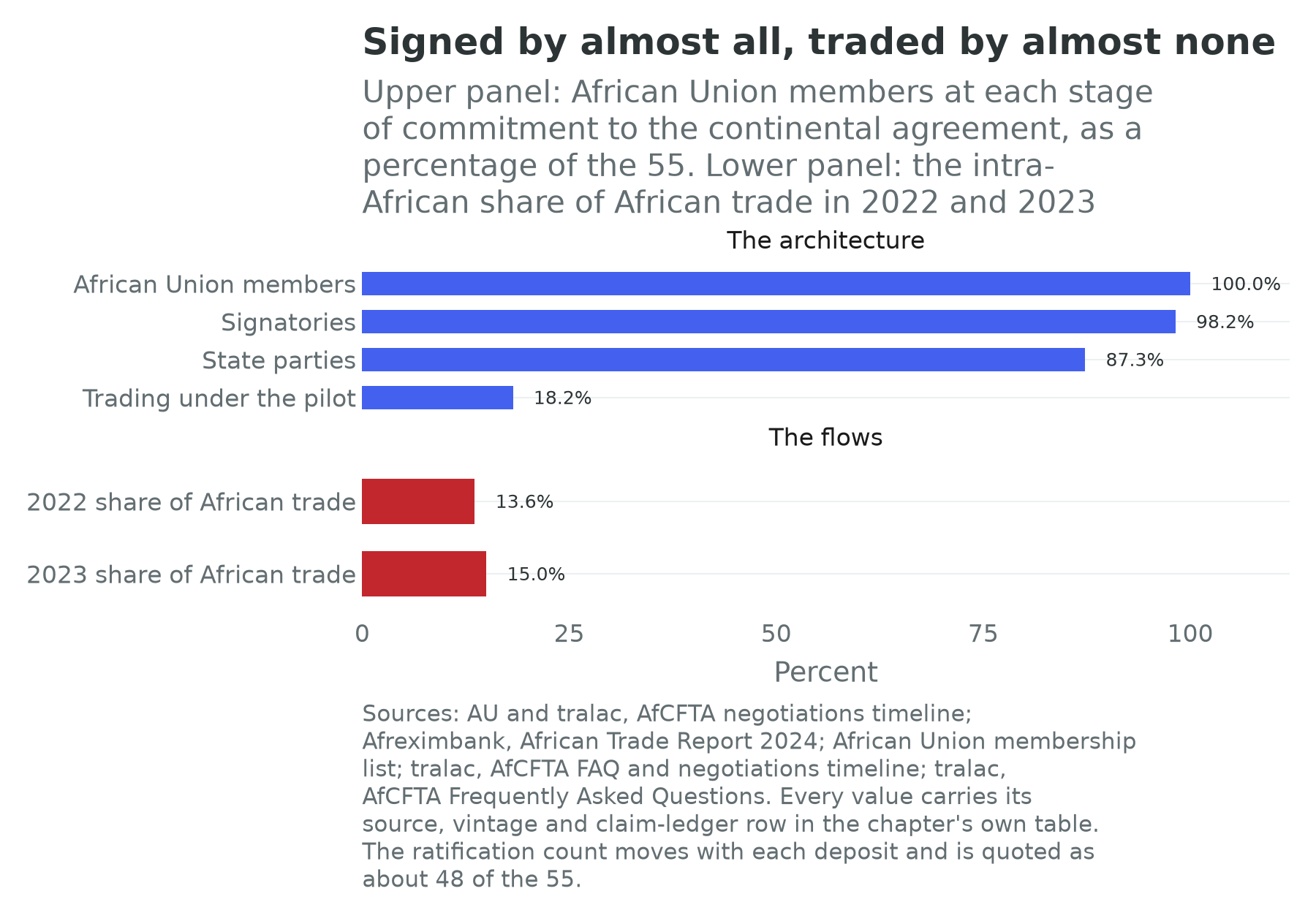
The African Continental Free Trade Area is the largest thing in this chapter and the youngest. It was signed at an extraordinary summit in Kigali on 21 March 2018 by 44 states; Nigeria and Benin signed at Niamey in July 2019, and Eritrea is the only African Union member that has never signed (tralac, 2025). It entered into force on 30 May 2019, thirty days after the twenty-second ratification, and trading under its preferences began on 1 January 2021. About 48 of the 55 have now ratified and become state parties, a count that moves with each deposit and that published sources give variously between 47 and 49 (tralac, 2025).
Then the machinery. Rules of origin have been agreed on 92.3 percent of tariff lines, covering 95.5 percent of intra-African trade; the outstanding 7.7 percent is textiles and clothing plus automotives, and the deadline for concluding them was extended into late 2025 (tralac, 2025). Those two sectors are not a random remainder. They are the labour-intensive assembly industries the recipe in Chapter 9 runs through and the vehicle platforms of Chapters 15 and 28, so the parts of the agreement still unfinished are the parts that would matter most for the identity’s second term. Tariff schedules are a similar story: a large majority of state parties have had schedules verified, a minority have not, and the published counts disagree enough that this chapter declines to give a number to the unit. Where the negotiating record is contested, saying so is more useful than a decimal place.
Beyond goods, the agreement has grown protocols more ambitious than its tariff schedules: on investment, competition policy and intellectual property in February 2023, and on both digital trade and women and youth in trade in February 2024 (Department of Trade, Industry and Competition, 2025). That matters for a reason unconnected with tariffs. Africa has more than 150 bilateral investment treaties between African states and many more with non-African partners, and a continental investment protocol that superseded them would be the largest single act of legal consolidation in African economic history. Whether it does is the question, and the answer is not yet known.
The Secretariat sits in Accra and has been led since March 2020 by Wamkele Mene as Secretary-General (African Union, 2020). Its most instructive instrument is the Guided Trade Initiative, launched in Accra on 7 October 2022 with seven participating states and concluded at the Council of Ministers in April 2025 with ten state parties actively trading under the agreement’s own rules (tralac, 2025). The name invites misreading. It was not a pilot tariff regime but an operational rehearsal: pick a few countries and a few products, walk a consignment through certification, clearance, preference claim and payment end to end, and find where the process breaks. That is a sensible thing for a secretariat with no enforcement power to do, and it is also a confession: an agreement in force since 2019 and trading since 2021 needed a supervised exercise to establish whether a shipment could actually claim a preference.
Architecture against flows
The two panels of Figure 7.3 are the argument of this chapter in one image.
Intra-African trade was 14.9 percent of African trade in 2023, on a value of $192.2 billion, up from 13.6 percent in 2022 (Afreximbank, 2024). The companion volume’s finding on mirror statistics sharpens Chapter 1’s warning: for more than 40 percent of African country pairs the two sides’ reported values of the same trade diverge by more than half (Wilse-Samson, 2026).
The order of magnitude is not in doubt. Somewhere around 15 percent of African trade is with other African countries, against shares conventionally quoted in the high fifties for Asia and the high sixties for Europe (UNCTAD, 2023). The honest thing is to put that on the page as the exhibit rather than explain it away, because the standard explanations are mostly true and mostly beside the point. Three are worth stating properly.
The first is composition, and it is the strongest. African exports are disproportionately primary commodities and Africa does not consume them: a continent that ships crude oil, cobalt, copper, cocoa and iron ore to industrial economies will have a low intra-regional trade share as a matter of arithmetic, whatever its border policy. If the share rises it will not be because the borders got easier first; it will be because the composition changed, which is a story about Chapters 11 to 19 rather than about customs procedure.
The second is Viner’s. A preferential area creates trade between its members and diverts trade from more efficient producers outside it, and the welfare arithmetic can go either way (Viner, 1950). For a continent whose members mostly produce similar things at similar cost and import manufactures from Asia, the trade-creation prize is smaller than the rhetoric implies and the diversion risk is real. That is the strongest analytical case against treating the continental agreement as a growth strategy in itself, and it is why this book’s interest in it runs through the rules and the corridors rather than the tariff lines.
The third is the border. The gravity evidence is consistent: African borders impose a cost far larger than the tariffs crossing them, and market access rather than distance predicts where African economic activity concentrates (Bosker and Garretsen, 2012), a claim made testable by the tradition that infers market access from transport costs rather than from straight-line distance (Fally, Paillacar and Terra, 2010). The policy finding is the companion volume’s: the binding constraints were never mainly tariffs, because the communities had already brought those down. They are non-tariff barriers, the days a truck spends at a border, the currency it has to convert into, and the roadblocks between the two (Wilse-Samson, 2026).
Put the three together and you get the framing this book adopts from ECDPM: policy supply has run far ahead of policy demand (Byiers, Jaïdi and El Yamani, 2024). There is no shortage of agreements. There is a shortage of firms that would use them, of administrations that could operate them, and of domestic coalitions that want them operated.
That last clause is where the political economy lives, and it deserves saying without euphemism. A border is a rent. Somebody collects at it, formally as customs revenue and informally as everything else, and in several countries in this book customs is at once the state’s most reliable revenue instrument and one of the governing coalition’s most reliable patronage instruments. Removing a border takes money and leverage from identifiable people now, for a diffuse and delayed gain to firms that may not exist yet. Khan (2010) predicts exactly this: the formal rule is adopted because adopting it is cheap and refusing it embarrassing, and then not enforced, because enforcement would cut against the distribution of organizational power the state rests on. The test in Dercon (2022) asks whether an elite has bet on growth; signing a trade agreement is the cheapest available way to look as though you have. The architecture is not hypocrisy. It is a rational response to a situation in which the signature is nearly free and the implementation is not.
There is a more generous reading, and this book takes it seriously too. African regional communities were built for security and sovereignty before trade, and several have done well on that mandate: ECOWAS ran peace operations in Liberia and Sierra Leone, IGAD brokered the agreement that ended Sudan’s north-south war, and SADC’s predecessor existed to reduce its members’ dependence on apartheid South Africa. To measure these bodies only by trade shares is to grade them on a paper they did not sit.
Two stress tests
An architecture is best understood when it is under load. Two events since 2022 have loaded it from opposite directions.
ECOWAS and the exit
The first is a contraction, and the most serious institutional reverse in West Africa since the community was founded in 1975.
Between 2020 and 2023 soldiers took power in Mali twice, in Burkina Faso twice and in Niger; ECOWAS answered with sanctions, in Niger’s case including the closure of land and air borders and the suspension of commercial and financial transactions, lifted in February 2024 (News Agency of Nigeria, 2024). The three governments responded by forming the Alliance of Sahel States, first as a mutual-defence pact under the Liptako-Gourma Charter in September 2023 and then, in July 2024, as a confederation with its own institutions (Xinhua, 2024). On 28 January 2024 they announced their withdrawal from ECOWAS; the treaty requires a year’s notice, and the withdrawal took effect on 29 January 2025, with a six-month transition during which the three continued to be treated as members for trade and movement (Al Jazeera, 2024; Usman, 2025).
The cards record the outcome. Mali, Burkina Faso and Niger each now carry one of the eight recognized communities, CEN-SAD, the least functional of them, plus the Alliance, which the Union does not recognize and which this chapter’s counts therefore exclude. Three landlocked states whose trade runs through their coastal neighbours’ ports have left the arrangement that governed that transit. They remain inside the West African monetary union and continue to use the CFA franc, which is the loudest single fact about the limits of the rupture and the one most likely to change; Chapter 8 takes up what a Sahelian currency exit would involve.
Three things stand out. The sanctions instrument failed on its own terms: it did not restore constitutional rule and it did produce an exit. The free-movement regime, the community’s genuine achievement, is now the asset most at risk, and it is the asset the population uses. And the exit reveals what the community was holding together, which was less a market than a set of mutual expectations about how power changes hands. Chapter 36 carries the Sahel at length; the point here is that an architecture which cannot survive a change in the type of government its members have rests on a political settlement rather than an economic interest.
The East African Community and the expansion
The second stress test runs the other way, and it is a warning about success.
The East African Community had five members through the 2010s. It admitted the Democratic Republic of the Congo in 2022 and Somalia in 2024, taking it to eight, and both cards record the memberships. The economic logic of the first is excellent: the eastern Congo’s trade already runs to Mombasa and Dar es Salaam, and formalizing it inside a customs union is what the corridor argument recommends. The administrative logic is harder. A customs union is a promise by each member to collect a common tariff at its own frontier and account for it honestly, and the Democratic Republic of the Congo does not control several of its eastern borders, where armed groups tax the mineral flows themselves; Chapter 31 sets out that territory in detail. Somalia’s card records its last census in 1975 and carries a low confidence flag.
The arithmetic of the expansion is unforgiving. The community’s median working-age population growth is now the fastest of the eight at 3.16 percent a year, and its members include the state with the continent’s most contested customs frontier and one with almost no statistical apparatus at all, while members were paying only about three fifths of their assessed contributions. A customs union is only as strong as its weakest collector, because a single unpoliced entry point is unpoliced for the whole union: goods that enter there and move under a single bond arrive in Nairobi having paid nothing. Its members know this, which is why the practical response has been to slow the extension of the Single Customs Territory rather than extend it, and why deepening and widening have turned out, here as in Europe, to be substitutes.
Money, in one paragraph
The Pan-African Payment and Settlement System is the piece of continental infrastructure most likely to matter and least likely to be photographed. Built by Afreximbank with the African Union and launched commercially in January 2022, it lets a bank in one African country pay a bank in another in their two local currencies, netting the settlement in a regional clearing arrangement instead of routing the payment through a correspondent bank in Europe or New York and converting twice into dollars (Afreximbank, 2024). A trader in Lagos paying a supplier in Accra currently pays two spreads and waits days; the promise is one spread and near-immediacy. It addresses the currency constraint without requiring any government to give up a tariff, which is why it is the instrument in this chapter with the fewest natural enemies. Whether it reaches scale is a question about central-bank participation, correspondent-banking relationships and compliance, and Chapter 8 owns all three; Chapter 16 carries the commercial side.
Where the architecture sits in the identity
The book runs on one piece of arithmetic: GDP growth is approximately the growth of output per worker, plus the growth of the employment-to-working-age ratio, plus the growth of the working-age population. Regional architecture belongs almost entirely to the third of those terms, and it is worth being explicit about why, because integration is routinely sold as a jobs programme.
Term one is untouched. No treaty makes people.
Term two is touched at one point only, and that point is mobility rather than trade. If a worker can move from a labour-surplus country to a labour-scarce one inside the same community, the employment ratio rises where she lands and the pressure eases where she left, which is what the West African free-movement protocol has done for four decades. But Chapter 10 supplies the scale correction: about 25 million people born in Africa live in another African country, roughly 1.7 percent of the continent’s population, and the African Union’s own free-movement protocol has four of the fifteen ratifications it needs (African Union Commission, 2019; Deutsche Welle, 2025). Whatever the architecture has done for term two, it has done at a scale of a percent or two. The visa is the everyday version of the same gap. Chapter 18’s reading of the 2025 Africa Visa Openness Report is the one to keep: visa-free pairs have risen and the composite score has fallen, a continent moving in both directions at once (African Development Bank and African Union, 2026). A project that needs a site visit, a counterpart meeting and a work permit still runs into the older fact that African citizens need a prior visa for a large share of other African destinations. That is an investment-delivery friction as well as a tourism one, which is why it belongs here beside the protocol count rather than only in the tourism chapter.
Term three is where the case sits, and it has three legs. A larger market lets a plant reach efficient scale. Competition from imports disciplines incumbents. And a customs union lets a value chain be split across borders, so that a component crosses a frontier three times before the finished good is sold, which is the mechanism behind almost every successful regional integration anywhere and the one that requires functioning borders rather than merely low tariffs.
The test is whether any of this is visible in the cards, and it is not. Table 7.1 shows no relationship between how integrated a community is and how its members’ identity terms behave: the East African Community, the most integrated of the eight, has median terms that look like the continent’s, and the Central African community, whose customs union exists mainly on paper, has the worst third term of the eight. The data exercise puts the same test more pointedly and gets the same answer: countries that share a community are no more alike in their identity arithmetic than countries that do not, and those in the most communities are, if anything, the ones whose arithmetic is least reliable, because overlapping membership and administrative fragility have the same geography.
Read that negative finding for exactly what it says. It does not show that regional integration does not work. It shows that the architecture as built, over the decade to 2024, is not yet doing enough work to be visible in a cross-section of 54 countries, which is what the flow numbers already told us. The evidence that integration works, where it exists, is at the level of the border post and the corridor rather than the treaty.
What the evidence says
Why this box is not about randomized trials
Every other evidence box in this book reports an experiment. This one cannot. Regional integration is a treatment applied to countries, not to households or firms, and there are 54 units on the whole continent; nobody can randomize a customs union. What exists instead is natural-experiment and before-and-after evidence, and the honest thing is to label it as such. Banerjee and Duflo (2009) make the general case for the experimental method and are also its most precise critics on this point: experiments answer questions about programmes delivered to many similar units, and are silent on general equilibrium and on institutions that exist once. A continental trade agreement is the second kind of question.
What the border-post evidence shows. The one-stop border post is the closest thing here to a clean design, because it is installed at a specific crossing on a specific date and the traffic on both sides is measured before and after. Chirundu, on the Zambia and Zimbabwe border, was Africa’s first, opened in 2009, and the assessments of it report substantial falls in clearance time with a recurring qualification: the gains erode where the physical facility is built and the joint operating procedures each agency has to sign are not (AfDB, JICA and NEPAD, 2016). The East African chain is better documented, and Malaba’s fall from two or three days to between four and eight hours is the number the corridor literature keeps returning to (Wilse-Samson, 2026). The lesson is consistent: the building is a fifth of the intervention and the procedures are the rest.
What the indicator evidence shows, and what happened to it. For fifteen years the most powerful instrument for border reform in Africa was not a treaty but a league table: the World Bank’s Doing Business rankings, whose trading-across-borders component counted documents, days and cost to move a container. Governments reformed to move up it, and many documented reductions in African border times date from that period. Then the index was withdrawn in 2021 after an investigation into irregularities in how its data had been handled, and replaced by a redesigned survey (World Bank, 2021; World Bank, 2026b). Two lessons follow and they point in opposite directions. Measurement is a policy instrument, and a ranking can move ministries a protocol cannot. And a policy instrument built on a measurement is only as good as the measurement, which is Chapter 1’s argument arriving from an unexpected direction.
What none of it can tell you. No study here identifies the effect of a customs union on a member’s output per worker, because the counterfactual does not exist. The evidence supports claims about crossings and corridors, not about continents. A book that wanted to argue the continental agreement into being would find that inconvenient; this one takes it as the reason to write Chapters 19 and 24 to 31 corridor by corridor.
The architecture in two worlds
Chapter 1 set out the assumption every argument in this book rests on, and the world in which it fails: one in which the frontier of production is a stock of machines and energy rather than a stock of workers, so that the marginal worker stops being the thing growth is made of. Regional architecture changes meaning completely between the two.
In the labour-abundant world, the case for the architecture is the case its designers make. A market of 1.5 billion consumers is the missing ingredient for a manufacturing sector that cannot reach efficient scale inside any single African economy; a customs union lets a value chain be split across four countries; free movement puts workers where the plants are. Everything in this chapter about rules of origin, border posts and common tariffs is instrumental to that, and the unfinished rules of origin are on textiles and vehicles precisely because those are the industries where it would bind first.
In the labour-redundant world almost none of that survives. A market of 1.5 billion consumers is worth what those consumers can pay, and if income stops scaling with the number of workers, the market of 2050 is not the market the projections describe. The consumer-market argument for African integration is, on inspection, a demographic argument wearing commercial clothes, and it inherits every one of Chapter 1’s doubts about demography.
What holds its value is different in kind. An electron is the same in both worlds, and a continental electricity market, in which a solar farm in Morocco or Egypt sells into a grid reaching other countries’ loads, is worth more in the second world than in this one, because the binding constraint on compute is turning out to be power rather than chips; Chapter 14 is an energy chapter for that reason. A continental data market is the same argument one layer up, and Chapter 17 carries it: rules on where data may be stored, whose law governs a cross-border service and what a cloud contract means are the trade barriers of a compute economy, and the digital-trade protocol is the only continental instrument addressing them. Rules hold their value too: a common competition regime, a common investment protocol and a working court are worth more, not less, when the asset is a data centre and a licence rather than a container.
The architecture that survives the second world is therefore the one that moves electrons and rules, not the one that moves goods. That is close to the reverse of the ordering the last twenty years of African integration has followed, and it is a testable claim about what the next twenty should be; Chapter 35 carries both worlds as a scenario axis. The uncomfortable corollary belongs on the page too. Power grids and data rules are the parts of the architecture with the smallest constituencies. A tariff schedule has exporters lobbying for it; a regional grid code has engineers. If the second world arrives, the continent will have spent its integration capital on the wrong protocol.
Connections to Other Chapters
- Chapter 5 (States, Political Settlements, and Development Bargains) supplies the vocabulary in which a signed but unimplemented treaty is a predictable outcome rather than a puzzle, and Chapter 6 (The Informal Economy) carries the informal cross-border trade the formal architecture does not touch.
- Chapter 8 (Money) owns the currency fragmentation this chapter counts and hands on, and the payments system described here in one paragraph.
- Chapter 10 (Labor, Youth, and Migration) owns intra-African mobility, the free-movement protocol’s ratification record, and the scale correction applied to this chapter’s term-two claim. Chapter 18 carries the visa-openness numbers this chapter’s identity section now points at; Chapter 19 treats that friction as one blocker on a financed cross-border asset.
- Chapter 19 (Trade, Logistics, and Ports) is where the corridor and border machinery is measured rather than described, and where the rules-of-origin and preference-utilization evidence lives.
- Chapters 24 to 31 (the growth poles) each carry a corridor section in which this chapter’s instruments are observed at one crossing; Chapter 26 (Nairobi and Mombasa) is the East African Community read as a working system and Chapter 24 (Lagos and Abidjan) the West African corridor read as an unreformed one.
- Chapter 33 (The Other Partners) takes up the external agreements that overlap this architecture, from the European Union’s economic partnership agreements to the Gulf and Turkish arrangements, and asks whose rules African integration is competing with.
- Chapter 36 (What Could Go Wrong) carries the Sahel and the political rupture whose institutional half is described here.
Discussion Questions
The eight recognized communities have 112 memberships across 54 states, and two of the eight are wholly contained inside a third. A reformer proposes to recognize four communities instead of eight and require every state to choose one. Set out what would be gained, name the three constituencies that would fight it hardest and say what each would lose, then say whether your answer changes if the choice were made by the Union rather than by each member.
This chapter argues that a border is a rent, and that removing it takes identifiable money from identifiable people now in exchange for a diffuse gain later. Take that as a design problem rather than a complaint. Propose a compensation mechanism that would make a customs union incentive-compatible for the member that currently collects most at its internal frontier, using the Southern African revenue-sharing formula as model or as warning, and say what data would be needed to operate it.
The chapter’s negative finding is that shared community membership predicts nothing about a country’s identity arithmetic. One reading is that regional integration does not work; another that the treatment has not been delivered in a dose detectable across 54 countries; a third that the outcome is measured over a decade in which the architecture changed and the flows did not. Argue for one, and state the observation, available before 2035, that would distinguish it from the other two.
Try It
Open three cards side by side: South Africa, Nigeria and Ethiopia, the continent’s largest, third-largest and ninth-largest economies. They share no regional economic community: South Africa is in SADC alone, Nigeria in ECOWAS and CEN-SAD, Ethiopia in IGAD and COMESA. Read the header block on each card first, then the three identity terms, then the confidence flag. Write one paragraph on a single question: these three produce more than a quarter of African output and have no common trade institution below the continental one, so what would a firm headquartered in one have to do to sell into the other two, and which instrument from this chapter would it actually use? Then swap two of them for Kenya and the Democratic Republic of the Congo, in four communities each, and ask whether four is visibly better than one.
Then open the AfCFTA linkage explorer on Ghana. It draws a ribbon between two African countries only where both of them report the flow, the exporter’s declaration and the importer’s, and the two figures agree once the importer’s has been put on the exporter’s basis; the rule and its tolerance are printed under the diagram. Read the four counts beside it before the diagram itself: how many of the pairs Ghana is an end of are reported by both sides and agree, how many are reported by both and disagree, how many by one side only, and how many by neither. Then move the year back two years and watch the counts change: the newest year is the thinnest, because countries report with a lag and the matrix fills in behind itself. Then switch to the continent and read the same four. Write a paragraph on what a continental trade share is a measurement of, given that most of the ordered pairs on the continent are not described by both of the two countries the goods pass between, and say which instrument in this chapter would change that count first: the tariff schedule, the rules of origin, the payments system, or the customs administrations that produce the declarations in the first place.
Data Exercise
Download all fifty-four cards from the country cards page on this site, as cards.csv if you work in a spreadsheet and cards.json if you want each number’s release travelling beside it. Build a table with five fields: header.recs, header.au_region, scale.population, scale.gdp_usd, and the pair identity.gdp_growth_implied and identity.gdp_growth_observed. Then answer four questions.
First, count memberships. Restrict to the eight communities the African Union recognizes, since three cards also carry a body it does not, and reproduce this chapter’s distribution across one, two, three and four. Report the population-weighted average number of memberships per person and explain why it exceeds the unweighted average.
Second, find every pair of communities sharing more than five members, and check the chapter’s claim that there are five such pairs. Then find every pair sharing no member at all, and say what the twelve empty cells have in common geographically.
Third, define each country’s identity gap as identity.gdp_growth_implied minus identity.gdp_growth_observed, available on 52 cards. Take every pair of countries, split the pairs into those sharing at least one community and those sharing none, and compare the median absolute difference in gap across the two groups. Then correlate the number of memberships with the absolute gap across the 52.
Fourth, write two sentences on what you found. Shared membership will predict nothing, and the correlation between memberships and the size of the gap will if anything be positive rather than negative. Say what that does and does not license you to conclude, distinguishing the claim that integration has no effect on growth from the claim that the identity gap is a measurement residual with no business tracking a country’s treaty commitments at all. Note which fields are null rather than zero, and never impute a null as a zero.
Data Sources and Further Reading
Key data sources
- The country cards’ membership field: every count, overlap and community aggregate here, including Table 7.1 and Figures 7.1 and 7.2. Memberships are recorded for the eight African Union-recognized communities, with the Alliance of Sahel States carried separately on three cards and excluded from every count.
- UN World Population Prospects 2024, medium variant, ages 15 to 64: Table 7.1’s population column and the first identity term. IMF World Economic Outlook, April 2026: the output column. ILOSTAT modelled estimates, November 2025: the second and third identity terms.
- tralac, AfCFTA Frequently Asked Questions and AfCFTA Negotiations Timeline: signature, ratification, rules-of-origin and Guided Trade Initiative status, and the source this chapter defers to where counts disagree. AfCFTA Secretariat, Accra: the protocols, the tariff-schedule process and the Initiative’s own reporting.
- Afreximbank, African Trade Report: intra-African trade values and shares, and the payments system. UNCTAD, Economic Development in Africa Report: the comparative regional shares.
- UNECA, the African Union Commission and the African Development Bank, Assessing Regional Integration in Africa and the Africa Regional Integration Index: the continent’s own assessment, dimension by dimension, and the standing reminder that productive integration scores worst of them.
- The regional secretariats: the ECOWAS Commission, the EAC Secretariat, the SADC Secretariat and SACU, for treaty instruments, tariff schedules and membership changes.
Further reading
- Trudi Hartzenberg and the tralac working papers, for a running technical commentary on African trade law as it is actually drafted, and Faizel Ismail (2021) on what an agreement negotiated between unequal African economies has to do to be fair.
- Landry Signé (2018), Unlocking Africa’s Business Potential, for the market-size case at its strongest, and Vera Songwe’s work at the Economic Commission for Africa for the institutional one.
- Bruce Byiers, Poorva Karkare and colleagues at ECDPM, for why regional bodies do what they do. Byiers, Jaïdi and El Yamani (2024) supply the policy-supply-against-policy-demand framing this chapter adopts.
- Jacob Viner, The Customs Union Issue (1950), still the cleanest statement of why a preferential area is not automatically a good idea, with Bosker and Garretsen (2012) on market access and African economic geography and Fally, Paillacar and Terra (2010) for the transport-cost machinery behind the measure.
- The New Regional Economics, chapters 12 to 15 (Wilse-Samson, 2026), for the corridor evidence, the rules-of-origin detail and the informal cross-border trade this chapter cites rather than repeats.