18. Tourism and the Creative Economy
Africa received 81 million international tourist arrivals in 2025, about 8 percent more than the year before and the fastest growth of any world region (UN Tourism, 2026). Over the same year the entire recorded-music market of Sub-Saharan Africa, every stream, download and disc, was worth 120 million dollars at trade value (IFPI, 2026). One Rwandan national park earned twice that from gorilla permits (Rwanda Development Board, 2026). Both halves of this chapter sell an experience of Africa to buyers elsewhere, and only one is a large industry.
Learning Objectives
After reading this chapter, you should be able to:
- Say why tourism has the strongest direct claim on the identity’s second term of any sector in Part III, what that claim rests on, and where it fails.
- Describe how a safari, a beach package and a film shoot differ in where the money lands, and say how leakage should be measured.
- Separate the audited numbers in this sector from the reported ones, and say which claims about Nollywood, Afrobeats and amapiano survive the distinction.
- Judge a visa policy, a park-fee regime and an air-service agreement as instruments of a single industrial policy.
- Explain what an experience sold to a human being becomes in a world that no longer needs workers, and state the counter-case.
Prior work: the community-conservancy and rangeland-livelihoods literature is surveyed in the companion volume, The New Regional Economics* (Wilse-Samson, 2026), and cited here rather than repeated.*
1. Overview
Tourism has the strongest labour claim of any sector in this Part, because it is unavoidably local: a hotel cannot be run from Rotterdam and a meal served in Zanzibar is cooked in Zanzibar. It is the one export sector in this book with a plausible claim on term two of the identity directly, rather than through a multiplier nobody has measured.
The counter-case gets the same billing: the jobs are seasonal, the wages low, the profitable links often owned offshore, and demand collapses on a security headline. The creative economy is the same argument in another medium, where the leakage is a platform’s cut.
Where the sector sits in the identity
Recall the arithmetic from Chapter 1: GDP growth is approximately output-per-worker growth, plus growth of the employment ratio, plus working-age population growth.
| Identity term | What this sector does to it | Reading |
|---|---|---|
| One: working-age population | Nothing directly; the islands and North Africa, where tourism matters most, are the slowest-growing cards | Mauritius runs at minus 0.24 percent a year and Cabo Verde at 0.52, against a median of 2.89 |
| Two: employment-to-working-age ratio | The strongest direct claim of any sector here, and the most seasonal | Five of the twelve tourism economies below post a positive term two, against 22 of the 53 cards |
| Three: output per worker | Modest and often negative: adding waiters lowers an economy’s average product | Namibia’s term three is minus 1.05 percent a year and Botswana’s minus 0.11 |
All figures are annual growth rates over 2014 to 2024. Sources: UN World Population Prospects 2024, medium variant, for term one; ILOSTAT modelled estimates, November 2025, for terms two and three; via the country cards.
Table 18.1 reads the twelve economies where tourism carries a serious share of foreign-exchange earnings the way the rest of the book reads a country.
| Country | Term one | Term two | Term three | Observed growth | Wage employment (percent) | Non-agricultural (percent) | Informal (percent) | Confidence |
|---|---|---|---|---|---|---|---|---|
| Morocco | 1.10 | -0.45 | 1.88 | 2.54 | 59.6 | 71.7 | not on the card | high |
| Egypt | 1.96 | 0.07 | 2.26 | 4.33 | 72.9 | 82.0 | 68.6 | high |
| Tunisia | 0.53 | -0.19 | 0.48 | 0.82 | 75.0 | 87.3 | 36.9 | high |
| South Africa | 1.61 | -0.45 | -0.48 | 0.67 | 82.7 | 94.6 | 34.8 | high |
| Kenya | 2.94 | -1.17 | 2.84 | 4.62 | 35.1 | 53.5 | 86.5 | high |
| Tanzania | 3.55 | 0.03 | 1.92 | 5.83 | 14.5 | 34.9 | 90.8 | medium |
| Rwanda | 2.83 | 0.65 | 3.26 | 6.72 | 59.1 | 63.5 | 84.3 | high |
| Botswana | 1.78 | 0.41 | -0.11 | 2.09 | 71.9 | 81.9 | 75.6 | medium |
| Namibia | 2.64 | -0.37 | -1.05 | 1.18 | 63.2 | 77.4 | 55.6 | low |
| Mauritius | -0.24 | 0.61 | 2.02 | 2.40 | 81.8 | 95.1 | 23.5 | high |
| Cabo Verde | 0.52 | -0.16 | 2.66 | 3.02 | 61.1 | 90.4 | 60.6 | medium |
| Seychelles | 2.24 | not on the card | not on the card | 4.36 | not on the card | not on the card | 14.2 | medium |
| Continental median | 2.89 | -0.15 | 0.74 | 2.91 | 31.0 | 59.0 | 89.1 |
Annual growth rates in percentage points over 2014 to 2024 in the first four numeric columns; shares and a flag in the rest. Term one is the working-age population aged 15 to 64; term two is modelled employment aged 15 and over divided by that population. The median row is taken column by column and is not a country. Sources: UN World Population Prospects 2024, ILOSTAT modelled estimates (November 2025) and the IMF World Economic Outlook (April 2026), via the country cards.
The tourism economies are the waged economies. Ten of the eleven that carry the field have a wage share above the continental median of 31.0 percent, and four, South Africa, Mauritius, Tunisia and Egypt, are in the top five of all 53 cards. Informality runs the other way: the Seychelles records 14.2 percent and Mauritius 23.5, the two lowest on the continent, against a median of 89.1. The places that sell experiences to foreigners have payrolls.
And a payroll is not a rising employment ratio. Figure 18.1 puts the wage overlay against term two across the 53 cards carrying both, and the relationship is nothing: a correlation of 0.03. Chapter 10 found the same from the other end, that the wage share measures income and not growth. Being a wage economy is a level, not a direction of travel.
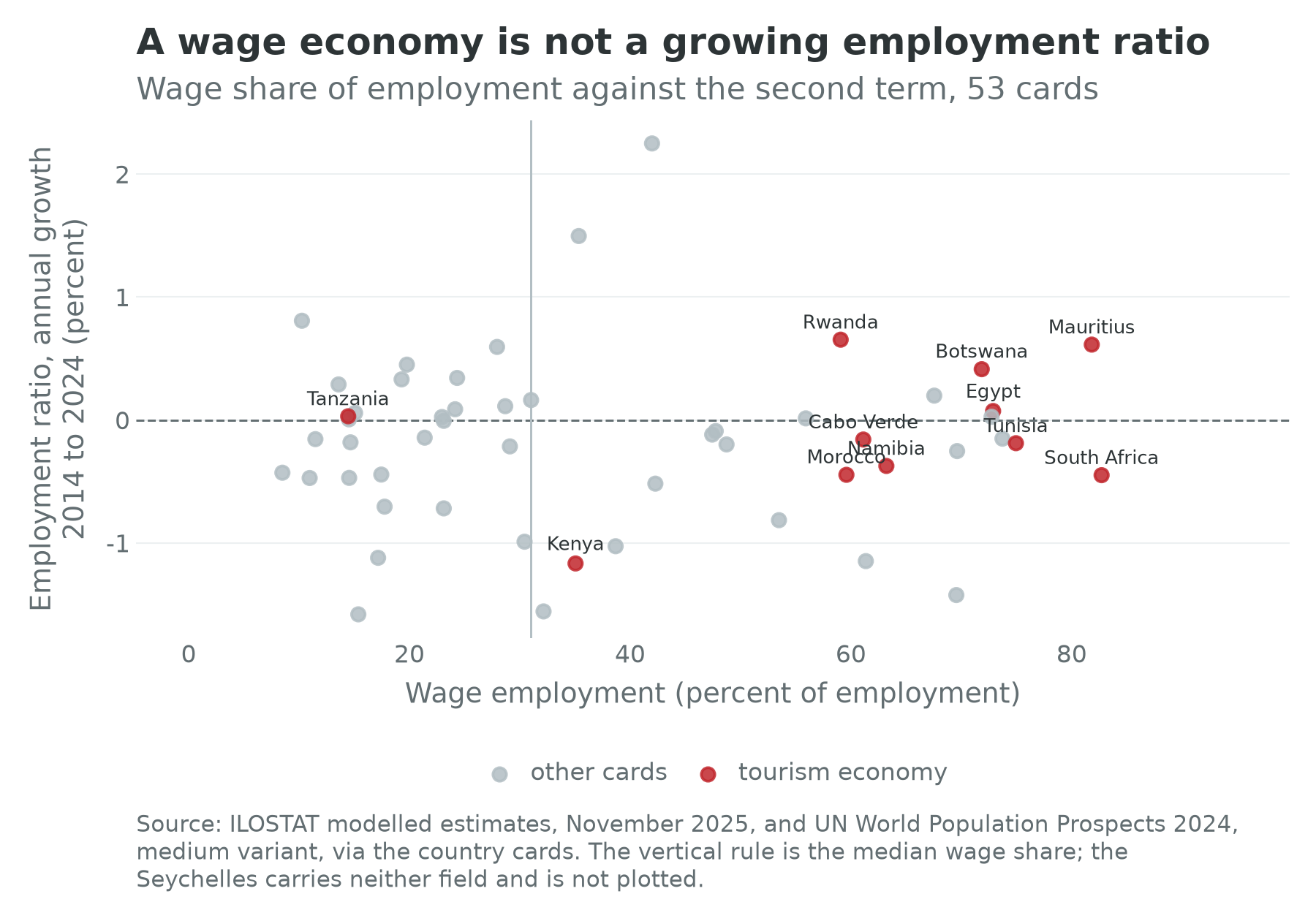
The most tourism-dependent economy on the continent has no decomposition. The Seychelles is the richest African country per head, at 18,479 dollars, and lives almost entirely on visitors. Its card carries no term two, no term three and no wage share, because the international employment series does not cover it. The one economy where the sector’s employment claim could be tested cleanly is the one where the employment data does not exist.
The experience economy in two worlds
Chapter 1 asked what each term becomes if the marginal worker stops mattering. In the labour-abundant world tourism is a conventional export with an unusually good employment coefficient, and the programme is the ordinary one: more seats, easier visas, better roads to the park gate, and a fight over how much of the package price stays.
In the labour-redundant world it is the last labour-intensive export standing. If the frontier becomes installed compute, energy and capital, with labour a complement at best (Acemoglu and Restrepo, 2019), the work that survives is work a machine cannot do or that a buyer does not want a machine to do. Carrying a bag, tracking a leopard, cooking for a person physically present: none of it automates cheaply, and some is bought precisely because a human being does it. Chapter 6 finds informality protective because it is too poor to be worth automating; tourism’s protection is different in kind, because it sells presence, which cannot be delivered over a network.
The creative economy sits on the other side of that line. A film and a track are pure information goods, made by the tasks generative systems are getting good at and consumed without anybody being anywhere. The optimistic reading is that the scarce input is the culture rather than the labour, and that amapiano is a thing a model can imitate and not originate. The pessimistic one is that the buyer becomes an algorithm, and that a continent whose creative exports reach the world through two American platforms rents its distribution from the firms most exposed to the change. The two halves of this chapter face opposite futures, and a policy treating them as one cultural sector will get both wrong.
2. How the industry works
The package, and where it lands
A European couple books two weeks in Kenya through a tour operator in Frankfurt, which has bought flights, ground handling, beds and park entry and keeps a margin. What lands in Kenya is the ground price, in four pieces plus a fifth that is not a payment at all: the visa, the only input in the chain that can be made cheaper by a signature.
The airline seat is usually the largest and most likely to be foreign. On a European carrier the fare never touches the Kenyan balance of payments except as landing fees; on a national carrier it does, which is why Chapter 26 treats Nairobi’s hub as a policy asset and a contingent liability at once (Kenya Airways, 2026).
The bed is the most misunderstood. A foreign-branded hotel is usually not foreign-owned: most chain hotels in Africa are built by local investors and run under a management agreement in which the chain supplies the brand, the reservation system and the standards for a fee on revenue and profit. The building, the payroll and most operating cash stay onshore; the fee and the reservation charge leave. That is a smaller leakage than the critique assumes and a larger one than the brochure suggests.
The third piece is everything bought locally, and it is where the linkage argument lives. A lodge that buys from its district rather than from Nairobi creates several jobs instead of one, and Chapter 11 has the reason it usually does not: a farmer near a lodge cannot reliably deliver twenty kilograms of tomatoes on a Thursday.
The fourth is the park fee: a price for a public good, levied on foreigners, denominated in dollars, collected at a gate. It is the closest thing in African public finance to a well-designed environmental tax, and its incidence problem is that those who bear the cost of living beside wildlife are not those who receive the fee. Under a state park model the money goes to a treasury and, in good cases, back to a wildlife authority. Under a conservancy model, of which Kenya’s Maasai Mara conservancies are the best-known instance, landowners lease land to an operator for a monthly rent per hectare regardless of how many tourists come, which makes the wildlife an asset rather than a pest. Whether that raises household welfare, and for whom, is the argument of the rangelands literature the companion volume surveys (Wilse-Samson, 2026).
Leakage is the word for everything that does not stay, and the sector’s most abused statistic. Figures of 40, 60 or 80 percent circulate without a denominator, computed variously on the package price, on gross receipts or on repatriated profits. Leakage is largest for the all-inclusive beach package and smallest for the small-lodge safari, and any figure quoted without its base should be ignored. The measurable version is the import content of tourism value added in a supply-and-use table, which almost no African country publishes.
The producer’s budget, and the two ways a track earns
A Nollywood feature is financed by a marketer’s advance against distribution rights, by a cinema release recouped through a box-office split and a later licence, or, since 2016, by a platform commission that owns the result. The windows matter more than the budget, and each is small. The whole Nigerian theatrical market grossed 15.6 billion naira, symbol ₦, in 2025, about 10 million dollars, a record and a 34.7 percent increase on the year before (Udugba, 2026). That is the entire cinema box office of the most populous country in Africa, roughly what a mid-sized American film takes in a good opening weekend. An industry producing on the order of a thousand classified titles a year on a base that size is not a film industry in the Hollywood sense (Daniel, 2026). It is a television industry with occasional cinema releases, and its economics are those of volume.
Music earns two ways that are often confused. A recording earns a royalty when streamed or sold, and the money runs from the platform to a distributor or label and then, after deductions, to the artist. A composition earns separately, through performing and mechanical rights collected by a society for writers and publishers. The first pipe works reasonably well because two or three global firms run it with functioning accounting. The second barely works, because it needs a domestic institution able to monitor public performance and pay out without capture. Nigeria’s history is dismal: a long fight between rival collecting societies over which may collect for musicians, during which the practical answer to who pays a Nigerian songwriter when a radio station plays his song was frequently nobody.
Which leaves the streaming platform as the industry’s cashier. Nigerian artists were paid more than 60 billion naira by a single service in 2025, about 40 million dollars, on 30.3 billion streams, with payouts up about 140 percent over two years (Spotify, 2026). South African artists earned more than 504 million rand, symbol R, on the same platform, nearly three quarters of it from listeners outside South Africa (Spotify, 2026). The audience is abroad, the payment comes from abroad, and it arrives through a foreign platform’s accounting system. This is an export sector whose receivables ledger sits on servers in another jurisdiction.
Piracy is the fourth actor and the reason the formal numbers are small. The answer has not been enforcement but format: same-day release to a platform, pricing a Lagos data bundle can bear, and monetising the live show, where the ticket cannot be copied. That is why the concert and the sponsorship are a larger share of African music income than of the American, and why the diaspora is the first market.
3. Industry structure
Hotels. The chains are the visible layer and the smaller part. Accor, Marriott, Hilton, Radisson and IHG operate the branded stock under management contracts, and their pipelines are the sector’s best forward indicator, extraordinarily concentrated: Egypt alone accounted for 185 planned hotels and 45,984 rooms in the 2025 count, 37.1 percent of the African total, while North African pipeline activity grew 23 percent against 6 percent in Sub-Saharan Africa (W Hospitality Group, 2025). Beneath the chains sits an African-owned regional layer, Serena, Mangalis, Azalaï, City Lodge and Sun International, and beneath that the guesthouse economy, which in most African cities is the majority of beds and appears in no chain’s count.
Safari operators and park managers. At the top sit the luxury camp groups, Wilderness, Singita, andBeyond, Asilia, charging per person per night what a city hotel charges per room per week; in the middle, the operators running vehicle circuits out of Arusha, Nairobi and Maun; at the bottom, the guide with a Land Cruiser and a telephone. The park may be run by a state wildlife authority, by a conservancy of landowners, or, increasingly, by a non-profit under a management contract, the model Section 9 profiles.
Airlines. Lift is the binding constraint on most African tourism and the least controllable input: long-haul access comes largely from European and Gulf carriers, intra-African access from a handful of hubs, of which Addis Ababa is the largest and the one Chapter 29 profiles. The economics are brutal, with thin margins, high fuel and navigation charges, and fleets exposed to a global engine supply chain no national carrier can influence, as Kenya Airways found when grounded wide-bodies turned a profitable year into a loss (Kenya Airways, 2026).
Studios, labels, platforms. Nigerian film has consolidated around firms that do several things at once, FilmOne, EbonyLife, Inkblot and Anthill; music has consolidated faster, with Mavin Records selling a majority stake to Universal Music Group in 2024, though independent labels still took 58 percent of royalties paid to Nigerian rights holders in 2025 (Spotify, 2026). Netflix, Spotify, YouTube, Boomplay and Showmax are the distribution layer, and the African-owned ones are the smaller ones: Showmax is the only large streaming platform with an African parent, while YouTube, the largest distributor of African music and film by volume, is almost absent from official statistics.
4. Geographic distribution
African tourism is four industries wearing one word.
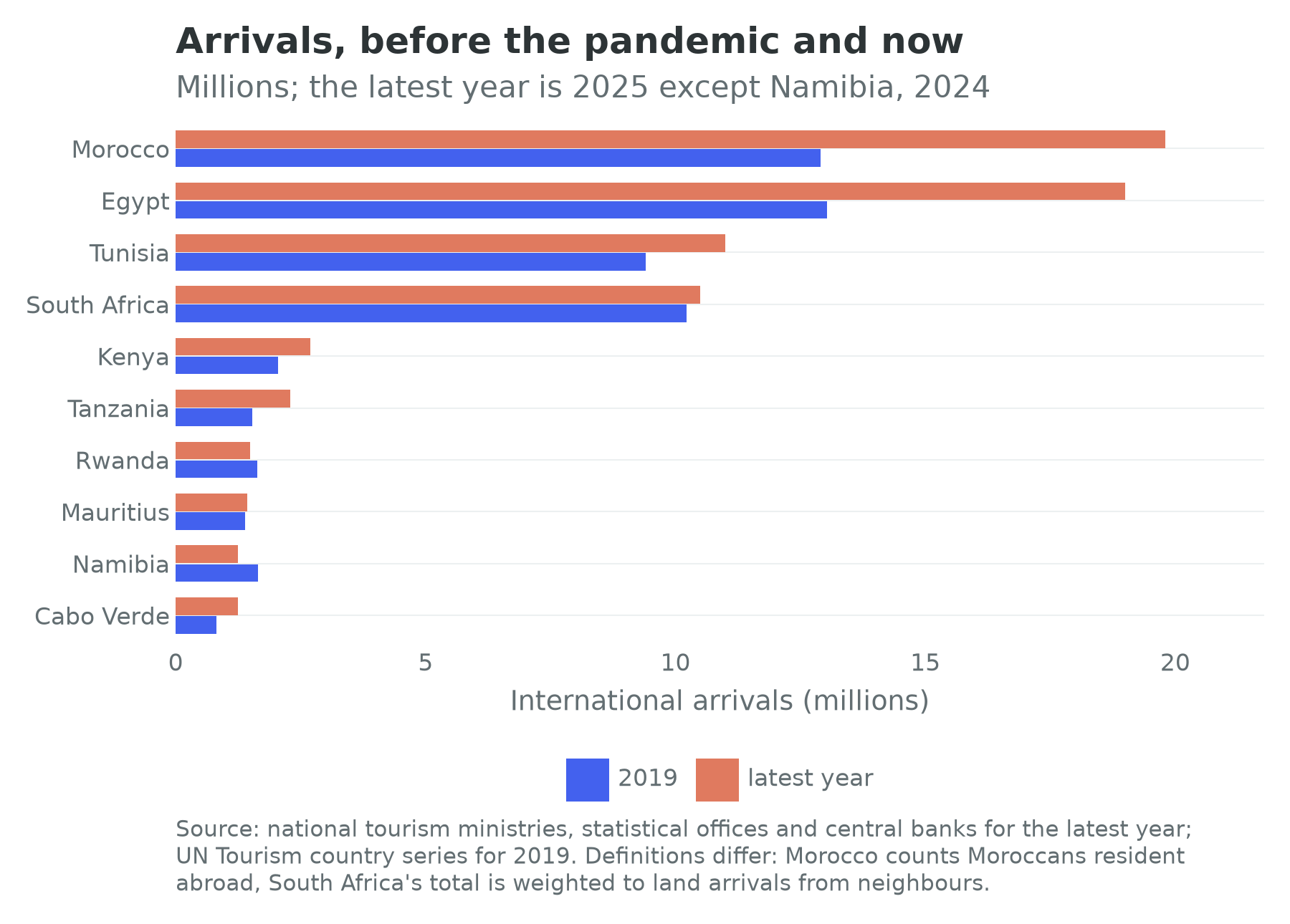
The North African beach and heritage complex is the largest by volume and the least discussed in the development literature. Morocco received 19.8 million arrivals in 2025 (El Masaiti, 2026) and Egypt about 19 million (State Information Service, 2026), between them nearly half the continental total, while Tunisia passed 11 million for the first time (APA News, 2025). This is a mass-market industry of package holidays and coastal resorts, with a heritage layer in the medinas and the monuments of Luxor and Giza. Chapters 27 and 28 own the two poles; the sector point is that these are the only African destinations at European scale, and their economics are those of the all-inclusive package: high volume, low yield, large leakage.
The East African safari circuit is the highest-yield mass segment on the continent. Tanzania received 2,294,495 international visitors in 2025 and earned 4.41 billion dollars from them, at an average spend of 289 dollars per person per night (Bank of Tanzania, 2026); Kenya received about 2.7 million and Rwanda 1.49 million (Tourism Research Institute, 2026; Rwanda Development Board, 2026). Tanzania earns from 2.3 million visitors roughly a quarter of what Egypt earns from 19 million (Bank of Tanzania, 2026). Yield, not volume, is the East African model.
The Southern African circuit is safari plus city plus a long-haul market slower to return. South Africa recorded 10.5 million overnight arrivals in 2025, 2.6 percent above 2019 (Statistics South Africa, 2026), although a large share is land arrivals from neighbours. Namibia is the clearest non-recovery on the continent, at 1.25 million arrivals in 2024, still roughly a quarter below 2019 (Ministry of Environment, Forestry and Tourism, 2025). Botswana’s high-value Okavango model has no comparable recent public series at all, which is a data-quality finding rather than a policy one.
The islands are the most tourism-dependent economies in Africa and the smallest. Mauritius received 1,436,250 arrivals in 2025 (Statistics Mauritius, 2026); Cabo Verde 1,248,052 visitors (Instituto Nacional de Estatística, 2026); the Seychelles 354,034 through week 47 of 2025 (Seychelles, National Bureau of Statistics, 2026). Here tourism is not one industry among several but the economy itself, and the pandemic was not a downturn but a solvency event.
The creative geography is tighter. Film concentrates in Lagos, Cairo and Ouarzazate; music in Lagos, Johannesburg and Accra; television in Cairo, which supplies the Arabic-speaking world with its Ramadan drama season and is the only African production centre with a captive market in its own language. Nairobi and Kigali are the newcomers, built on conference and production infrastructure rather than a domestic audience. The Growth Pole Map’s tourism layer carries the heritage sites, the destination hubs and these production clusters as separate categories, because they are separate industries.
5. Workforce
Gender. Hospitality is one of the largest formal employers of women in the developing world, and in Africa the gap it addresses is enormous: Egypt’s male employment ratio exceeds its female ratio by 51.7 percentage points and Morocco’s by 44.7, against a continental median gap of 11.8 points. Chapter 10 showed that North Africa’s middle term is largely a question about women’s participation, so a sector hiring women into wage jobs at scale where the gaps are widest is doing something no other sector in Part III can claim. It also hires them into the lowest grades and rarely into management.
Seasonality and the informal fringe. The largest quality defect in tourism employment is that the work stops: a Mediterranean resort staffs up in May and down in October, a safari camp works the dry season. Seasonal work is real employment on the international definition and it is not a career, and the identity’s second term cannot see the difference. Every formal job also sits beside several informal ones, and in Kenya and Tanzania, where informality runs at 86.5 and 90.8 percent of employment, the visible tourism economy is a thin formal crust on an informal base. That fringe is unusually productive by informal standards, because its customer pays hard currency, and unusually fragile, because the customer stops coming at once.
Youth, and the awkward fact. The three safari economies of Southern Africa have the worst youth idleness on the continent: Botswana records 38.0 percent of young people not in employment, education or training, South Africa 34.6 and Namibia 31.9, against Tanzania’s 12.8. A high-yield, low-volume model is a good foreign-exchange earner and a small employer, and the countries that have run it hardest have the largest cohorts of young people with nothing to do. Yield per visitor and jobs per visitor pull against each other.
Skills. Certifications do not travel and the ladder is short, which is why Chapter 20’s mobility question lands here. In the creative economy the constraint is technical: Africa is short of colourists, sound engineers, editors and line producers, the craft base a foreign production leaves behind if it stays long enough. That is the theory of the Ouarzazate complex.
6. Regulation and policy
The visa. The African Development Bank’s index of visa openness scores every country on how easily other Africans can enter it, and the 2025 reading is a warning. The combined score fell to 0.445, below each of the three previous years, even though visa-free travel scenarios rose to 814, the highest ever recorded and 28.2 percent of all intra-African pairs, and 31 countries, 57 percent of the continent, now offer an electronic visa to Africans against nine in 2016 (African Development Bank and African Union, 2026). A composite falling while the visa-free count rises is a continent moving in both directions at once, and it means the cheapest tourism policy available to an African government remains largely untaken.
The air-service agreement. The Single African Air Transport Market was meant to do for aviation what the free-trade area is meant to do for goods. Thirty-eight states have signed the solemn commitment and twenty-six have signed memoranda of implementation, together covering more than 80 percent of African air traffic (International Civil Aviation Organization, 2026). Yet fares stay high, routings stay indirect, and airlines still negotiate traffic rights city pair by city pair with governments that have signed. Signing an instrument is policy supply; implementing it against a protected national carrier is policy demand, and Chapter 7’s framework covers the case.
The park fee. Park pricing is where an African government most clearly acts as a monopolist. A Rwandan gorilla permit costs 1,500 dollars for an international visitor and about 500 for a citizen of an East African Community state, after the price was doubled in 2017 (Rwanda Development Board, 2026). The strategy is explicit: raise the price, cap the visitors, capture the surplus that was going to tour operators. Gorilla tourism generated 248 million dollars in 2025, 71.4 percent of leisure-tourism revenue, and total tourism revenue reached 685 million dollars against 498 million in 2019, on 1.49 million visitors against 1.63 million (Rwanda Development Board, 2026). Fewer visitors, more money. In employment terms Rwanda’s card gives the answer the sector should want: a second term of 0.65 percent a year, fourth highest of the 53 cards, on a between-sector productivity component of 3.43 percentage points a year, the second largest of the 21 countries the transformation database covers, against a within-sector component of only 0.17. The gains came almost entirely from moving people between sectors rather than from firms getting better. Chapter 31 reads the settlement behind it; the sector point is that a high-price tourism strategy is a reallocation strategy, and reallocation is what Rwanda’s arithmetic shows.
Its marketing counterpart is the sponsorship. Rwanda’s tourism board has bought advertising with European football clubs since 2018 and reports that tourism revenue rose 17 percent to 498 million dollars in the partnership’s first year (Rwanda Development Board, 2026). Treat that as the board’s claim rather than an estimate: there is no counterfactual, and the same years carried a permit price rise. What can be said is that a country of 14.3 million bought recognition in Europe at a price a tourism ministry could afford.
Film incentives and classification. The cash rebate does most of the work, and Morocco has the continent’s most effective one: 30 percent of qualifying local spend refunded to foreign productions, which with desert locations, crews and a two-hour flight from Europe has made it the largest foreign-production location in Africa. Foreign productions spent 1.21 billion dirhams, symbol DH, there in 2025 on the film centre’s own accounting, about 121 million dollars, while a figure of 1.5 billion dirhams for the same year circulates in the trade press (Centre Cinématographique Marocain, 2026; Variety, 2026). The state has committed a further 240 million dirhams to a production complex at Ouarzazate, on the theory that the way to capture more of a shoot is to keep it in the country longer (Variety, 2026). Classification is the other side of the same instrument: Nigeria’s censors board classified 1,088 films in 2024 and 1,185 in 2025, the only audited count of Nollywood’s output that exists (Daniel, 2026), and every larger number in circulation estimates a system whose lower tiers never present a film for classification.
Copyright. The last instrument would move creative incomes most and has moved least. A functioning collecting society converts public performance into a royalty stream; a contested one converts it into a lawsuit. Until it works, African music’s domestic earnings will be live performance and sponsorship, and its recorded earnings will arrive from abroad.
7. Recent trends
The recovery is complete and unevenly distributed, with beach and heritage destinations recovering faster than long-haul safari ones, because a charter seat is cheap and a Johannesburg connection is not. Receipts recovered faster than arrivals, which matters more. Egypt earned a record 16.7 billion dollars in tourism receipts in its 2024/25 fiscal year, a 56.1 percent increase and 3.7 percent of GDP (Arab Finance, 2026); Morocco collected a record 112 billion dirhams, about 11.3 billion dollars, in tourism receipts in 2024, 43 percent above 2019 (Ministry of Tourism, Handicrafts and Social and Solidarity Economy, 2025). Prices rose, stays lengthened, and the mix shifted towards higher-spending markets, which is what every African tourism ministry says it wants.
Gulf capital arrived, and it buys coastline. The largest tourism transaction in African history is the Ras El Hekma agreement, in which an Abu Dhabi sovereign fund agreed to pay 24 billion dollars for development rights to 170 square kilometres of Egyptian coast (ADQ, 2024). Chapter 27 argues about what that means for Egypt’s balance sheet; the sector observation is narrower. The largest capital flows into African tourism now come from the Gulf and buy land rather than operate hotels, which is Chapter 25’s enclave pattern transplanted to a beach.
The streaming money arrived and then partly left. Between 2016 and 2023 Netflix and Amazon commissioned African originals at a scale nobody had seen, paying full production costs and training crews. Then it stopped: Amazon cut African commissioning in January 2024, and from November 2024 Netflix stopped commissioning new Nigerian originals, though it denies exiting the market, with currency depreciation and production-cost inflation the reasons most often given (Semafor, 2024). A commissioning budget is not a market. It is a corporate capital-allocation decision made in another country and revised annually, and it can be withdrawn without anything having changed in Lagos except the exchange rate.
The music went the other way, and the number is still small. Recorded-music revenues in Sub-Saharan Africa rose 15.2 percent in 2025 to 120 million dollars, with South Africa 78.1 percent of the regional total, while global recorded-music revenues passed 30 billion dollars (IFPI, 2026). Sub-Saharan Africa, with a sixth of the world’s people, is four tenths of one percent of the world’s recorded-music market, in the decade its music became famous. The Grammy academy created a category for African music performance for the 2024 ceremony, first won by the South African artist Tyla, and Burna Boy, Wizkid and Tems fill arenas in cities where nobody speaks their first language. None of it shows up in the regional revenue line, because when a Nigerian artist signed to a global label is streamed in Berlin the revenue is booked where it was earned. Africa’s music is a large export and a small industry.
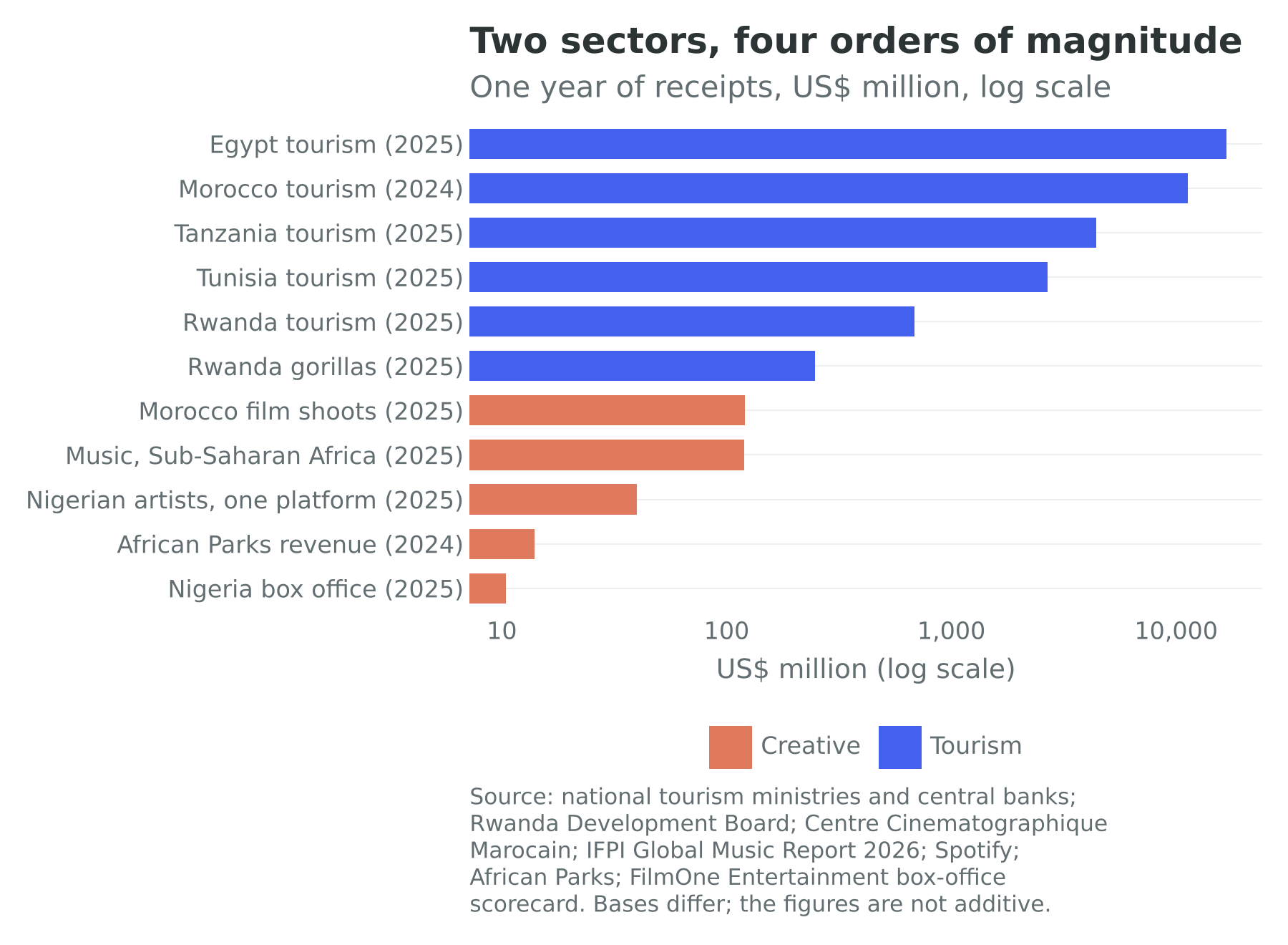
The most-quoted numbers are the least counted. The World Travel and Tourism Council, with Oxford Economics, puts travel and tourism at 228 billion dollars of African GDP in 2025, 7.0 percent of the regional total, supporting 30.2 million jobs (World Travel and Tourism Council, 2026). Those figures are used everywhere, including by finance ministries, and should be quoted with their construction attached: they are total contributions, direct plus indirect plus induced, built from an input-output model rather than counted, and such models overstate a sector’s impact where its share is largest.
8. Climate exposure
Tourism sells the thing climate change is destroying, which makes this section short to write and hard to read.
The reefs go first. The Red Sea coast of Egypt and the reefs of Zanzibar, Mauritius and the Seychelles are the physical asset behind the diving and beach segments, and bleaching is a function of sea-surface temperature. The Red Sea’s corals are unusually heat-tolerant; the western Indian Ocean’s are not, and repeated bleaching since 1998 has changed what a diver sees. A resort whose principal amenity is a reef holds a depreciating asset, and nothing in its balance sheet says so.
The safari ecosystems run on rain. Wildlife tourism depends on migrations that are functions of rainfall, and the East Africa droughts of the 2020s killed wildlife as well as livestock. Chapter 29 carries the drought argument for the Ethiopian highlands and Chapter 11 for agriculture; the tourism point is that a safari product is a promise about animals in a place at a time. The conservancy model is exposed twice, because a household whose herd dies is under pressure to convert wildlife land to something that pays this year.
Heat moves the season and water binds the islands. A summer in Luxor or Sharm El Sheikh above the human comfort threshold does not destroy the monuments; it shifts Mediterranean and Red Sea tourism towards spring and autumn, which for a seasonal worker means a longer, thinner year. A tourist also consumes several times the water of a resident, and Cabo Verde, the Seychelles and the Moroccan south run their tourism on desalination, groundwater or both. Chapter 28 calls Moroccan desalination industrial policy; on a small island it is starker, because the resort and the town draw on the same aquifer and the resort can pay more.
And the sector’s own emissions are the argument against it. Long-haul aviation is the largest carbon component of an African holiday and it is not marginal. The counter-argument, which this book finds persuasive but not conclusive, is that the emissions are the visitor’s and the income the host’s, that no other export sector transfers as much value per tonne of carbon to a low-income country, and that a carbon price on aviation without a compensating transfer would tax the poorest destinations hardest. Chapter 34 carries the argument in full.
9. Firm profiles
African Parks
African Parks is not a firm in the ordinary sense, which is why it is the right profile. It is a non-profit, founded in 2000, that signs long-term management contracts with African governments to run their national parks, taking delegated authority over management, law enforcement, tourism concessions and finance while the state retains ownership. It manages 24 protected areas in 13 countries covering more than 20 million hectares, and reported park revenue rising 13 percent to more than 14 million dollars in 2024 on about 230,000 visitors (African Parks, 2025). Fourteen million dollars across an area the size of Senegal is not a commercial return: the organisation is funded overwhelmingly by philanthropy. A handful of famous parks earn real tourism revenue and the rest are public goods financed by transfer.
The institutional argument is this book’s real interest. A management contract is a partial, voluntary transfer of state capacity to a specialist operator, with a defined term and measurable outputs, in exactly the domain where Chapter 5’s vocabulary predicts the state will be weakest: a remote area, a low-value constituency, an enforcement problem and revenue that is easy to capture. The critique is serious, since authority over territory is contracted to an organisation accountable to foreign donors and communities beside these parks have not always consented to how boundaries are enforced. The model’s spread is evidence about what African states find hard rather than about what non-profits do well. It employs exactly the people term two cares about, rangers, trackers and camp staff in districts where the alternative is subsistence agriculture, and at continental scale it is tiny.
TPS Eastern Africa, operating as Serena Hotels
The Aga Khan Fund for Economic Development’s hotel arm, listed in Nairobi, is the clearest African-owned answer to the question of who profits from African hospitality. It runs city hotels, safari lodges and resorts across Kenya, Tanzania, Uganda, Rwanda, Mozambique and Zanzibar, and it publishes accounts, which in this sector is a distinction. Revenue reached 10.19 billion Kenyan shillings, symbol KSh, in 2024, up 5.18 percent, with profit after tax of 1.32 billion shillings, helped by an exchange gain (TPS Eastern Africa, 2026). Then the first half of 2025 arrived: revenue down 11 percent to about 4 billion shillings and a net loss of 15.9 million shillings against a profit of 696 million a year earlier, which management attributed to the protests across Kenya that summer (TPS Eastern Africa, 2026).
That sequence is the profile. A well-run regional group with owned property and a diversified geography swung from a strong year to a half-year loss because of political events that had nothing to do with hotels. Tourism is the sector in which a country’s politics are priced instantly and by foreigners, and every argument here about its employment virtues must be read against that volatility, because a payroll is a fixed cost and a booking is not.
Mavin Records, with EbonyLife and FilmOne
Mavin, founded in Lagos in 2012 by the producer Michael Collins Ajereh, known as Don Jazzy, is the label behind Rema and Ayra Starr. In February 2024 Universal Music Group agreed to acquire a majority stake, with the founder retaining leadership; terms were not disclosed, but the price was reported in the 150 to 200 million dollar range (Billboard, 2024). As a success story it is unambiguous: a label built in Lagos on Nigerian talent created enough value in twelve years that the largest music company in the world bought it. As a balance-sheet event it is the pattern of this whole book, a foreign firm buying a claim on future African cultural output, paid in dollars today, with the revenue booked where the streams occur; Chapter 21 calls this the ownership question, and it applies to a catalogue as it applies to a copper mine. As an employment story it is nothing at all: a label of this size employs tens of people, and the industry’s employment sits in studios, video crews and events companies, almost none of it visible in the wage-employment overlay of a country whose wage share is 13.6 percent, fifth lowest of the 53 cards.
The screen side shows the same strategy from the other end. FilmOne distributes, exhibits and produces, and its box-office reporting is the closest thing Nigeria has to an industry statistic; EbonyLife, founded by Mo Abudu, produces television and film, runs the highest-grossing cinema in anglophone West Africa, which the trade press reported at 838.7 million naira in 2024, and planned a cultural venue in London for the end of 2025 (Anya, 2025). Nollywood’s response to a 10 million dollar theatrical market (Udugba, 2026) has been vertical integration at home and a search for hard currency abroad. The London move is that strategy made physical, and a reminder that an export industry whose customers are all abroad has its fortunes set abroad.
10. What the evidence says
Four studies, and what they cannot answer
There is no randomised evaluation of a tourism strategy and there never will be, because governments do not randomise their coastlines. The evidence here is quasi-experimental and bounds the argument rather than settling it.
Tourism does raise local incomes, on the best available identification. Faber and Gaubert (2019) studied Mexico’s coastal resorts, using variation in natural beach and reef endowments to instrument for where tourism developed, and found large long-run effects on local employment and wages, with positive spillovers into manufacturing through demand linkages rather than the crowding-out the Dutch-disease story predicts. That is the strongest evidence that tourism is a development strategy rather than a rent, and it is about a country with a manufacturing base and a working domestic supply chain. Whether the mechanism operates where the vegetables are imported is the open question, and Chapter 11 explains why it might not.
Paying people not to cut trees works, and it is cheap. Jayachandran, de Laat, Lambin, Stanton, Audy and Thomas (2017) randomised payments for ecosystem services across 121 villages in western Uganda. Deforestation on treated land ran at roughly half the control rate over two years, with no evidence of displacement, and the delayed emissions were worth more than twice the programme’s cost. That is the cleanest evidence that conservation payments change behaviour at a price a state could afford, and the microeconomic foundation under the conservancy model in Section 2. What it does not establish is durability: whether the trees stand when the payments stop is what the conservancies are a twenty-year experiment in.
Cash reaching a rural economy multiplies, which is how a park fee should be judged. Egger, Haushofer, Miguel, Niehaus and Walker (2022) measured the general-equilibrium effect of large cash transfers across Kenyan villages and recovered a local fiscal multiplier of about 2.5. A conservancy lease, a park-fee share and a wage bill are all cash arriving in a thin rural economy. It also warns that when tourism stops the same multiplier runs backwards.
The pandemic was the natural experiment nobody wanted. In 2020 demand went to approximately zero everywhere at once, and the tourism-dependent islands took the largest output losses in Africa. The episode tells us the size of the exposure and not the counterfactual growth path, because everything else moved at the same time.
Nothing here supports the claim that tourism is a transformation strategy in Chapter 9’s sense. Everything supports the modest claim that it employs low-skilled labour where there is no alternative, which is what term two is about.
11. Data sources
- UN Tourism: the World Tourism Barometer for continental arrivals, and the country series behind the 2019 baseline in this chapter’s arrivals file.
- National tourism ministries, statistical offices and central banks: latest-year arrivals and receipts, cited individually. The Bank of Tanzania’s visitor exit survey is the best, being a survey rather than an administrative count.
- World Travel and Tourism Council with Oxford Economics: total contribution to GDP and employment, quoted only with the method named. African Development Bank, Africa Visa Openness Report: the openness score. International Civil Aviation Organization: status of the single air-transport market. UNESCO World Heritage Centre, national park authorities and tourism boards: the site coordinates behind this chapter’s map layer.
- IFPI, Global Music Report: recorded-music trade revenue for Sub-Saharan Africa. Spotify reporting for country payouts and streams, which covers one platform and is not a market total.
- Nigeria’s National Film and Video Censors Board for classified titles and FilmOne Entertainment’s annual box-office scorecard, compiled from Comscore data, for box office, the only two audited series in the African screen sector; the Centre Cinématographique Marocain for foreign-production spend.
- Company and organisation reporting: African Parks, TPS Eastern Africa, EbonyLife, Kenya Airways and the disclosure on Mavin. Country cards: the identity terms, the overlays, informality and the data-quality fields. The cards carry no sector fields, and
balance_sheet.exports_top3counts merchandise only, so services such as tourism never appear in it; every sector number here comes from a named source.
12. Exercises
Connections to other chapters
- Chapter 6 (The Informal Economy) owns the informal fringe around every formal tourism job, and Chapter 10 (Labor, Youth, and Migration) the overlays Sections 1 and 5 read.
- Chapter 7 (The Regional Architecture) supplies the policy-supply-against-policy-demand framing Section 6 applies to the air-transport market; Chapter 17 (Digital and Telecoms) the platform argument that decides how much of a royalty reaches an African artist; Chapter 19 (Trade and Logistics) the services trade in which tourism receipts are recorded.
- Chapter 26 (Nairobi and Mombasa) carries the East African hub and its airline; Chapter 27 (Cairo and Suez) Egyptian tourism receipts as a rent stream and the Ras El Hekma transaction; Chapter 28 (Casablanca and Tangier) Morocco’s World Cup build-out and its water constraint; Chapter 29 (Addis–Djibouti: The Landlocked Industrializer) Ethiopian Airlines and the drought exposure of the East African ecosystems; Chapter 31 (Where the State Is Thin) Rwanda’s settlement, inside which the gorilla-permit strategy sits.
- Chapter 34 (Climate Finance) carries the aviation-emissions and adaptation-finance arguments Section 8 raises and does not settle.
Discussion questions
Tourism receipts arrive as foreign exchange and leave as imported inputs, management fees and repatriated profit. Design a measurement of net receipts a finance ministry could implement, and explain why almost no African country publishes one.
Rwanda charges 1,500 dollars for a gorilla permit and earned more from fewer visitors in 2025 than in 2019 (Rwanda Development Board, 2026). Botswana runs the same model and records 38.0 percent of its young people not in employment, education or training. Argue that yield maximisation is the right tourism policy for a small African state, then argue the opposite, and say what evidence would decide between them.
Sub-Saharan Africa’s recorded-music market was worth 120 million dollars in 2025, in the decade its music became globally famous (IFPI, 2026). Explain how both facts can be true at once, using the distinction between where a service is produced and where its revenue is booked, then say what would have to change institutionally for the second number to look more like the first.
Try it
Open the three cards side by side: the Seychelles, Rwanda and Botswana, three tourism economies of different kinds. Read the identity block first and notice that the Seychelles has no second or third term at all; then the overlays, where Rwanda has the strongest employment ratio and Botswana the worst youth idleness. Write one paragraph on a single question: which of the three has the best tourism strategy, and which piece of evidence on the cards, rather than in this chapter’s prose, is doing the most work in your answer? Then open the Growth Pole Map, switch on the tourism layer, and switch on the confidence toggle. The layer carries the heritage sites, destination hubs and production clusters this chapter names; the toggle hatches the countries whose numbers will not carry the weight. Say what a reader loses when a sector’s geography is described in prose rather than plotted.
Data exercise
Download all fifty-four cards from the country cards page on this site, as cards.csv or as cards.json if you want the release each number came from travelling beside it, and take this chapter’s arrivals file from the same page. Build a table with identity.employment_to_wa_growth, overlays.wage_employment_share, overlays.youth_neet, scale.gdp_per_capita, scale.population and data_quality.confidence_flag. Then do three things. First, reproduce Figure 18.1 and confirm the correlation between the wage share and the second term across the 53 cards carrying both, then recompute it for the twelve countries of Table 18.1 alone. Second, join the arrivals file to the cards, compute arrivals per head, rank the twelve, and say which you would call tourism-dependent on the evidence rather than on reputation. Third, list every field in Table 18.1 that is null for the Seychelles and say what a reader may conclude about the most tourism-dependent economy on the continent. Treat nulls as missing, never as zeros.
Further Reading
- Richard Newfarmer, John Page and Finn Tarp, eds., Industries without Smokestacks (2018), for the framing this chapter belongs to: tourism and the creative sector as tradable, labour-intensive services.
- Iain Christie, Eneida Fernandes, Hannah Messerli and Louise Twining-Ward (2014), Tourism in Africa, still the most complete account of the sector’s supply chain and its employment coefficients.
- Katherine Homewood, Patti Kristjanson and Pippa Chenevix Trench (2009), eds., Staying Maasai?, for the livelihoods evidence underneath the conservancy model, and the KAZA Secretariat on transfrontier conservation (KAZA Secretariat, 2015).
- The IFPI Global Music Report and the annual platform payout disclosures, read together and sceptically: one is a market measurement and the other a firm’s marketing.