5. States, Political Settlements, and Development Bargains
Learning Objectives
After reading this chapter, you should be able to:
- Define a political settlement, a rent, a deals environment and a development bargain precisely enough to use them on a named country, and say which question each of the three frameworks answers that the other two do not.
- Describe how rents are actually distributed in African economies, through public employment, licences and foreign exchange, land, and public contracts, and say which of the identity’s three terms each mechanism moves.
- Explain what the neopatrimonialism literature claimed, why Mkandawire’s objection to it matters for anyone doing empirical work on this continent, and what developmental patrimonialism is a name for.
- Read structural adjustment, the Africa Rising decade and the seizures of power since 2020 as settlement changes rather than as policy episodes.
- Use the cards’ data-quality fields as direct evidence about state capacity, and state what a coding of settlements against the identity can and cannot show.
Prior work: the Rwandan sequencing case used here as one instance of a growth settlement, security first, then administration, then property adjudication, then a market strategy, is set out at length in the companion volume, The New Regional Economics, chapter 12 (Wilse-Samson, 2026). This chapter cites it rather than repeating it.
The governments of the 36 African countries in the continental revenue statistics collected, on average, on the order of 16 percent of their output in tax in 2022, against more than 30 percent across the rich democracies (OECD, African Union Commission and ATAF, 2024). That is the aggregate. The mechanism is easier to see one city at a time. In Kananga, a provincial capital of about a million people in the centre of the Democratic Republic of the Congo, the provincial government levied a property tax on every household, and before a team of researchers helped it knock on doors, 0.1 percent of households paid it (Weigel, 2020). Not one in ten. One in a thousand.
Neither number is a story about laziness or venality, and reading them that way is the first mistake this chapter is written to prevent. A state that collects a tenth of what a European state collects is not a European state performing badly. It is a different kind of organization, built for different purposes, resting on a different distribution of power, and the useful question is not why it fails to behave like something it is not, but what it is actually doing and for whom.
This chapter supplies the vocabulary for that question, and it is the vocabulary that every growth-pole chapter in Part VI uses. Mushtaq Khan’s political settlements explain why the same written rule is enforced in one capital and ignored in the next. Lant Pritchett, Kunal Sen and Eric Werker’s Deals and Development explains what an economy looks like when it runs on deals rather than rules, and why growth accelerations are so often changes in the deals rather than in the law. Stefan Dercon’s development bargain asks the blunt question Chapter 4 adopted as its test: has this country’s elite bet on growth, or on dividing what already exists?
Where the chapter sits in the identity is worth stating first. GDP growth is approximately the growth of output per worker, plus the growth of the employment-to-working-age ratio, plus the growth of the working-age population, and all three are growth rates. Term one is not a political variable in any useful sense: no settlement decides how many people were born twenty years ago. Terms two and three are almost entirely political, in that everything which makes a worker more productive or gets her into paid work runs through a decision somebody with power had to take and enforce. The last part of this chapter sorts the 54 countries by the kind of settlement they have and reads the cards for each group. The answer is uncomfortable, and Chapter 10 has to carry it.
What a state is here
Start with the physical problem. Jeffrey Herbst’s argument is that African states were built to solve one European states never faced: populations small relative to land, land expensive to cross, and therefore enormous costs of broadcasting authority from a capital to a periphery. The result was a long history of polities that controlled cores and negotiated with peripheries rather than administering them, and a colonial and then a post-colonial state that inherited the same geography with the same arithmetic (Herbst, 2000). Map any African state’s revenue collection and the territory where its writ reliably runs, and you will not get a shaded polygon. You will get a capital, a port, a mining district, and the roads between them.
The colonial state made that worse in a particular way. Crawford Young describes an apparatus built for extraction and command, with a thin administrative core and a coercive edge, handed over intact at independence to the nationalists who had campaigned against it (Young, 1994). Mahmood Mamdani names the specific inheritance: a bifurcated state, in which a small urban population were citizens under civil law and the rural majority were subjects under a customary authority that colonial administrations had licensed, and often invented, to govern them cheaply and at a distance (Mamdani, 1996). The chiefs in Chapter 22’s land argument and in this chapter’s tax experiments are that institution, still in place, still holding information about who lives where that no ministry has.
Frederick Cooper gives the resulting state its most useful name. It was and is a gatekeeper state: an apparatus with very little capacity to transform the society it governs and very good control of the interface between that society and the world economy, which is to say the port, the customs post, the export licence, the foreign-exchange account and the concession contract (Cooper, 2002). Everything a gatekeeper state can do, and everything worth fighting over inside it, sits at that gate. This is why control of the state is not one prize among many but the prize: the state is where the economy’s tradable surplus passes through. It is also why taxes on international trade still supply on the order of a fifth of tax revenue across the region, against low single digits in rich countries (OECD, African Union Commission and ATAF, 2024). The gate is still the cheapest place to collect.
Pierre Englebert supplies the last piece, which explains why states that cannot administer their territory persist anyway. African states hold something valuable that has nothing to do with capability: international legal sovereignty, a seat, a central bank, a right to borrow, a right to sign a mining contract. That juridical status is a resource, and it accrues to whoever holds the capital. A ruler whose income comes from recognition rather than from taxing production has a weak incentive to build the machinery that would tax production, and a strong incentive to stop anybody else being recognized (Englebert, 2009). Chapter 31 shows what that looks like in the Central African Republic, where security is bought from outside and paid for in concessions.
Two cautions. None of this says African states are alike: Ken Opalo’s work on legislatures shows that institutional variation across the continent is very large and mostly unexamined, because the comparative literature treated African legislatures as decorative and never asked why some acquired real capacity and others did not (Opalo, 2019). The variation is the subject; the average is a distraction. And a thin state is not the same as no state. Somalia has had no effective central government for most of thirty-five years and has a functioning mobile-money and international money-transfer industry, because private orders arose where the public one did not. Order and the state are different things, and confusing them is how outside observers repeatedly misread what is in front of them.
Three vocabularies
The three frameworks answer three different questions, which is why this book uses all of them. Khan asks what a country’s institutions rest on. Pritchett, Sen and Werker ask how business actually gets done under those institutions. Dercon asks what the people with power have decided to do with the whole arrangement.
Khan: institutions have to fit the power
A political settlement is the distribution of organizational power among a society’s elites and their followers, together with the institutions that distribution can sustain (Khan, 2010; Khan, 2018). “Organizational power” is the operative phrase. It is not wealth and not formal office. It is the capacity of a group to organize, to impose costs, to disrupt, and therefore to have to be paid attention to: a party machine, a union, a regional bloc with a claim on the army, a business association, governors who control the votes in a federation, a militia.
The central claim follows from one observation about enforcement. Institutions are not self-executing. Enforcing a rule against a group with real organizational power costs resources the state may not have, and the group can resist. So an institution survives only if the distribution of benefits it produces is tolerable to the groups able to disrupt it. Write a rule that would cost a powerful group more than it can be compensated for, and either the rule is not enforced or it is enforced and the settlement breaks. Both happen constantly. This answers the question that puzzles anyone who reads African statute books: why the same well-drafted anti-corruption law, procurement code or land-registry statute is a live instrument in one capital and a dead letter three hundred kilometres away. The text is identical. The power underneath it is not.
Khan’s typology of clientelist settlements turns on how strong the factions excluded from the ruling coalition are, and how strong the lower levels are inside it. Four configurations recur in this book.
- A dominant party settlement has weak excluded factions and weak lower levels: the leadership can enforce a decision downward and need not buy off a rival bloc. Tanzania, under a party in office since independence, is the type case, and Chapter 26 reads it as one. Its advantage is time horizon: a leadership that expects to be there in fifteen years can invest a rent rather than distribute it.
- Competitive clientelism has strong excluded factions and strong lower levels: two or more organized coalitions alternate, each with a patronage network to pay, and neither can commit beyond an electoral cycle. Ghana is the clearest African instance, and Chapter 24 shows its fiscal cycle following its electoral one with a regularity no technical reform has broken. Zambia, in Chapter 30, is the copper version.
- A weak dominant party has weak excluded factions and strong lower levels: a centre facing no rival that cannot make its own machine do what it says. A great deal of implementation failure attributed to capacity is this.
- A vulnerable authoritarian coalition has strong excluded factions and weak lower levels: a centre that can command downward while under threat from outside the coalition, and which therefore has a short horizon and buys support with whatever is liquid.
The typology’s practical use is that it predicts what a reform will meet. In a dominant-party settlement the question is whether the leadership wants it; under competitive clientelism, whether it survives the next election; in a vulnerable authoritarian coalition, whether the government will still be there.
A rent is any income above what the resource would earn in its next-best use: a licence, a monopoly, a subsidy, a below-market allocation of foreign exchange or land, an above-market public contract, a protected job. The word carries a pejorative charge in ordinary economics and should not carry one here. Rents are how every industrializing state has financed its industrialization, including all four of the Asian cases Chapter 9 tests. The question is never whether there are rents. It is whether they are conditioned on anybody producing anything, which is the discipline Chapter 9 calls export performance, and which is what separates a Korean subsidy from an import licence.
Pritchett, Sen and Werker: deals, not rules
Khan describes a structure. The second framework describes what sitting on that structure feels like to a firm, and it is the one the pole chapters use most.
A firm in a low-income economy does not face rules, in the sense of general provisions applied impersonally to whoever meets them. It faces deals: particular arrangements with particular officials, in which what happens to your consignment, licence, tax assessment or land title depends on who you are and what has been agreed (Pritchett, Sen and Werker, 2018). The deals environment is the standing character of those arrangements, and it varies on the two dimensions this book uses as its main political-economy axes.
The first is ordered against disordered. In an ordered deals environment a deal struck today is honoured tomorrow: the official who made it can deliver, and his successor will not reopen it. In a disordered one the deal is only as good as the last conversation, and the firm buys the same permission repeatedly. Order is not honesty. A thoroughly corrupt system can be highly ordered, with a known price and reliable delivery, and firms will invest in it; a clean-on-paper system in which nothing can be relied on is disordered, and they will not.
The second is open against closed. In an open environment, entry to the valuable deals is available to a firm that turns up with a good project. In a closed one, access is rationed by connection, and a newcomer can be very successful in the space the incumbents leave and can never enter the space they occupy. This is the dimension Douglass North, John Wallis and Barry Weingast were pointing at with limited-access orders, and a closed order is stable precisely because the incumbents’ rents depend on limiting entry (North, Wallis and Weingast, 2009).
Cross the two and you get the grid this chapter codes with. Ordered and open is the closest thing to a rules economy. Ordered and closed has produced a large share of the growth episodes in the historical record and very few of the political ones: contracts hold, policy is predictable, and the club is not accepting members. Chapter 27 reads Egypt as about as ordered and as closed as a middle-income economy gets, Chapter 28 reads Morocco the same way, Chapter 24 reads Côte d’Ivoire’s post-2011 settlement as ordered and closed, and Chapter 29 says the same of Djibouti and of Ethiopia before 2018. Disordered and open is the frustrating quadrant, entry possible and nothing holding, which is Chapter 26’s reading of Kenya. Disordered and closed is the worst of both, and Chapters 30 and 31 read the Democratic Republic of the Congo that way.
The framework’s real contribution is dynamic. Growth accelerations, in this reading, are usually changes in the deals rather than in the rules, which is why they are so badly predicted by cross-country regressions on institutional indices: the index measures the law, and the law did not move. It is also why growth episodes end without anything visible breaking. The deals stopped being honoured, and no gazette recorded it.
Dercon: the bargain
A development bargain is an agreement among the people who actually have power, whether or not they hold formal office, to pursue growth and development rather than to divide the pot that already exists (Dercon, 2022). It has three parts that fail separately. The elite has to want growth, in the specific sense of being willing to lose something for it. The state has to be able to deliver something. And somebody has to be willing to gamble, which is Dercon’s title and his point: development strategies are bets under uncertainty, most of the specific policies will be wrong, and what distinguishes the countries that get somewhere is a willingness to correct rather than to defend.
Three things the test is not. It is not a test of democracy: Dercon’s most uncomfortable finding, which Chapters 24 and 26 restate, is that betting on growth is not a bargain to share power, and the two are separable in both directions. It is not a test of good institutions, usually answered by looking at outcomes and calling them causes. And it is not a claim about intentions, because rhetoric is free. The evidence is the budget and the moments when a government had to choose. Chapter 4 set out the questions, and they recur pole by pole: does public investment go into things that raise the traded output of somebody who is not politically connected, or into things that can be allocated? When an exporter and a domestic rent-holder want opposite decisions, who wins, and how often? Is there a policy the government has held to across a change of minister, at a visible cost to a constituency it needed?
The three fit together in a sequence. The settlement is the structure and it changes slowly. The deals environment is how that structure feels to a firm and it can change in a year. The bargain is a decision taken inside the structure about what the whole arrangement is for. A country can have a closed settlement and a growth bargain, which is Rwanda. It can have an open settlement and no bargain, which is this chapter’s reading of several of the continent’s better democracies. And it can have a bargain and no capability, which is the hardest case of all, because the will is there and nothing can be delivered.
How rents are actually distributed
Frameworks are cheap. What makes this one useful rather than decorative is that the distribution of rents runs through a small number of identifiable mechanisms, each of which can be watched. Four carry most of the weight.
Public employment. In most African countries the state is the largest formal employer and public pay the largest discretionary item in the budget: wage bills run on the order of 6 percent of output and something like a quarter to a third of government spending (International Monetary Fund, 2026f). A public job is the cleanest rent there is, because it is divisible, renewable, geographically targetable and visible to the recipient’s whole family. In identity terms it flatters term two and depresses term three: adding public employees raises the employment ratio and lowers output per worker unless the employees do something. Which is why fiscal programmes and settlement politics collide so predictably. A hiring freeze is a line in a table and a rupture in a patronage network, and the second is why so many freezes are announced and not observed.
Licences and foreign exchange. The gatekeeper state’s characteristic instrument is a permission that is worth money: an import licence under a quota, a fuel allocation, a telecommunications licence, a mining permit, a customs classification, and above all an allocation of foreign exchange at an administered rate when the market rate is very different. That last has been the largest single rent in several African economies of the last two decades. When the official and parallel rates diverge, whoever receives dollars at the official rate has been handed the difference, and the size of the gift is a matter of public record. Chapter 8 works through the monetary side and Chapter 24 through Nigeria’s, where unifying the exchange-rate windows in 2023 abolished a rent so large that the reform is still the central political fact of the country. Robert Bates made the same argument a generation earlier about agricultural marketing boards, which bought crops below the world price and spent the difference on urban food and industrial favours (Bates, 1981). The instrument changes; the structure does not.
Land. Land is the rent growing fastest, because urbanization is making it valuable at a pace no other asset matches. In much of the continent the state holds the freehold or an authority holds it in trust: Ethiopia’s constitution vests all land in the state and the people, and Nigeria’s Land Use Act vests it in the state governors. Wherever that is the arrangement, converting peri-urban land from customary use to serviced plots is an administrative act, and the difference between the two values goes to whoever the official names. Chapter 22 carries the full argument, and every pole chapter’s megaproject section is partly a story about who got the land around it.
Public contracts. Procurement matters more than its accounting share because it shapes what a state builds. A settlement that distributes rents through contracts prefers projects that are large, visible, financeable and awardable, which is to say stadiums, airports, capital cities and roads that end at ribbons, over projects that are small, dispersed and hard to allocate, which is to say maintenance, extension services, teacher supervision and the rules under which a firm hires its fifth employee. Chapter 28 makes that observation about a state very good at delivering deadlines with ribbons. The bias is not corruption in the narrow sense; it is what a rent-distributing settlement finds legible.
Two things follow for the identity. All four mechanisms are better at moving term three’s composition than its level: they decide who gets the investment, not whether it raises productivity. And none of them requires a labour force. A rent from a licence, a mine, a land conversion or a contract is captured without employing anyone, which is where the last section of this chapter ends up.
Neopatrimonialism, and why Mkandawire’s objection matters
The dominant academic vocabulary for African politics for about thirty years was neopatrimonialism: the idea that African states combine a formal-legal apparatus with a patrimonial logic in which authority is personal, office is a private resource, and the ruler binds a clientele by distributing state assets. Bayart’s The State in Africa gave the mode its most vivid name, the politics of the belly, and it captured something real about how power is exercised and how ordinary people talk about it (Bayart, 1993). Chabal and Daloz pushed it to the limit, treating disorder itself as a political instrument rather than a failure (Chabal and Daloz, 1999).
Thandika Mkandawire’s 2015 critique is why this book does not build on that vocabulary, and it is a methodological lesson rather than a territorial complaint (Mkandawire, 2015). It has three parts. The concept has no variance and therefore no explanatory power: if every African state is neopatrimonial, neopatrimonialism cannot explain why Botswana grew at Asian rates while its neighbours did not, or why one country grew for a decade and then stopped. The literature also ran the inference backwards, explaining growth failures by neopatrimonialism while the evidence for neopatrimonialism was very often the growth failure; when African economies grew quickly in the 2000s the framework had nothing to say, and its adherents mostly did not revisit it. That is the shape of an unfalsifiable claim. The third objection is substantive and lands hardest. Patronage, personalized authority and the private use of office are not African peculiarities but features of most states at most income levels, including the ones that industrialized. Korea’s developmental state ran on rents distributed by a personalized authority to favoured conglomerates. What made it developmental was not the absence of patrimonial features but the presence of a discipline: the rents were conditioned on export performance. Mkandawire’s earlier essay makes the constructive version, that the African developmental state was declared impossible on a very short and very unusual sample, and that the conditions under which African states were asked to develop, debt crises and imposed adjustment above all, would have defeated the East Asian states too (Mkandawire, 2001).
What replaces it is the vocabulary above, plus one hybrid term the pole chapters use. Developmental patrimonialism, named by David Booth and Frederick Golooba-Mutebi from the Rwandan case, is the arrangement in which rents are centralized rather than dispersed and managed over a long horizon by a leadership that expects still to be there, so that they are invested rather than distributed (Booth and Golooba-Mutebi, 2012; Kelsall, 2013). The mechanism is the party-owned holding company taking anchor positions in sectors where domestic capital is absent. It is patrimonial in Bayart’s sense and developmental in Studwell’s, and the two are not in contradiction, which is precisely Mkandawire’s point. Chapters 26 and 31 read Rwanda that way, with Filip Reyntjens’s standing counter-account beside it.
Two more terms belong here. State capacity in this book means something narrow and testable: the ability of a state to know what is happening on its territory and to act on it, which in practice means to register, to count, to collect and to enforce. It is not state size and not good policy. And a development bargain is distinct from and downstream of the political settlement: the settlement says what is enforceable, the bargain says what the enforceable power is being used for.
What the numbers are made of, again
Chapter 1 treated the census vintage, the rebase year, the labour-force-survey year and the statistical-capacity score as a data-quality layer. Read the other way, they are the cleanest available measures of state capacity in the narrow sense just defined. A census is a state finding every person on its territory and writing them down. There is no more basic act of administration, and a country that has not performed it in forty years is telling you something about itself that no governance index measures as directly.
Eleven of the 53 countries with a recorded census year last counted before 2010, and 34 of the 54 have run a labour-force survey within five years. The median statistical-capacity score across the 53 cards carrying one is 61.7, and only twelve reach 70.
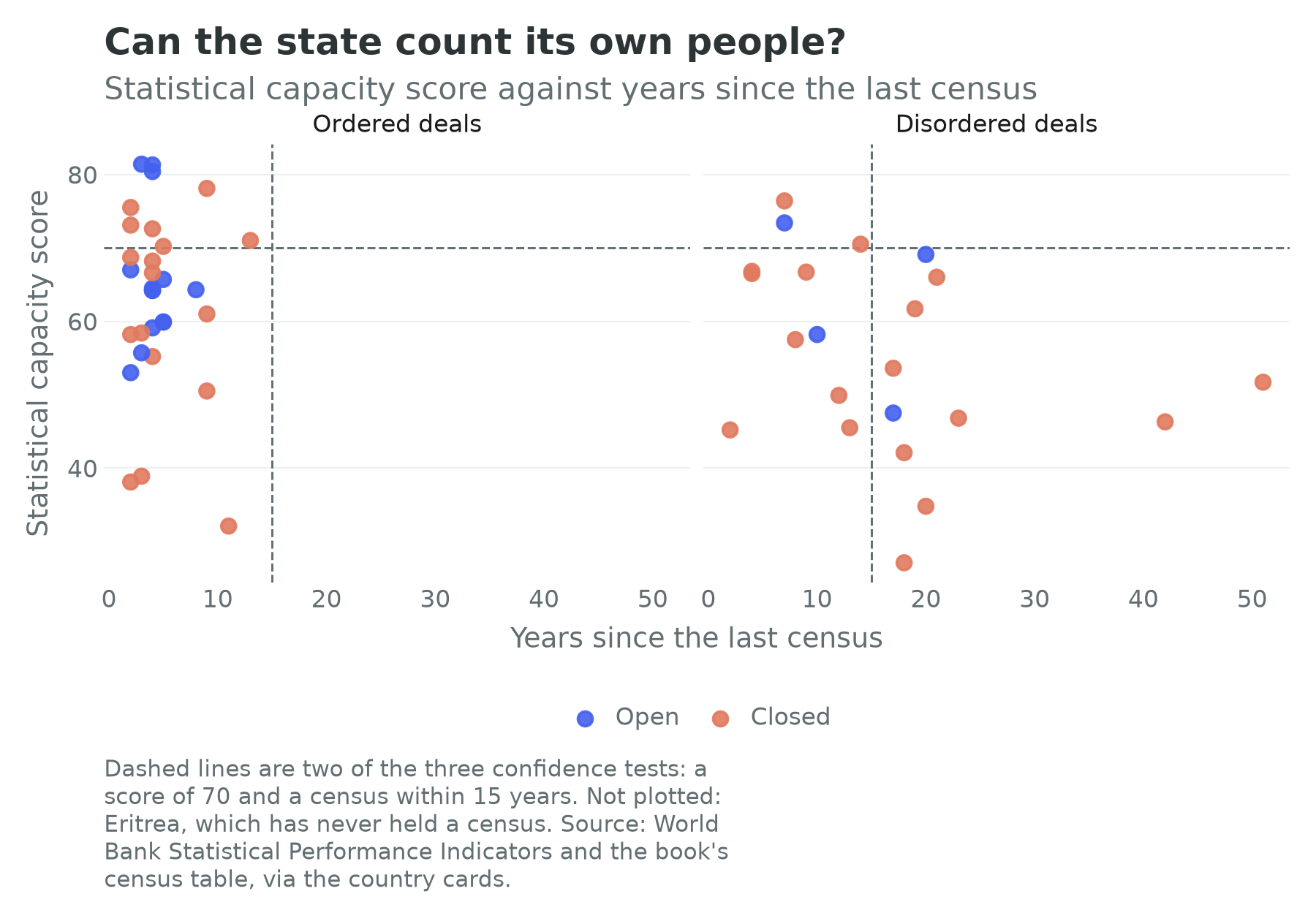
Figure 5.1 is the argument in one picture. Every country this chapter codes as having an ordered deals environment has counted its people within about thirteen years; the whole right-hand end of the census axis, the countries that last enumerated fifteen, twenty, forty or fifty years ago, is drawn from the disordered group. The median statistical-capacity score among the eighteen countries coded disordered and closed is 52.7, against 66.6 among the eighteen coded ordered and closed and 64.3 among the fourteen coded ordered and open, and nine of those eighteen last counted before 2010.
Part of that is mechanical: a country in a civil war does not run a census, so some of the correlation is a definition. The more interesting point is that statistical capacity is not simply a function of income. Across the 53 cards carrying both, the score correlates with the logarithm of income per head at only 0.12. Senegal outscores Gabon by a wide margin on a fifth of the income, and Equatorial Guinea, with one of the continent’s highest incomes per head, scores 32.1. Counting your people is a choice a poor state can make and a rich one can decline to make, and which happens is a fact about the settlement.
Episodes, not conditions
Morten Jerven’s methodological complaint about the growth literature is that it modelled African performance as a chronic condition to be explained when it was a sequence of episodes to be dated (Jerven, 2015). Read as episodes, the two events that dominate the continent’s recent economic memory are settlement stories rather than policy stories, and reading them the other way is how both were misunderstood.
Structural adjustment. The Berg report of 1981 diagnosed African stagnation as a problem of policy: overvalued currencies, taxed farmers, bloated parastatals, protected industry (World Bank, 1981). The diagnosis was substantially right about the policies, and the programmes that followed nonetheless produced a decade and a half of very poor outcomes. Nicolas van de Walle’s account of why is a settlement account rather than an economic one. Governments implemented the parts of the package that were cheap for the ruling coalition, devaluation and price liberalization, and did not implement the parts that were expensive for it, civil-service retrenchment, privatization of the enterprises that employed clients, and dismantling the licence system (van de Walle, 2001). The result was neither adjustment nor the status quo but a partial-reform equilibrium that persisted for years, because it was compatible with the distribution of power in a way full implementation was not. That is Khan’s argument in its purest form, and Mkandawire and Soludo’s contemporaneous African critique made the same structural point from the other direction: the reforms were designed as though the state were a machine to be re-tuned rather than a settlement to be renegotiated (Mkandawire and Soludo, 1999).
Africa Rising. Chapter 4 covers the decade and the hangover. The settlement reading adds one thing. What changed after 2000 was, in many countries, not the rules but the deals: civil wars ended, currencies stabilized, external debt was cancelled, and commodity prices rose, so that governments could pay their coalitions without taxing production and firms could rely on arrangements holding for more than a season. That is a movement toward ordered deals, and it produced exactly the acceleration the framework predicts. What it did not produce was a change in access, and Chapter 4’s counter-case is legible in that gap: an economy whose deals become reliable but not open gets investment in the incumbents’ sectors, which raises output per worker somewhat and employs very few people. Ndulu and his co-authors had already sorted the earlier record into recurring growth syndromes rather than a single condition, state controls, adverse redistribution, unsustainable inter-temporal choices and state breakdown, with a residual category of syndrome-free periods that grew respectably (Ndulu et al., 2008; Collier and O’Connell, 2008). The finding that matters here is that the syndrome-free periods were not the periods with the best institutions on paper. They were the periods when the settlement was not doing one of those four specific things.
What the growth settlements bought, and what each cost
Four settlements are cited in every discussion of African growth, and Chapter 9 tests them against the recipe. What belongs here is what each was as a political arrangement and what it cost, because a book that quotes only the successes is doing the thing Chapter 1 warned against.
Botswana. A cattle-owning elite that already dominated the economy took control of a state whose one asset turned out to be diamonds, negotiated a fifty-fifty arrangement with the mining company rather than nationalizing or being captured, and then, decisively, put the proceeds through a budget and a stabilization fund rather than through a presidency (Acemoglu, Johnson and Robinson, 2003). The settlement was narrow, ordered and unusually disciplined, and it held because the elite’s own wealth sat in cattle and land rather than in the state. The cost is visible in the identity: output per worker fell at 0.11 percent a year over the decade to 2024, the economy is still a diamond economy, and unemployment is among the highest in the world. Botswana solved the resource curse and did not solve diversification.
Mauritius. James Meade’s 1961 report predicted Malthusian failure for a densely populated sugar monoculture with a fast-growing population and communal tensions (Meade, 1961). What happened instead was an export processing zone from 1970 that let the sugar oligarchy invest outside sugar without redistributing sugar, a franchise extended to the whole population, and a settlement that included the unions rather than suppressing them (Subramanian and Roy, 2003). The cost was a long dependence on textile quotas that eventually expired. Its working-age population now shrinks at 0.24 percent a year, the arithmetic of a completed transition.
Rwanda is developmental patrimonialism, read in full in Chapters 26 and 31. It bought the continent’s second-highest observed growth rate over the decade, 6.72 percent a year, on output per worker growing at 3.26 percent and one of only six employment ratios rising by more than half a percentage point a year. The costs are a closed politics, a regional policy that has cost the country sanctions and a border, and an unpriced succession risk, since a settlement built on one leadership’s horizon has no mechanism for the moment that horizon ends.
Ethiopia to 2018 is the case Dercon uses most and the one supplying his hardest qualification, having advised the government he writes about. A coalition under the effective control of one party ran an explicitly Asian developmental model: land in state ownership, the commanding heights held by state enterprises and party endowments, public investment at a share of output among the highest in the world. It produced the continent’s fastest output-per-worker growth, 5.91 percent a year, and its sharpest fall in the employment ratio, minus 1.58 percent a year. The cost was the settlement itself: a coalition that concentrated power in order to deliver growth could not survive the political opening of 2018, and the war that followed destroyed much of what had been built. Chapter 29 carries it. The lesson is not that the bargain was fake, but that a bargain resting on an exclusionary settlement is a bet on that settlement holding, and settlements have to be renewed.
Settlement change since 2020
Between 2020 and 2023 soldiers took power in Mali twice, in Guinea, in Sudan, in Burkina Faso twice, in Niger and in Gabon, and in Chad the army installed the late president’s son at the head of a transitional council; power has since been seized again in Madagascar in October 2025 and in Guinea-Bissau in November 2025 (Associated Press, 2025). Eleven seizures in nine countries in six years, or ten if Chad’s army-managed dynastic succession is excluded as some trackers exclude it, on a continent where the coup had been widely declared obsolete.
The temptation is to read this as a security story with economic consequences. The settlement reading is better, and it has three parts.
Most of these were adjustments inside the existing elite rather than revolutions. In the Sahel the armies that took power were the same armies the previous governments had failed to pay, equip or protect, and their grievance was about the terms on which the coalition operated. In Gabon the officers who removed a presidency in August 2023 came from inside the presidential guard, and their leader was subsequently elected to the office he had taken. That is a redistribution of organizational power inside a narrow coalition, and it predicts what has followed: a change in who receives the rent, not in what the rent is for.
The changes also have external content. The three Sahelian states that left the West African community, formed their own alliance and completed the exit in January 2025 did something to their economies that no domestic reform could have done in the time available, since a landlocked economy’s transit arrangements are its trade policy (Usman, 2025). Chapter 7 carries the regional architecture and Chapter 36 the Sahel.
The third part is the one this book keeps returning to. Chapter 2 established that the belt running from the Atlantic to the Red Sea is where the identity’s first term runs fastest and its other two are least measurable, and Chapter 10 found that eight of the fourteen countries where a falling employment ratio met a fast-growing working-age population have not run a labour-force survey in five years. A settlement whose object is survival does not count its people, does not run a survey and does not build the port. The seizures of power are therefore not exogenous to the economics: they are the mechanism by which the states with the largest demographic task acquire the least capacity to perform it. Elections have moved the same way where no soldier moved at all. Chapter 24 records Benin’s politics narrowing as its economy grew, Chapter 26 records Tanzania’s opening and closing again, Chapter 30 records Angola’s succession reallocating a rent without opening access. Across all of them the deals have become somewhat more ordered and no more open, which is the configuration the next section prices.
What the cards say when settlements are sorted
The country cards carry no governance field, and this book is not going to invent one. What follows is the chapter’s own coding, applied to all 54 countries and set against the identity terms the cards do carry. It is this book’s reading and not a measurement, and it is published in full so that a reader who disagrees with a row can move it and recompute. Two questions produce it. Is the deals environment ordered, meaning that an arrangement struck with the state today is likely to be honoured in three years, or disordered? Is it open, meaning that a firm with a good project and no political connection can reach the valuable deals, or closed? Where a pole chapter in Part VI has already coded a country, the table follows it.
| Deals environment | Countries |
|---|---|
| Ordered and open (14) | Botswana, Cabo Verde, Ghana, Liberia, Malawi, Mauritius, Namibia, São Tomé and Príncipe, Senegal, Seychelles, Sierra Leone, South Africa, The Gambia, Zambia |
| Ordered and closed (18) | Algeria, Angola, Benin, Comoros, Côte d’Ivoire, Djibouti, Egypt, Equatorial Guinea, Eritrea, Eswatini, Mauritania, Morocco, Republic of the Congo, Rwanda, Tanzania, Togo, Tunisia, Uganda |
| Disordered and open (4) | Guinea-Bissau, Kenya, Lesotho, Nigeria |
| Disordered and closed (18) | Burkina Faso, Burundi, Cameroon, Central African Republic, Chad, Democratic Republic of the Congo, Ethiopia, Gabon, Guinea, Libya, Madagascar, Mali, Mozambique, Niger, Somalia, South Sudan, Sudan, Zimbabwe |
Table 5.1: the chapter’s coding of the deals environment, following Pritchett, Sen and Werker (2018). This is the book’s reading, not a measurement, and each row is an argument rather than an observation. The disordered group holds 57.4 percent of the continent’s population and produces 33.5 percent of its output.
Two features are worth pausing on before the medians. The disordered half is not a periphery: it holds more than half the continent’s people and a third of its output, and it contains Nigeria, Ethiopia and the Democratic Republic of the Congo, three of the four largest populations on the continent. And the disordered-and-open cell has four members, which is a finding rather than a coding accident: openness without order is unstable, and its occupants are either very small or very large and all, in their different ways, hard to govern.
| Group | Countries | Term one | Term two | Term three | Wage employment (percent) | Median income per head ($) | Median statistical score | Confidence: high / medium / low / unrated |
|---|---|---|---|---|---|---|---|---|
| Ordered and open | 14 | 2.57 | -0.14 | 0.25 | 38.7 | 3,678 | 64.3 | 3 / 5 / 6 / 0 |
| Ordered and closed | 18 | 2.67 | 0.03 | 1.54 | 44.9 | 2,830 | 66.6 | 5 / 10 / 2 / 1 |
| Disordered and open | 4 | 2.92 | -0.43 | 0.68 | 29.7 | 1,267 | 63.7 | 1 / 1 / 2 / 0 |
| Disordered and closed | 18 | 3.19 | -0.32 | 0.70 | 17.3 | 929 | 52.7 | 2 / 4 / 10 / 2 |
| All 54 | 54 | 2.89 | -0.15 | 0.74 | 31.0 | 1,678 | 61.7 | 11 / 20 / 20 / 3 |
Table 5.2: medians by group. The first three columns are annual growth rates in percentage points over 2014 to 2024: term one is the working-age population aged 15 to 64, term two is modelled employment aged 15 and over divided by that population, term three is output per worker. Each median is taken column by column and is not a country. Sources: UN World Population Prospects 2024, ILOSTAT modelled estimates (November 2025), the IMF World Economic Outlook (April 2026), and the World Bank Statistical Performance Indicators, via the country cards. The grouping is the book’s coding.
The second coding is Dercon’s own question, applied country by country: has the elite bet on growth, on dividing what exists, or is the answer not yet in? Where Dercon names a case the coding follows him, with Ethiopia and Rwanda as elites that bet on growth, Nigeria, Malawi and the Democratic Republic of the Congo as elites that did not, and Kenya left open (Dercon, 2022). Everything else is this book’s reading, taken from the pole chapters where they exist. Ten countries are coded as having bet on growth: Benin, Botswana, Cabo Verde, Côte d’Ivoire, Ethiopia, Mauritius, Morocco, Rwanda, Seychelles and Tanzania. Twenty-seven are coded as having bet on division and seventeen as unresolved.
| Bargain coding | Countries | Term one | Term two | Term three | Observed growth | Wage employment (percent) | Median statistical score |
|---|---|---|---|---|---|---|---|
| Bet on growth | 10 | 2.54 | 0.11 | 2.02 | 4.95 | 59.1 | 69.2 |
| Unresolved | 17 | 2.94 | -0.14 | 0.22 | 3.40 | 35.1 | 59.9 |
| Bet on division | 27 | 2.94 | -0.19 | 0.48 | 2.52 | 24.3 | 54.4 |
Table 5.3: medians by the chapter’s reading of the development bargain. Growth rates are annual, in percentage points, over 2014 to 2024. Sources as in Table 5.2. Six of the 54 readings follow Dercon (2022) where he names the case; the other 48 are the book’s own, and each is an argument rather than an observation.
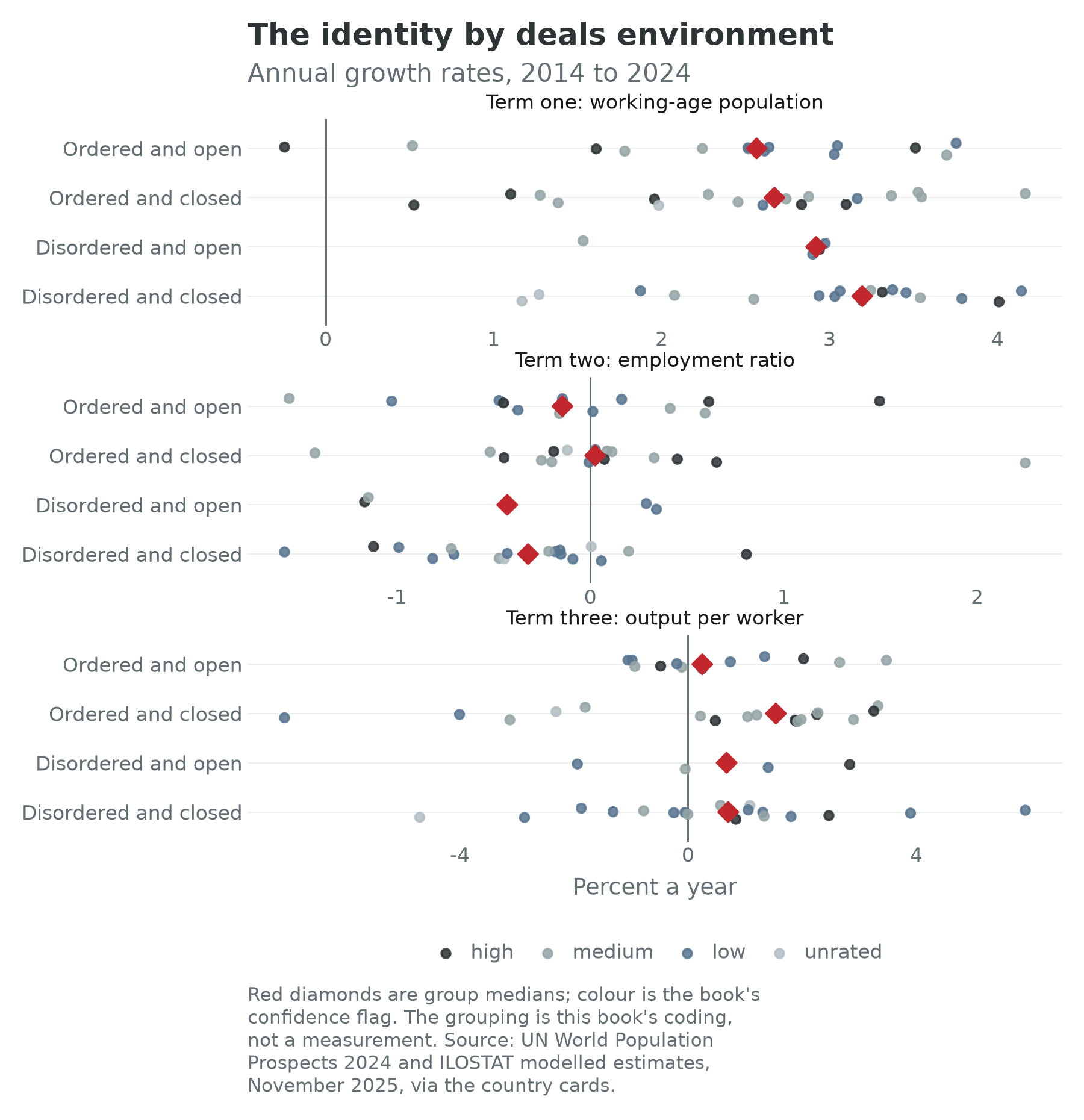
Read the three tables together, because the finding is in the comparison of columns rather than in any one of them.
Term three separates the groups, and by a lot. Across the four deals quadrants the median output-per-worker growth rate runs from 0.25 percent a year to 1.54, a spread of 1.29 percentage points, and across the three bargain groups from 0.22 to 2.02, a spread of 1.80. The ten countries coded as having bet on growth posted a median term three nearly three times the continental median of 0.74. The data-quality fields show the same thing: statistical capacity correlates with term three at 0.49 across the 52 cards carrying both, so the continent’s productivity growth over the decade sat disproportionately in the states that can count their own people.
Term two does not separate them at all. Across the four quadrants the median employment ratio moves from minus 0.43 to plus 0.03, and across the three bargain groups from minus 0.19 to plus 0.11: spreads of less than half a percentage point, with every median sitting within half a point of zero. Statistical capacity, which predicts term three at 0.49, predicts term two at 0.04, which is nothing. The countries this chapter codes as having the best settlements and the countries it codes as having the worst converted their demographic inheritance into employment at almost exactly the same rate, which is to say at no rate at all.
That is Chapter 10’s central finding arriving five chapters early, and this chapter should hand it over rather than pretend to have discovered it. Good settlements bought productivity and did not buy jobs. A reader who wants it properly qualified, with the survey coverage, the wage-employment overlay and the fourteen countries where a falling ratio met a fast-growing working-age population, should read Chapter 10, which does the work.
Four caveats, because a coding this crude deserves them.
Causation is not settled by anything here. A settlement may produce productivity growth; productivity growth may make a settlement look ordered; and an observer who knows a country grew is likelier to code its politics generously. This coding was written against the pole chapters rather than against the growth data, which helps a little and does not solve it.
Composition does much of the work. The ordered-and-closed group holds Egypt, Morocco, Côte d’Ivoire and Rwanda, four of the continent’s better-run economies on any measure, and it also holds Eritrea and Equatorial Guinea. The ordered-and-open group’s low term-three median of 0.25 is partly the arithmetic of containing South Africa, Namibia and Zambia, whose productivity fell over the decade for reasons Chapters 25 and 30 attribute to mining and to electricity rather than to democracy.
The result is uncomfortable and should be stated rather than softened. On this coding, over this decade, closed settlements outperformed open ones on productivity: a median term three of 1.05 across the 36 countries coded closed against 0.25 across the 18 coded open. That is Dercon’s corollary, that a bargain to bet on growth is not a bargain to share power, in continental aggregate. It is one decade and a crude coding, and a reader is entitled to be suspicious of a finding this convenient for authoritarians. Hiding it would be worse, and the point of publishing the coding is that somebody can now argue with it.
And the data-quality layer cuts against the whole exercise. Ten of the eighteen countries in the disordered-and-closed group carry a low confidence flag and two cannot be rated at all, against two low flags in the ordered-and-closed group. The group whose numbers this chapter would most like to trust is the group whose numbers are worst, and the direction of the resulting bias is not known.
What the experiments say: can state capacity be built, and by whom?
Four randomized studies bear on the narrow definition of state capacity used here, and together they mark out what this literature can and cannot answer.
Taxation makes citizens. Weigel (2020) randomized a door-to-door property-tax campaign across 356 neighbourhoods of Kananga, in the Democratic Republic of the Congo. Compliance rose from 0.1 percent in the control group to 11.6 percent where the campaign ran: a very large proportional change and a very small absolute one, and the combination is the finding. What followed matters more. Political participation rose by about 5 percentage points, roughly 31 percent, as taxed citizens became likelier to attend town-hall meetings and to evaluate official performance, and they revised their beliefs about what the province collected and what it owed them. The fiscal contract, usually asserted from European history, was observed. Chapter 31 uses the same result at the level of a thin state.
Local information is the constraint, not local honesty. Balán, Bergeron, Tourek and Weigel (2022) ran the complement, randomizing whether the same campaign was collected by central state agents or by local city chiefs. Collection by chiefs raised compliance by about 3 percentage points, from 6.3 percent under central collectors to 9.5, and raised revenue by about 44 percent. They also collected more bribes. The compliance gain came from information: the chiefs knew which households could pay. That is Khan’s argument in experimental form, and Mamdani’s customary authority doing what the ministry cannot.
Incentives inside a bureaucracy move revenue and not much else. Khan, Khwaja and Olken (2016) randomized performance pay for property-tax collectors across the tax circles of Punjab, in Pakistan, over two years, and found revenue about 9.4 log points higher in the incentivized circles than in controls after two years. The gain came from a small number of properties reassessed at their true value rather than from a broader base. Most properties paid no more tax and reported higher bribes, and taxpayer satisfaction did not improve. The comparison matters because Punjab’s tax administration is far denser than any in this chapter’s disordered group: even where the machine exists, sharpening its incentives raises collections without changing what the machine is.
Building institutions from outside does not take. Casey, Glennerster and Miguel (2012) evaluated a community-driven development programme across Sierra Leone under a pre-analysis plan written before the data arrived, which is why the result is credible. The programme delivered the public goods it was funded to deliver and left no durable change in local institutions or in who made decisions. Chapter 31 reports the eastern Congolese replication of the same finding.
What these can answer is whether a specific administrative constraint is real and movable, and all four say yes. What they cannot answer is the question this chapter is about. None of them changes a political settlement, and a campaign that lifts property-tax compliance to 11.6 percent has demonstrated a mechanism, not financed a road. The gap between what can be demonstrated and what would have to be delivered is the honest shape of the evidence base under any chapter on the state.
Settlements in two worlds
Chapter 1 asked every chapter to say what its subject becomes if the frontier of production stops needing workers. For this chapter the answer is the sharpest in the book, because the political-settlement lens already has the vocabulary for it.
In the labour-abundant world the settlement question and the growth question are connected by employment, and the connection runs both ways. An elite that wants growth needs its population to work, because that is where output comes from; and a population that works acquires organizational power, because a wage-earning class can withdraw its labour, organize and demand. That is why Chapter 10 argues that employment is what makes a growth bargain self-enforcing: an elite that grows the economy through wage employment cannot easily choose who benefits, while an elite that grows it through resource rents can choose precisely. The hopeful reading of this book’s bet depends on that mechanism. As the workers arrive they become a faction with power, and settlements have to accommodate factions with power.
In the labour-redundant world the mechanism is gone, and the lens says exactly what replaces it. Every one of the four rent mechanisms above, licences, land, contracts and the gate, is captured without employing anyone. Rents from sun, minerals, land and carbon are easier to capture than rents from a labour force, because a solar farm does not strike, a cobalt concession does not vote, and a carbon credit does not have to be paid a wage. An elite that does not need its population in order to produce has no economic reason to strike a bargain with it, and Chapter 13’s account of the resource curse describes that configuration inside one sector. The labour-redundant world generalizes it to the whole economy.
Three consequences follow, and each makes a later chapter more important than it currently looks. The settlement question becomes the entire distribution question, because if income no longer arrives through wages it arrives through whatever the settlement decides to transfer, which is Chapter 23’s subject and a fiscal problem in economies whose informality leaves almost no payroll to tax. State capacity in the narrow sense used here, knowing who lives where and being able to collect from them, becomes more valuable rather than less, because a transfer system is exactly a register plus a payment rail, and Kananga’s door-to-door campaign is the thing that has to work. And the countries whose settlements are already organized around dividing a rent, 27 of the 54 on this chapter’s coding, turn out to have been running a preview.
The honest position is Chapter 1’s. Nobody knows which world arrives, and this chapter proceeds in the first. But a reader should notice that the frameworks here were built to explain a world in which elites bargain with people who produce things, and that they describe, without modification, a world in which elites no longer have to.
Connections to Other Chapters
- Chapter 4 (The Case and the Counter-Case) states the development-bargain test this chapter builds into a framework, and its fifth objection, that the settlement itself is failing, is the section on seizures of power here.
- Chapter 6 (The Informal Economy) is the other half of what a thin state means: firms and workers outside the state’s register are outside its taxation, its regulation and its statistics.
- Chapter 10 (Labor, Youth, and Migration) carries the finding this chapter hands over, that settlements sort countries by productivity and not by employment, and reads the middle term country by country with the survey coverage attached.
- Chapter 21 (Capital and Sovereign Debt) is where the balance-sheet consequences of a settlement land: what a government borrowed, what for, and who is asked to pay when it cannot.
- Chapters 24 to 31 (the growth poles) each open their fourth section with this vocabulary and apply it to one pole, which is where the country-level texture lives.
- Chapter 32 (China in Africa) is the largest single external input into African settlements over the last two decades, because a lender that does not condition on domestic governance changes what a ruling coalition has to concede to get money.
- Chapter 36 (What Could Go Wrong) carries the Sahel, the coups belt and the failure modes at length.
Discussion Questions
This chapter codes 36 of the 54 countries as having closed deals environments, and reports that their median output-per-worker growth over the decade to 2024 was more than four times that of the 18 coded open. Give the strongest argument that this is a real relationship, then the strongest argument that it is an artefact of the coding, the decade or the composition of the two groups. Then say what evidence, observable before 2035, would distinguish them.
Mkandawire’s objection to neopatrimonialism is that a property shared by every case cannot explain differences among them. Apply the same test to this chapter’s own framework. Is “the elite bet on growth” vulnerable to the same objection, given that the bet is usually inferred from the growth? Propose one piece of evidence, observable before the growth outcome is known, that would make the test falsifiable, and say what it would cost to collect for all 54 countries.
A finance minister has budget for one of two things: a national census, or a programme that would raise the employment ratio by a quarter of a point for three years. This chapter argues that the census is a direct measure of state capacity, and Chapter 10 argues that the employment ratio is where the book’s thesis lives. Make the case for each, then say whether your answer depends on which of Chapter 1’s two worlds you think is arriving.
Try It
Open the three cards side by side: Rwanda, Ghana and the Democratic Republic of the Congo, in that order. This chapter codes them as ordered and closed with a growth bargain, ordered and open with the bargain unresolved, and disordered and closed with the bargain unresolved. Read down the three identity terms, then down the four data-quality fields, then open the Growth Pole Map and switch on the confidence toggle. Write one paragraph on a single question: which of the differences between these three countries, in the identity or in the data quality, would you have predicted from the settlement descriptions alone, and which one surprised you? Then say whether the surprising one is evidence against the coding or against the numbers.
Data Exercise
Download all fifty-four cards from the country cards page on this site, as cards.csv if you work in a spreadsheet or cards.json if you want the release each number came from travelling beside it. Build a table with six columns: identity.working_age_pop_growth, identity.employment_to_wa_growth, identity.output_per_worker_growth, data_quality.spi_overall_score, data_quality.last_census_year and scale.gdp_per_capita. Then do four things. First, reproduce Table 5.2 by joining this chapter’s coding to the cards and taking the median of each identity term by group, then recompute after dropping the three largest economies in each group. Second, compute the correlation between data_quality.spi_overall_score and each of the three identity terms, and write two sentences on why the answers for term two and term three differ so much. Third, recode at least five countries where you disagree with the chapter, write your reason for each in one line, and recompute: say whether the term-three spread survives your recoding and whether a term-two spread appears. Fourth, drop every country whose data_quality.confidence_flag is low or unset, recompute everything, and write two sentences on whether the chapter’s central claim survives being restricted to the countries whose numbers can be trusted. Note which fields are null rather than zero, and never impute a null as a zero.
Data Sources and Further Reading
Key data sources
- The country cards for every identity term, income and data-quality field quoted here: UN World Population Prospects 2024 (medium variant, ages 15 to 64) for term one, ILOSTAT modelled estimates (November 2025) for terms two and three and the wage-employment overlay, the IMF World Economic Outlook (April 2026) for output and income per head, and the World Bank Statistical Performance Indicators with the book’s census and survey table for the data-quality layer.
- The chapter’s own coding of the deals environment and the development bargain, published in Tables 5.1 to 5.3 and offered as an argument rather than as a measurement.
- OECD, African Union Commission and the African Tax Administration Forum, Revenue Statistics in Africa, for tax-to-GDP ratios and the composition of tax revenue; IMF, Regional Economic Outlook: Sub-Saharan Africa, for public wage bills.
- ACLED for the record of seizures of power and their dates, and Afrobarometer for what citizens report about the state that the state does not report about itself.
Further reading
- Mushtaq Khan, “Political Settlements and the Governance of Growth-Enhancing Institutions” (2010) and “Political Settlements and the Analysis of Institutions” (2018), for the framework at its source.
- Lant Pritchett, Kunal Sen and Eric Werker, eds., Deals and Development (2018), for growth episodes as changes in the deals environment, with Douglass North, John Wallis and Barry Weingast, Violence and Social Orders (2009), behind the open-and-closed axis.
- Stefan Dercon, Gambling on Development (2022), for the test this book adopts, and Brian Levy (2014), Working with the Grain, for what a practitioner does with a settlement he cannot change.
- Thandika Mkandawire, “Neopatrimonialism and the Political Economy of Economic Performance in Africa” (2015), which should be read before any of the older literature it is about, and “Thinking About Developmental States in Africa” (2001) for the constructive version.
- Jeffrey Herbst, States and Power in Africa (2000), Frederick Cooper, Africa since 1940 (2002), Crawford Young, The African Colonial State in Comparative Perspective (1994), Mahmood Mamdani, Citizen and Subject (1996), and Pierre Englebert, Africa: Unity, Sovereignty and Sorrow (2009), for what the state on this continent is and where it came from.
- Ken Ochieng’ Opalo, Legislative Development in Africa (2019), for the institutional variation the comparative literature has not looked at; Benno Ndulu and co-authors (2008) for the growth record sorted into syndromes rather than a condition; and Nicolas van de Walle (2001) with Thandika Mkandawire and Charles Soludo (1999) for adjustment read as a settlement story from outside and from inside.