8. Money: Currency Zones, Central Banks, PAPSS
A Ghanaian importer paying a Nigerian supplier sends money from Accra to Lagos, about 400 kilometres. Until very recently the payment went to New York first. Cedi bought dollars in Accra, the dollars moved from that bank’s American correspondent to the Nigerian bank’s American correspondent, and they became naira in Lagos two to five days later, having paid a fee at each of four institutions and a spread at each of two conversions. Nothing about the geography required this. It was required by the fact that no Ghanaian bank held an account at a Nigerian one, and that the only ledger both sat on was a dollar ledger kept somewhere else.
Learning Objectives
After reading this chapter, you should be able to:
- Read Africa as a system of monetary zones and regimes rather than as fifty-four monetary policies, name the two shared-currency zones and the rand area, and place any African country in a regime family from its country card.
- Explain how the CFA franc arrangement works, what the 2019 to 2021 reform changed and what it did not, and state the strongest version of both the case against the zone and the case for it.
- Use the parallel-market premium as the diagnostic it is: say what a rationed foreign-exchange market does to a firm, and read the reform episodes of 2023 and 2024 against that measure.
- Distinguish central-bank independence from fiscal dominance, name the instruments through which a treasury borrows from its own central bank, and say what the resulting inflation episodes cost.
- Say what a continental payment rail can and cannot do about currency fragmentation, and set the identity’s three terms against a country’s monetary regime without claiming that the regime causes them.
Prior work: the currency-fragmentation half of the border-effect argument, and the mechanics of a cross-border payment under the continental trade agreement, are set out in the companion volume, The New Regional Economics, chapter 14 (Wilse-Samson, 2026). This chapter cites that material and adds the zone-by-zone identity arithmetic the companion volume does not have.
Money is the part of the African economy a visitor notices first and the literature discusses least well: it is impossible to spend a week in Lagos, Kinshasa or Harare without being told a second exchange rate, and the discussion is usually about one central bank at a time when the interesting structure is at the level of the zone. Fourteen African countries do not have their own monetary policy at all. Three more have surrendered theirs to a neighbour, and two to a foreign currency they do not issue.
The identity is the discipline. GDP growth is approximately the growth of output per worker, plus the growth of the employment-to-working-age ratio, plus the growth of the working-age population, and all three are growth rates. A currency regime is not one of the three terms. It is a constraint on the environment in which all three are determined: it sets the price of imported capital goods, it decides whether a firm can get the dollars to buy them, and it determines whether a household’s savings survive a decade. The chapter’s central claim is the modest one the cards support: the choice of currency regime does not predict where a country sits on the identity. What it predicts is the variance, and the tails.
The monetary map of the fifty-four
Start with the count. The fifty-four country cards carry forty-two distinct currency codes and thirteen regime labels, and only two codes appear on more than one card: the West African CFA franc, on eight, and the Central African CFA franc, on six. Every other African country has a currency of its own, and each is a wall at a border.
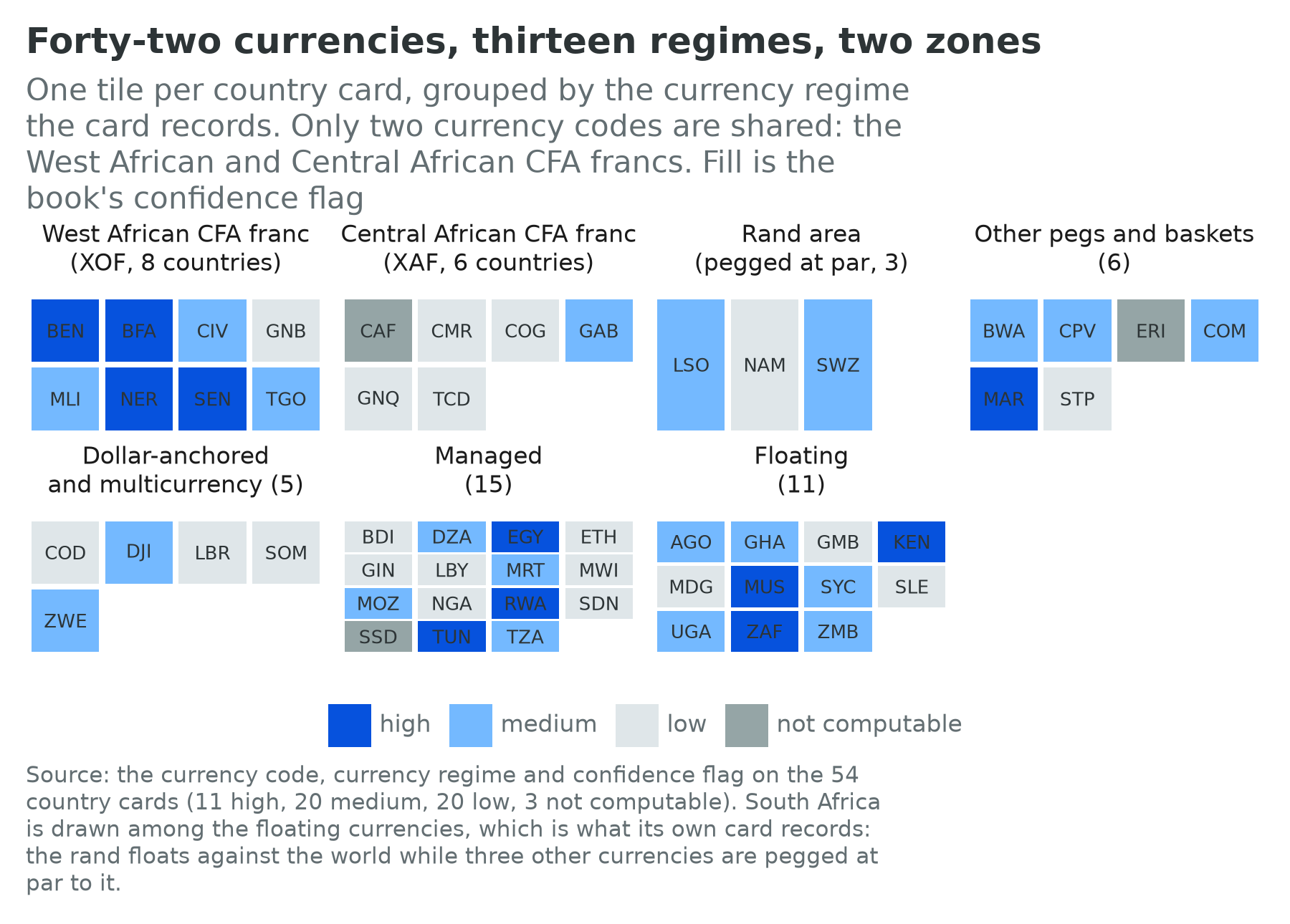
Table 8.1 collapses the thirteen labels into seven families and sets each against the identity.
| Zone or regime family | Countries | Share of continental population (percent) | Term one: working-age population | Term two: employment ratio | Term three: output per worker | Observed growth | Wage employment (percent of employment) | Confidence: high / medium / low |
|---|---|---|---|---|---|---|---|---|
| West African CFA franc (XOF) | 8 | 10.0 | 3.21 | 0.23 | 1.65 | 5.20 | 23.0 | 4 / 3 / 1 |
| Central African CFA franc (XAF) | 6 | 4.3 | 2.88 | 0.00 | -1.04 | 2.21 | 26.8 | 0 / 1 / 4 |
| Rand area, pegged at par | 3 | 0.4 | 1.53 | -1.15 | -0.05 | 1.18 | 63.2 | 0 / 2 / 1 |
| Other pegs and baskets | 6 | 3.0 | 1.88 | -0.05 | -0.15 | 2.44 | 57.8 | 1 / 3 / 1 |
| Dollar-anchored and multicurrency | 5 | 10.0 | 2.61 | -0.18 | 1.05 | 2.83 | 29.1 | 0 / 2 / 3 |
| Managed | 15 | 51.8 | 2.94 | -0.25 | 0.57 | 2.91 | 38.7 | 3 / 4 / 7 |
| Floating | 11 | 20.4 | 3.03 | -0.03 | 0.48 | 3.40 | 29.5 | 3 / 5 / 3 |
| All fifty-four | 54 | 100.0 | 2.89 | -0.15 | 0.74 | 2.91 | 31.0 | 11 / 20 / 20 |
Families are collapsed from the currency-regime label on each country card; every card falls in exactly one. The identity columns are medians of annual growth rates in percentage points over 2014 to 2024, taken column by column, so a row is not a country. The confidence counts do not always sum to the country count, because three cards carry no flag. Sources: UN World Population Prospects 2024 for term one; ILOSTAT modelled estimates, November 2025, for terms two and three and the wage-employment overlay; the IMF World Economic Outlook, April 2026, for observed growth; all via the country cards.
Three readings, in ascending order of interest.
The first is the one the table is usually asked for, and the answer is nothing. Set the twenty-four cards pegged to something, whether the euro, the rand, the dollar or a basket, against the twenty-six that are managed or floating, and the medians are hard to tell apart: working-age population growth of 2.62 percent against 2.98, an employment ratio flat in both at 0.00 against minus 0.19, output per worker at 0.96 against 0.57, and observed growth of 2.56 percent against 3.34. A currency zone is neither a growth strategy nor a growth obstacle on this evidence, and the chapter will keep saying so as it works through the arguments on both sides.
The second reading kills the same argument from the other direction. The two CFA franc unions share a currency, a peg, a guarantee and a history, and their medians sit on opposite sides of the continental middle. The West African eight post a median output-per-worker growth of 1.65 percent a year against a continental 0.74, and observed growth of 5.20 percent against 2.91; the Central African six post minus 1.04 and 2.21. All eight West African cards have a positive third term, led by Côte d’Ivoire at 2.90 percent and Burkina Faso at 2.47; four of the six Central African cards have a negative one, with the Republic of the Congo at minus 4.00 and Equatorial Guinea at minus 7.07. What separates them is not monetary: one union grew cocoa, cotton, cashew and a services economy while the other pumped oil into a price collapse.
The third reading is about measurement. The two unions differ by twenty-four points on the World Bank’s statistical-performance score, at a median of 70.4 for the West African eight against 46.2 for the Central African six, and where four of the eight western cards carry a high confidence flag, four of the six central ones carry a low flag and a fifth is not computable at all. A monetary union is a machine for producing comparable statistics, since its members share a central bank that must publish accounts for all of them. One of these two has used it.
One column deserves its own sentence. The rand area’s three pegged members post the worst median second term on the continent, at minus 1.15 percent a year against a continental minus 0.15, and the highest median wage-employment share of any family here, at 63.2 percent against a continental 31.0. That combination, a wage economy shedding its wage employment, is Chapter 25’s finding about South Africa arriving in three small neighbours that import their monetary policy from it. The zone did not cause it. The zone transmits it.
The CFA franc: one currency, two unions
Fourteen African countries, holding 14.4 percent of the continent’s population and producing 12.4 percent of its output, use a currency they did not design and cannot devalue. It is Africa’s longest-lived monetary arrangement and its most bitterly argued about.
How it works
There are two unions and two central banks. The West African Economic and Monetary Union, UEMOA, has eight members, Benin, Burkina Faso, Côte d’Ivoire, Guinea-Bissau, Mali, Niger, Senegal and Togo, and its central bank, the BCEAO, sits in Dakar. The Central African Economic and Monetary Community, CEMAC, has six, Cameroon, the Central African Republic, Chad, the Republic of the Congo, Equatorial Guinea and Gabon, and its central bank, the BEAC, sits in Yaoundé (Banque de France, 2020). The two CFA francs are separate currencies with separate codes, so a trader moving goods from Douala to Abidjan changes money.
Four features define the arrangement, and only the first is widely known.
The peg is fixed and it is to the euro, at 655.957 CFA francs, unchanged since the euro was created in 1999. That is the euro conversion of the parity set by the devaluation of 1994, which halved the CFA franc against the French franc (Banque de France, 2020). The devaluation is the founding trauma of the modern debate: decided in Paris and Washington, and it halved the external purchasing power of every salary in fourteen countries.
Convertibility is guaranteed by the French Treasury, without limit. If a CFA central bank runs out of euros, France supplies them. Nothing is more consequential and nothing harder to price, because the guarantee has almost never been drawn on, and an insurance policy that is never claimed is either extremely good or extremely expensive, depending on what was paid for it.
The counterpart used to be the operations account, in French the compte d’opérations, an account at the French Treasury in which each central bank had to keep a set share of its foreign reserves: 65 percent from 1973, reduced to 50 percent in 2005. The deposits earned interest, which the critics never dispute; what they dispute is that African reserves were held in Paris at all. And governance was shared, since France appointed representatives to the boards and policy committees of both central banks, so that no monetary decision in either union could be taken over French objection (Pigeaud and Sylla, 2021).
What the 2019 reform changed
On 21 December 2019, in Abidjan, the presidents of Côte d’Ivoire and France announced that the West African CFA franc would be renamed the eco, that the requirement to hold half the union’s reserves at the French Treasury would end, that the operations account would close, and that French representatives would withdraw from the BCEAO’s governing organs. The French parliament approved the new cooperation agreement in January 2021 and the reserves were repatriated during 2021 (Pigeaud and Sylla, 2021). Two things did not change, and they matter most: the peg stayed at 655.957, and so did the French guarantee of unlimited convertibility, which is precisely why the peg could stay, and which the Fund’s annual consultation on the union’s common policies still treats as the frame within which the union’s reserve position is judged adequate (International Monetary Fund, 2026l). In Central Africa nothing changed at all: the BEAC’s operations account at the French Treasury held about 5,575 billion CFA francs at the end of 2022, and a reform study presented to the region’s heads of state in March 2023 has not been published (Mbarga, 2023).
Then the renaming stalled, for a reason that is a small classic of African regional politics. The eco was not a CFA project. It was the name of the single currency planned for all fifteen members of the Economic Community of West African States, and the six countries of the West African Monetary Zone, Nigeria and Ghana among them, condemned the Abidjan announcement as unilateral: eight francophone states appropriating the name of a currency they had not agreed to join (Dossavi, 2020). The regional single currency was pushed back to 2027 (Reuters, 2021), and at the book’s information cutoff the West African CFA franc still carries its old name and code. The architecture of African monetary integration is rich and its enforcement thin, which is Chapter 7’s diagnosis of the regional communities generally.
The newest pressure comes from the zone’s own members. Mali, Burkina Faso and Niger formed the Alliance of Sahel States in September 2023, announced their withdrawal from the wider West African community in January 2024, and made the alliance a confederation in July 2024; the withdrawal took formal effect on 29 January 2025, with a six-month transition in which the three kept their regional trade and travel privileges (Al Jazeera, 2024; Xinhua, 2024; Usman, 2025). Leaving the currency has been discussed by all three governments and done by none, for reasons of arithmetic rather than sentiment: three landlocked states with weak revenue systems, active insurgencies and no reserves of their own would be issuing a new currency into a market that would price it immediately. The CFA franc’s deepest political defence is that its critics have to explain what happens on the first morning after.
The argument, stated on both sides
The case against the zone is made most forcefully by Fanny Pigeaud and the Senegalese economist Ndongo Samba Sylla, whose Africa’s Last Colonial Currency (2021) is the book the debate now organizes itself around. It has three parts. Historically, the arrangement was created in 1945 as an instrument of imperial monetary control, and its architecture was never redesigned for independent states. Economically, a peg to the euro is a peg to a slow-growing, low-inflation region whose business cycle has nothing to do with West Africa’s, it produces a chronically overvalued real exchange rate, and overvaluation taxes exactly the labour-intensive tradables the continent needs. Politically, a monetary policy a government cannot change is one a population cannot vote on, and the zone’s low inflation has been purchased with credit rationing that keeps the private sector small. The Togolese economist Kako Nubukpo has pressed a version of the same case from inside the institutions, arguing for a wider parity band, a basket rather than a single anchor, and a mandate that includes employment as well as prices (Nubukpo, Ze Belinga, Tinel and Dembélé, 2016). That is the reformist rather than the abolitionist position, and it has the most traction among the zone’s own technocrats.
The case for the zone is not the case its critics attribute to it, and it has three parts too.
The first is the inflation record, which is not in dispute. The zone’s inflation has run persistently below the Sub-Saharan average and with far less variance, which the Fund’s own book-length assessment documented even where it was critical of other features (Gulde and Tsangarides, 2008). Set that beside Figure 8.3 below: no CFA country appears among the continent’s inflation catastrophes, and none has had to explain to its citizens why their savings evaporated.
The second is that the counterfactual is not a well-run independent currency. It is the currency the same state would actually have issued, run by the same finance ministry. A monetary constitution that removes the printing press from a government’s reach is a commitment device in Chapter 5’s sense, and its value is highest exactly where the settlement is least able to make credible commitments on its own. That is uncomfortable, because it says the zone is most useful to the states least capable of governing themselves, but it should be met rather than dismissed.
The third is that the empirical work has not found the growth penalty the critics predict. Comparative studies of exchange-rate regimes generally find CFA membership associated with lower inflation and no clear difference in growth once the usual controls are applied, a result that disappoints both camps (Coulibaly and Davis, 2013). Fielding reaches a similar place from the monetary side: a common nominal anchor has not delivered the convergence of real variables a currency union is supposed to produce (Fielding, 2005). Table 8.1 is this book’s version of that null result, and the split between the two unions is the reason to trust it.
What survives is narrower than either camp would like. The peg has bought price stability and has not bought growth. The guarantee has bought convertibility, which is worth a great deal on a continent where Chapter 29’s Ethiopian firms could not get dollars at any price, and it has been paid for in policy autonomy that four of the six Central African members were in no position to use well anyway. The deepest cost is the one neither side quantifies: fourteen states have spent sixty years without having to build a monetary institution, and institutions that are never built are not there when the arrangement ends.
How one central bank sets policy for eight countries
The BCEAO’s monetary policy committee meets quarterly in Dakar and sets one policy rate for eight economies whose cycles do not coincide. In a single year, Côte d’Ivoire may be running a cocoa boom and Niger a drought, Senegal opening an oil field and Mali losing a third of its territory. The committee cannot lean against any of these individually. What it can do is move the union’s main refinancing rate in quarter-point steps, which it began raising in 2022 and took to 3.50 percent in December 2023 as the euro area tightened (Mabika, 2022; Mabika, 2023). Because the currency is pegged, the rate is barely a domestic choice: it has to stay close enough to the euro-area rate to keep the capital account from leaking.
The instrument that actually differs by country is not the rate. It is the allocation of central-bank refinancing across national banking systems, and the ceiling on how much of each state’s debt the banks may present for refinancing. That is a quantity instrument, it is administered, and it is why the zone’s critics call its monetary policy credit rationing with a European face. A finance minister in Bamako who wants a looser policy does not lobby for a rate cut. He lobbies for a refinancing ceiling.
The rand area
The Common Monetary Area is the continent’s other shared-money arrangement and its quietest. Under a multilateral agreement of 1992, successor to the Rand Monetary Area of 1974, the Namibian dollar, the Lesotho loti and the Swazi lilangeni are each pegged at par to the South African rand, R, and the rand is legal tender in all three countries; South Africa compensates them for the seigniorage forgone on rand circulating outside its borders (Maizière and Vertier, 2023). Botswana left in 1976, and its pula is now managed against a basket, which is why its card records a basket peg. The anchor is unusual in its own right: the South African Reserve Bank, established in 1921 and the continent’s oldest, has always had private shareholders, 783 of them in 2019, whose dividend is capped at 10 cents a share a year, an arrangement the governing party resolved in 2017 to end by nationalising the bank (Mail and Guardian, 2019).
The arrangement has survived half a century without a crisis, because the three small members chose to import a monetary policy made in Pretoria for South African conditions. That is defensible when your economy is a small appendage of the anchor’s, since pegging to your only trading partner removes an exchange rate that would otherwise be pure noise. The price is that a central bank accountable to South African voters sets policy for three countries whose citizens do not vote in South African elections. What it does not remove is the transmission. When South African growth stalls, as it did across the decade with output per worker falling at 0.48 percent a year, the small members do not get an independent stabilization policy. They get the same recession with less fiscal room. Lesotho’s employment ratio fell at 1.15 percent a year, Eswatini’s at 1.42 and Namibia’s at 0.37, against a continental median of minus 0.15. Chapter 25 argues that Gauteng is a productivity platform that stopped producing productivity. The rand area is how three other countries inherited the result.
Dollars: Harare, Mogadishu, Kinshasa
Where the state cannot make a currency people will hold, people hold somebody else’s.
Zimbabwe is the standing experiment in monetary destruction and reconstruction. The hyperinflation of 2007 and 2008 reached a peak monthly rate of about 79.6 billion percent in mid-November 2008, the second highest ever recorded (Hanke and Kwok, 2009). In early 2009 the government abandoned the Zimbabwe dollar and legalized a basket of foreign currencies, of which the United States dollar became dominant (Mutsaka, 2019). That decade of dollarization did what dollarization does: it stopped the inflation immediately, and it removed the state’s ability to run a monetary policy, to act as a lender of last resort, or to earn seigniorage. Bond notes followed in 2016, an electronic Zimbabwe dollar in February 2019, and a decree making it sole legal tender that June (Mutsaka, 2019; Bloomberg, 2019). In April 2024 the currency was replaced again by the ZiG, short for Zimbabwe Gold, notionally backed by gold and foreign-exchange reserves, and devalued by about 43 percent five months later, to about 24.4 to the dollar (Le360 Afrique, 2024). Its card records the regime honestly as managed multicurrency, because the dollar still carries most transactions. A currency is a claim on a state’s future behaviour, and a state that has defaulted on that claim three times inside twenty years cannot re-establish it by decree.
Somalia is the opposite case, a currency that failed by absence rather than excess. No central bank issued Somali shillings between the collapse of the state in 1991 and the reconstruction of the Central Bank of Somalia, and as the old notes wore out, counterfeit and unauthorized notes multiplied. What filled the gap was the dollar plus two private systems: the hawala networks carrying remittances from the diaspora, and mobile money, which let even the smallest payment be made in dollars and removed one of the last everyday uses of the shilling (Musse, 2026). Its card records the regime as dollarized, and its identity decomposition is the second worst-fitting on the continent, with implied growth exceeding observed by 1.92 percentage points, which is what happens when a statistical system is rebuilt around an economy nobody has measured.
The Democratic Republic of the Congo is the most consequential, because it is the largest. The Congolese franc circulates for small transactions, while the dollar is the default unit of account and store of value for households, firms and the state: about 95 percent of bank deposits and 85 to 90 percent of bank loans are in foreign currency, mainly dollars (Linge, 2025). A country of 109 million people, with output per worker growing at 1.81 percent a year and a working-age population at 3.38, runs the fastest-growing of Central Africa’s large economies on a currency its own citizens will not save in. Chapter 31 reads that as a balance-sheet fact: the seigniorage the Congolese state forgoes each year accrues to the United States Federal Reserve instead.
The managed middle, and the price of a licence
Twenty-six of the fifty-four cards record a managed or floating rate, and those twenty-six hold 72.2 percent of the continent’s population and produce 74.8 percent of its output. This is the majority case, and its diagnostic is not the announced regime but the parallel-market premium.
How it actually works: a day in a rationing regime
Consider a country whose central bank posts an official rate and lacks the foreign exchange to meet demand at it. The posted rate is not a lie. It is a price at which a quantity is rationed, and everything interesting happens in the rationing.
The morning begins with an allocation. The central bank decides how many dollars to release and to whom, usually through the commercial banks and against a priority list: fuel first, then pharmaceuticals, then fertiliser, then capital goods, then everything else. A firm submits its import documents to its bank, the bank submits them to the central bank, and the firm waits. In Ethiopia before July 2024 the wait was routinely measured in weeks, and Chapter 29 records what that did to an industrial-park programme built at great expense: a World Bank assessment found the parks employing about 19 percent of their capacity and realising about 15 percent of their export potential, with tenants naming the availability of dollars, rather than power, roads or labour, as the binding constraint (World Bank, 2022b).
Because the queue is long and the price low, the allocation is worth more than the dollars themselves. It is a licence, and licences have a market. A firm at the front imports at the official rate and sells at prices set by the parallel rate; a firm at the back buys its dollars in the street. The gap between the two rates is the market price of the licence, and it is the single most useful number in African macroeconomics. It is almost never in the official statistics.
The street market has its own institutions and they are respectable ones. In Francophone and East Africa the licensed bureau de change sits on the same block as the unlicensed dealer, and the spread between them is a policy indicator. In northern Nigeria the street dealer is the aboki, and the aboki rate is quoted daily and used by firms for internal accounting long before it reaches any official series. The distinction between the two markets is regulatory rather than economic: both match buyers and sellers of dollars, and only one does it at a price that clears.
Three consequences follow, and each shows up in the identity. Term three suffers first, because a manufacturer cannot buy the machine. Term two suffers next, because the firm that cannot buy the machine does not hire the shift. And the composition of investment shifts toward whatever can be financed without imports, which on this continent means property, trade and the extraction of things already in the ground.
Three reforms, and what the premium did
Between June 2023 and July 2024 three of Africa’s largest economies abandoned rationed exchange rates within thirteen months of each other, which is the closest thing to a natural experiment the continent’s monetary history offers.
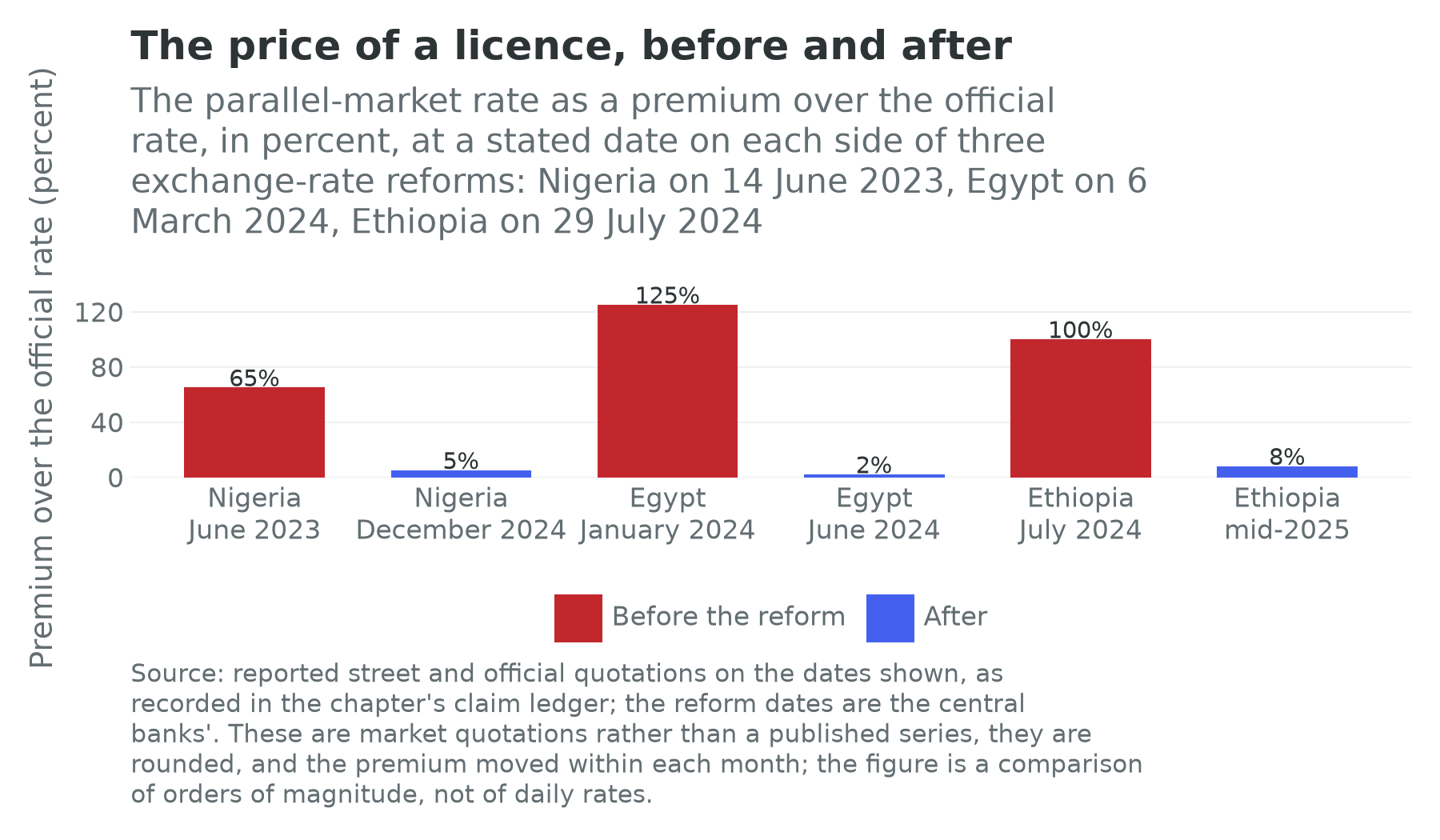
Nigeria. On 14 June 2023 the Central Bank of Nigeria collapsed the segmented windows through which the naira, ₦, had been traded at several official rates at once, and the official rate went from ₦471.67 to ₦664.04 to the dollar in a day, trading as weak as ₦791 (Olisah, 2023). By February 2024 it had passed ₦1,500 (TheCable, 2024), and by December 2024 the parallel rate stood only about 11 percent above the official one (Ekeghe, 2024). The reform was necessary and brutal: measured inflation reached 34.8 percent in December 2024. The card’s identity numbers record the wreckage that preceded the reform rather than what followed, with output per worker falling at 1.94 percent a year while the employment ratio rose at 0.29, the configuration in which people work more and produce less.
Egypt. Egypt devalued in November 2016, again in March, October and December of 2022, and again on 6 March 2024, when the pound, E£, was allowed to fall to about half its previous value. That move was possible because it arrived beside a $35 billion investment commitment from an Abu Dhabi sovereign fund and an enlarged Fund programme, which together supplied the reserves to defend a rate nobody had to guess at (ADQ, 2024; International Monetary Fund, 2026a). Before it the parallel rate had reached a premium of about 125 percent; within months the gap was negligible. Egypt is the case in which the money to close a premium came from outside, and Chapter 27 takes up what that implies about its external position.
Ethiopia. On 29 July 2024 the National Bank of Ethiopia abandoned the managed rate and let the birr, ETB, float, on the same day the Fund approved a four-year arrangement of about $3.4 billion (International Monetary Fund, 2026b). The premium had been running near 100 percent. Chapter 29 follows what happened next, and its verdict is worth importing: the stabilization succeeded on every macroeconomic measure, and the export response was gold and coffee rather than manufactures, which is not what the reform was justified by.
Ghana ran the other way. The cedi, GH₵, lost more than half its value against the dollar between January and October 2022 (International Trade Administration, 2022), inflation reached 54.1 percent that December (Ghokeng, 2023), and the government defaulted on its external debt and then restructured its domestic debt through an exchange completed in February 2023 (Ghana, Ministry of Finance, 2023; International Monetary Fund, 2026d). Ghana had a floating rate all along. A float is not a defence against a fiscal crisis; it is a mechanism for expressing one in prices. Its card records a floating regime, output-per-worker growth of 3.48 percent a year, among the highest on the continent, and an employment ratio falling at 1.56 percent a year, among the lowest.
Who the central bank works for
The formal answer is price stability. The practical answer, in a country whose government cannot borrow at a tolerable rate and cannot raise revenue, is the treasury, and the technical name for that condition is fiscal dominance.
The clearest instrument is the direct advance. The Central Bank of Nigeria Act permits the bank to lend the federal government up to 5 percent of the previous year’s revenue, an arrangement known as ways and means. In December 2022 the president asked the Senate to restructure about ₦23.7 trillion of those advances, many multiples of the statutory ceiling (Azeez, 2023), and in 2023 ₦22.7 trillion was converted into 40-year bonds at 9 percent, so that it would appear as debt rather than monetary financing (Presidency of Nigeria, 2023). Nothing in that sequence was hidden. It means that for several years Nigerian monetary policy was a residual of the fiscal position, and the naira’s collapse and the inflation that followed are what a residual looks like when it is finally reported at market prices.
Ghana ran the other version, in which the central bank held the debt rather than issued the money. When the domestic debt exchange was completed in 2023, the Bank of Ghana took losses on its own holdings large enough to drive its balance sheet into negative equity, recording a loss of about GH₵60.8 billion for 2022 and negative equity of about GH₵55.1 billion (Desewu and Imirhe, 2023). A central bank with negative equity is not necessarily insolvent in any operational sense, since it can create the currency its liabilities are denominated in. That is exactly the problem: the only way it recapitalizes itself is by doing the thing it exists to prevent.
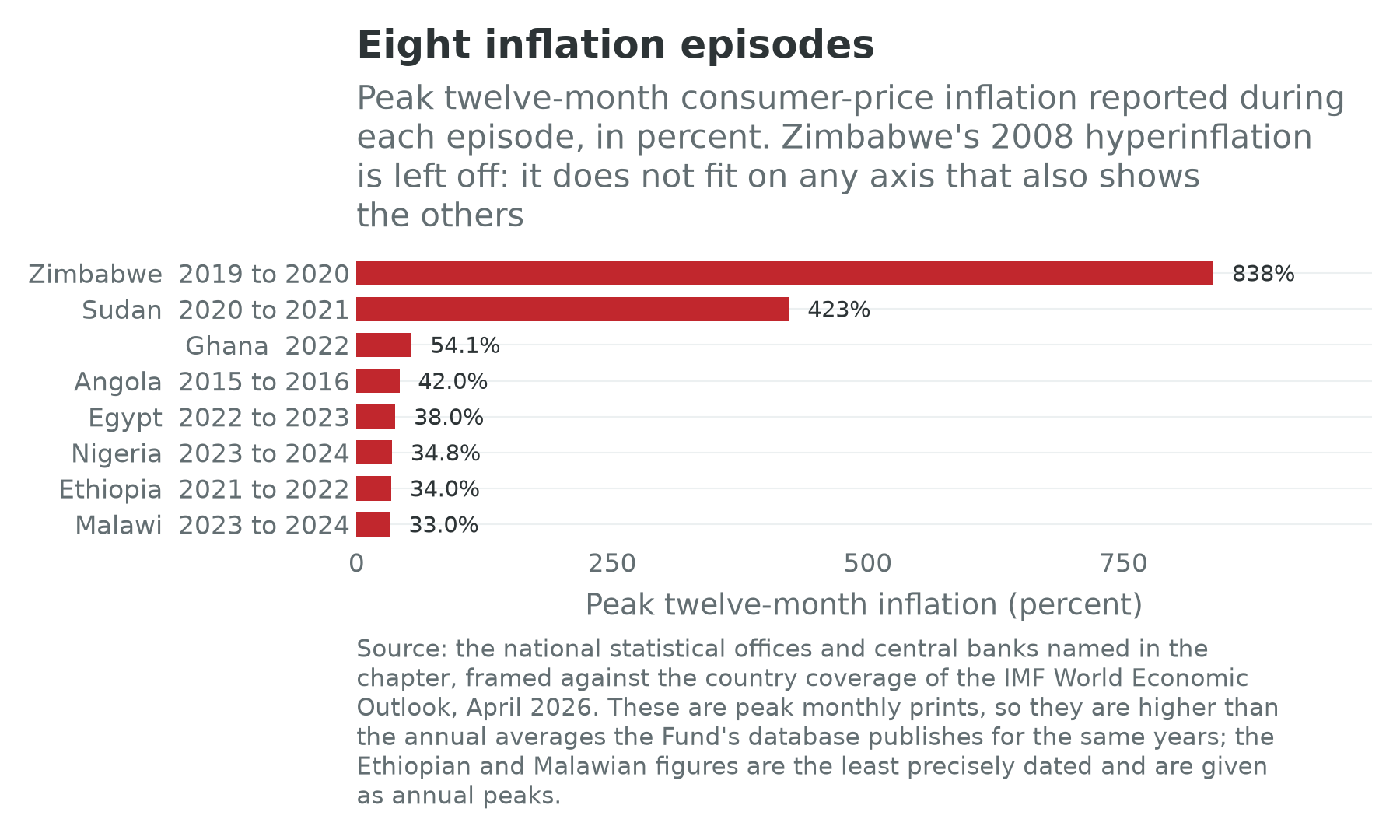
Read Figure 8.3 for the pattern rather than the ranking. Every one of the eight is a country with its own currency; none is in a currency union. Six are commodity exporters that borrowed against a price and then met the price on the way down. Seven involved an exchange-rate adjustment the government resisted, delayed, and then made all at once. And the distributional incidence was the same in every case, because inflation is a tax collected from people who hold currency and paid to people who hold debt, land and foreign assets, which on this continent is a very short list.
One methodological warning belongs here, Chapter 1’s arriving in a new place. Nigeria rebased its consumer price index in January 2025, and measured headline inflation fell from 34.80 percent in December 2024 to 24.48 percent the following month without a single price falling (Alex and Edeh, 2025). The rebasing was overdue and technically correct. It is also a reminder that part of what we call an African inflation episode is a statement about a basket weighted to 2009.
The rails
Currency fragmentation is a payments problem before it is a monetary one, and this is where the last decade has actually delivered something.
Why a payment went to New York
The mechanism is correspondent banking: a bank that wants to send money where it holds no account uses a bank that does, and settles with it in a currency both hold, which for African banks has overwhelmingly meant the dollar and an American or European correspondent. Each hop takes a fee and a day. That architecture has been contracting. The number of active correspondent banking relationships worldwide fell by roughly a quarter between 2011 and 2022, and the decline was steepest in exactly the regions with the smallest payment volumes and the weakest anti-money-laundering supervision, which includes most of Africa (Rice, von Peter and Boar, 2020). The literature calls this de-risking, and it is a rational response by large banks to a regime in which the fine for processing one illicit payment exceeds the lifetime profit on a small correspondent relationship. The result is that the cheapest way to make a payment inside Africa has been getting more expensive for a decade, for reasons decided in Washington and Basel.
How a PAPSS payment settles
The Pan-African Payment and Settlement System is Afreximbank’s answer, developed with the continental free-trade area’s secretariat, piloted in the West African Monetary Zone in 2021 and launched commercially in Accra in January 2022 (Afreximbank, 2024). It is deliberately unambitious about monetary union and deliberately ambitious about plumbing. Follow the same Accra-to-Lagos payment through it. The importer instructs her bank in cedi. The bank sends the instruction to the switch, which validates it, applies a rate, and passes it to the Nigerian bank, which credits the supplier in naira. Settlement is reported to the beneficiary in about two minutes rather than days. No dollars have been bought and no correspondent bank used. Instead the two central banks have accumulated a claim on each other, netted at the end of the day, with Afreximbank standing as settlement agent and, crucially, as the provider of the settlement liquidity that saves a central bank in deficit from having to find hard currency that afternoon.
That last clause is the whole invention, and it is why PAPSS is a balance-sheet product rather than a technology product. Somebody has to carry the residual imbalance, and no African payment system did this before because nobody was willing to. By 2026 the system reported links to more than a dozen central banks and over 150 commercial banks, and Afreximbank has estimated that full adoption could save the continent on the order of $5 billion a year in transaction costs (Afreximbank, 2024). Both figures are the operator’s, and the savings estimate is a projection.
Two cautions belong beside the enthusiasm. The first is scale. The cards now carry membership of the continental payment system, read off the network’s own coverage sheet, and fourteen of the fifty-four are participants: Djibouti, The Gambia, Ghana, Guinea, Kenya, Liberia, Malawi, Nigeria, Rwanda, Sierra Leone, Tanzania, Uganda, Zambia and Zimbabwe. Six of those fourteen are the West African Monetary Zone that piloted the thing, which is a decade of monetary cooperation showing up as a payment rail. Nine more countries are reachable only inbound, through an extended network of correspondent arrangements rather than as members, and eight more are marked as joining soon; the distinction matters, because a country you can send money to is not a country whose banks can send money out. And a payment rail moves money between countries that already trade. Intra-African trade was 14.9 percent of the continent’s trade in 2023, up from 13.6 percent in 2022 (Afreximbank, 2024). A cheaper pipe does not create the flow; Chapter 19 argues about the flow.
What the mobile rails already move, and what a remittance costs
Meanwhile a different set of rails has been moving very large sums without asking permission. Mobile money moved about $836 billion across Africa in 2022, dwarfing anything the formal cross-border system carries (GSMA, 2023). Chapter 16 owns the firms; the monetary point is that in several countries the largest retail payment system is now run by a telecommunications company, the float inside it is a monetary aggregate no central bank designed, and the definition of money where most transactions pass through a wallet is a live question rather than a textbook one. The interoperability problem is the one PAPSS addresses, one layer down: a wallet in Nairobi and a wallet in Kampala are as separate as two banks in two countries, and for the same reason.
The rail that carries the most money to households is the remittance corridor. Sub-Saharan Africa received about $54 billion in 2023, and across low- and middle-income countries remittances now exceed foreign direct investment; Chapter 10 places those flows on the identity (KNOMAD and World Bank, 2024). What belongs here is the price. Sub-Saharan Africa is the most expensive region on earth to send money to: the average cost of sending $200 was around 8 percent in 2024, against a global average nearer 6 percent and a Sustainable Development Goal target of 3 percent, and the most expensive corridors are intra-African ones (World Bank, 2025f). A migrant sending from Johannesburg to Gaborone pays more than one sending from London to Lagos, which is the correspondent-banking retreat and the currency fragmentation showing up in a household budget.
Two institutions
The BCEAO, Dakar. The West African central bank is the most consequential African institution that almost nobody outside its eight member states can name. In its present form since 1962, it moved its headquarters from Paris to Dakar in 1978 and keeps an agency in the capital of each member state, so a Malian bank deals with a Malian office of a supranational institution (International Monetary Fund, 2002). Its statutes make price stability the priority objective, its policy committee meets quarterly (Banque Centrale des États de l’Afrique de l’Ouest, 2026b), and it publishes monetary and financial statistics for all eight countries in a single series (Banque Centrale des États de l’Afrique de l’Ouest, 2026a). That last item is worth more than it sounds, and it is the likeliest explanation of the statistical-performance gap between the two CFA unions noted above.
Afreximbank, Cairo. Established in 1993 by African states, African institutional investors and non-African partners, the African Export-Import Bank is the closest thing the continent has to a trade-finance central institution, and PAPSS is its most consequential product (Afreximbank, 2024). Notice what kind of body built the continental payment rail: not the African Union, not a central-bank association and not a regulator, but a multilateral bank with a balance sheet, because the binding constraint was settlement liquidity and the only institution that could supply it was one that could lend.
What the experiments say
Four studies, and the limits of what a payment experiment can tell a central bank
Monetary policy is close to unrandomizable. No country will be assigned a currency regime by lottery, and the questions this chapter is about, whether a peg is worth its cost and whether a float stabilizes anything, are settled by comparison and by argument. What has been randomized, or credibly quasi-randomized, is the payment layer.
Jack and Suri (2014) asked whether cheaper payments change how households absorb shocks. Using the staggered rollout of Kenya’s mobile-money network as the variation, they found that when a household with an M-Pesa account suffered a negative shock, consumption did not fall, while comparable households without access saw consumption drop by about 7 percent. The mechanism was not the technology but the network: users received more remittances, from more senders, over longer distances. The systems question is whether the cost of moving small sums binds on informal insurance, and the answer was that it did.
Suri and Jack (2016) followed the same rollout for a decade and found that access lifted about 194,000 households, roughly 2 percent of Kenyan households, out of extreme poverty, concentrated among female-headed households and running through a shift out of agriculture into business. That is a large claim from a quasi-experiment, and it has been argued about.
Suri, Bharadwaj and Jack (2021) asked the harder question, which is what happens when the same rails carry credit rather than transfers. Digital loans in Kenya made eligible households less likely to cut spending after negative shocks, without the deterioration in other outcomes that critics of digital lending had predicted. The finding is not that digital credit is good. It is that at the margins studied the resilience gain was real and the harm was not detectable.
Aker, Boumnijel, McClelland and Tierney (2016) randomized the delivery mechanism rather than the money. Households in Niger receiving a drought-relief transfer got it either in cash or by mobile phone. The mobile arm produced greater diet diversity and more child consumption of certain foods, through the reduced time cost of collection and, the authors suggest, the greater privacy of the transfer within the household. A payment mechanism turns out to be a distributional instrument inside the family.
What this evidence tells a central bank is that the cost of moving small sums is a first-order constraint on welfare, which is a direct argument for the rails of the previous section. What it cannot tell a central bank is whether to peg, whether to float, or when to devalue. On those questions the best available discipline is not experimental: it is the classification work of Reinhart and Rogoff (2004) and its update by Ilzetzki, Reinhart and Rogoff (2019), which established that what countries announce about their exchange-rate regime and what they actually do are different things, and that the parallel-market rate is often the honest series. That is the intellectual basis of the regime labels this chapter reads off the cards, and of the reason it does not trust any of them without the premium beside it.
Money in two worlds
Chapter 1 asked the reader to hold two worlds at once. In the labour-abundant world the identity is a lever, term one is Africa’s endowment and terms two and three are the work. In the labour-redundant world the frontier of production is compute, energy and capital, labour is a complement at best, and income per head depends on who owns the machines and on the terms of trade for what a country has under it (Acemoglu and Restrepo, 2019; Korinek and Stiglitz, 2021).
In the labour-abundant world, everything above is a story about firms. A currency’s job is to let a manufacturer buy a machine and sell a shirt, and the case against a rationed exchange rate is Chapter 29’s case from Ethiopia’s industrial parks: an economy that cannot allocate foreign exchange to its exporters has built its factories for nothing. The case against a chronically overvalued peg is the same one a step earlier, since the peg taxes the exporter before the queue does. Both run through wage employment, and both assume the point of the exchange rate is to get workers into tradable production.
In the labour-redundant world the argument changes shape, and the change is uncomfortable. If output at the frontier is made by machines a country rents rather than by workers it employs, a currency’s value is tied to what the country owns rather than to what its workers produce. That is not hypothetical. It is the commodity-currency regime, and much of this continent has lived in it for fifty years. The naira, the Angolan kwanza, Kz, the Congolese franc and the Central African CFA franc are already priced off the value of things in the ground rather than the productivity of the people above it, and the resource-curse literature is, read this way, a preview of monetary life in a world that does not need labour: such currencies appreciate when the commodity is wanted and collapse when it is not, they crowd out tradable manufacturing, and the state that issues them has no fiscal reason to bargain with its own workforce. Chapter 13 documents the pattern for minerals and Chapter 21 for the borrowing it enables.
Read that way, the CFA peg looks different in the second world. A country whose export receipts are a rent rather than a wage bill has less use for a competitive exchange rate, because there is no labour-intensive export sector for a devaluation to help, and more use for a stable one, because its problem is converting a volatile rent into a predictable stream of imports. That is an argument for the zone its defenders do not make and its critics would find infuriating, and it becomes stronger the further the second world advances.
Does a continental payment rail matter more or less in that world? Less, if the trade that matters is a container of ore leaving for a port outside Africa, settled in dollars between counterparties who both have correspondent banks. More, if what Africa sells to the machines is electricity, land and minerals and what it needs in return is a way of distributing the proceeds internally, because a state whose revenue is rent rather than payroll has to move transfers to households at very low cost. Chapter 23 prices those transfers and Chapter 35 carries the scenario. The payments layer survives the second world intact; the exchange-rate-regime debate is the part that changes meaning.
Connections to Other Chapters
- Chapter 7 (Regional Architecture) owns the regional communities and the continental trade area whose monetary annexes this chapter reads; the CFA unions are also economic unions and appear there under a different aspect.
- Chapter 16 (Finance and Fintech) owns the banks, the mobile-money operators and the capital markets; this chapter is about the money itself and stops where the firms begin.
- Chapter 19 (Trade, Logistics and Ports) carries the trade flows a payment rail exists to serve, and the correspondent-banking problem as a trade-finance problem.
- Chapter 21 (Capital and Sovereign Debt) carries the borrowing that fiscal dominance finances, and Chapter 37 the Eurobond Africa-premium exhibit that prices what a monetary reputation is worth.
- Chapters 24 and 27 are poles inside the two largest managed-rate economies, Chapter 29 is the case study of a rationed currency and its float, and Chapter 33 takes up what a monetary regime means for the partners who lend into it.
- Chapters 1, 21 and 35 carry the two-worlds argument this chapter’s penultimate section applies to money.
Discussion Questions
The two CFA franc unions share a currency, a peg and a guarantee, and their median output-per-worker growth over the decade to 2024 sits at 1.65 percent a year in the west and minus 1.04 in the centre. Construct the strongest argument that the currency is nevertheless doing causal work in this comparison, then the strongest argument that it is not, and say what evidence would decide between them.
A finance minister in a rationing regime tells you that unifying the exchange rate would double the domestic price of fuel and medicine overnight, and that she cannot survive politically doing it. The parallel premium in her country is 80 percent. Set out what she should do in what order, and be specific about who pays in each of the first three months. Then say whether your answer would change if her country were in a currency union and the question were whether to leave.
This chapter argues that the payments layer survives the labour-redundant world and the exchange-rate-regime debate changes meaning in it. Take the opposite position: argue that a country whose income is rent rather than wages needs a floating currency more, not less, and say what that implies about which of the fifty-four are best placed.
Try It
Open the three cards side by side: Côte d’Ivoire, Cameroon and Ghana. The first two share a currency in all but the code, the same euro peg and the same French guarantee; the third has floated throughout and went through a default and a domestic debt restructuring inside the window. Read down the three identity terms, then the wage-employment share, then the data-quality block. Write one paragraph on a single question: if you were told only the currency regime of these three countries, which of the numbers in front of you could you have predicted, and which would have surprised you? Then switch on the confidence toggle on the Growth Pole Map and note which of the two CFA unions disappears.
Data Exercise
Download all fifty-four cards from the country cards page on this site, as cards.csv or as cards.json if you want the release each number came from travelling beside it. Group the cards by header.currency.code and, separately, by header.currency.regime. Then do four things. First, confirm that only two currency codes appear on more than one card, and report the median of identity.working_age_pop_growth, identity.employment_to_wa_growth and identity.output_per_worker_growth for each of the two zones, with the distribution of data_quality.confidence_flag inside each. Second, reproduce the two CFA rows of Table 8.1 and say in two sentences what the comparison does to the claim that a currency union suppresses growth. Third, define a pegged group from the regime labels, compute the gap between identity.gdp_growth_implied and identity.gdp_growth_observed for every card carrying both, and test whether the pegged group’s absolute gap is smaller than the managed and floating group’s: you should find the two medians indistinguishable to two decimal places, and you should then look at the four largest gaps on the continent and say what they have in common that is not monetary. Fourth, cross-tabulate overlays.wage_employment_share against the regime label and say why the rand area’s high value and the West African CFA zone’s low one are facts about income rather than about money. Treat nulls as missing, never as zeros.
Data Sources and Further Reading
Key data sources
- The country cards’ currency block: the code, symbol and regime label for all fifty-four countries, from which Figure 8.1 and Table 8.1 are built. The labels follow the classification tradition of Ilzetzki, Reinhart and Rogoff rather than any country’s own announcement.
- UN World Population Prospects 2024, medium variant, for term one; ILOSTAT modelled estimates, November 2025, for terms two and three and the wage-employment overlay; IMF World Economic Outlook, April 2026, for observed growth and output levels. Ages 15 to 64 throughout.
- The BCEAO and the BEAC for the CFA unions’ monetary statistics, policy rates and reserve positions, and the South African Reserve Bank for the Common Monetary Area.
- National statistical offices and central banks, cited by name, for the inflation and exchange-rate episodes: the Reserve Bank of Zimbabwe, the Central Bank of Nigeria and the National Bureau of Statistics of Nigeria, the Bank of Ghana, the Central Bank of Egypt, the National Bank of Ethiopia and the Banque Centrale du Congo.
- Afreximbank for the continental payment system and intra-African trade shares; World Bank Remittance Prices Worldwide and the World Bank and KNOMAD briefs for corridor costs and remittance flows; GSMA for mobile-money volumes.
Further reading
- Fanny Pigeaud and Ndongo Samba Sylla, Africa’s Last Colonial Currency (2021), for the case against the CFA franc at book length, and Kako Nubukpo and co-editors (2016) for the reformist position from inside the zone.
- Anne-Marie Gulde and Charalambos Tsangarides, eds., The CFA Franc Zone (2008), for the Fund’s own assessment, with David Fielding (2005) and Issiaka Coulibaly and Junior Davis (2013) for the empirical record on inflation, growth and convergence.
- Carmen Reinhart and Kenneth Rogoff (2004) and Ethan Ilzetzki, Carmen Reinhart and Kenneth Rogoff (2019), for the classification of exchange-rate regimes that underlies every regime label in this chapter.
- Tavneet Suri and William Jack (2014, 2016, and with Prashant Bharadwaj in 2021) for what cheap payments do to households, and Jenny Aker and co-authors (2016) for what the delivery mechanism does inside one.
- Tara Rice, Goetz von Peter and Codruta Boar (2020), for the global retreat of correspondent banking and why Africa was hit hardest.